
Wayve, the UK-based autonomous-driving company, has raised $1.2 billion in a Series D round that values the business at $8.6 billion, placing it among Europe’s most valuable AI startups. The London-based company, founded in 2017, has become a leading proponent of an end-to-end, learning-first approach to self-driving, and it says the new capital will accelerate the move from research to large-scale commercial deployment over the next few years.
Who backed the round
The Series D was led by Eclipse, Balderton and SoftBank’s Vision Fund 2. Strategic participants included the automakers Mercedes-Benz, Nissan and Stellantis, the parent of Jeep, Dodge, Chrysler and several European brands, alongside the technology companies Microsoft and Nvidia. The ride-hailing company Uber committed up to an additional $300 million in milestone-based capital to help scale Wayve-powered robotaxi deployments, bringing the total secured to roughly $1.5 billion. The round was later extended with a further reported $60 million from the chipmakers AMD, Arm and Qualcomm. A range of institutional investors, including Ontario Teachers’ Pension Plan, Baillie Gifford and the British Business Bank, also took part. The Series D follows a $1.05 billion Series C in 2024 that was likewise backed by SoftBank, and it marks a sharp step up in valuation, reflecting how quickly investor appetite for real-world, physical AI has grown.
What the money is for
Wayve has framed the raise as the foundation for a global autonomy platform rather than a single-city robotaxi service. The company plans to begin commercial robotaxi trials in 2026, with an initial service in London, and to bring supervised autonomy software to consumer vehicles from 2027. In its announcement the company emphasised a market it described as spanning every vehicle in motion, arguing that autonomy will scale less through city-by-city robotaxi rollouts and more through a platform that automakers and fleets can deploy and continually improve. Microsoft chief executive Satya Nadella, whose company is both an investor and Wayve’s cloud provider, said the firm was pushing the limits of embodied AI for autonomous driving.
The technology
Since 2017 Wayve has advocated an end-to-end deep-learning approach, training models on large volumes of driving data and video so that vehicles learn to drive in a way the company likens to human behaviour. Its AI Driver software is licensed directly to vehicle manufacturers, runs on onboard compute and embedded sensors, and does not depend on high-definition maps. The company says its foundation model has been trained on diverse data drawn from more than 70 countries and many vehicle platforms, which it argues allows the same system to generalise across car brands and locations. The approach sits within the broader field of embodied AI, in which models learn to act in the physical world rather than only process text or images. Wayve’s systems run on Nvidia chips hosted on Microsoft’s Azure cloud.
The Nissan agreement
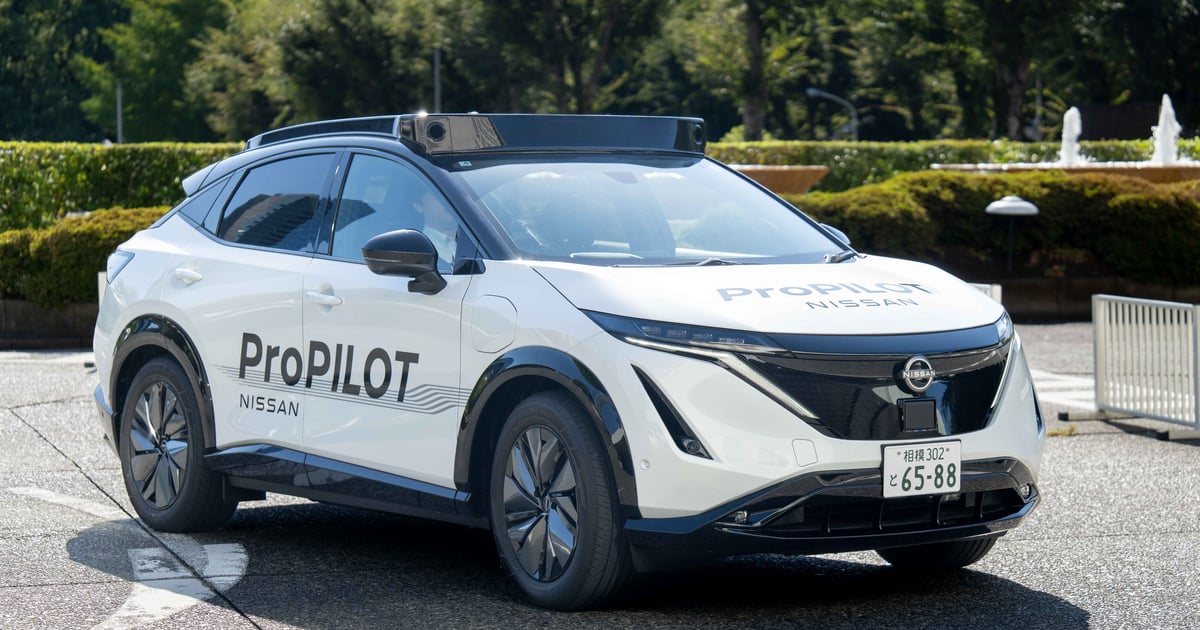
Nissan is the first automaker to commit to deploying Wayve’s technology at scale. In April 2025 the two companies announced that Wayve’s AI Driver software would feature in Nissan’s next-generation ProPILOT system, and in December 2025 they signed definitive agreements to integrate the technology across a broad range of Nissan vehicles. Nissan plans to introduce the first model equipped with the new ProPILOT in Japan in fiscal year 2027. The initial product is a Level 2 system that operates under driver supervision rather than a fully driverless one, an important distinction, since autonomy in this context still means a human remains responsible behind the wheel.
What it signals
The size of the round, and the unusual breadth of its backers, points to where the autonomous-driving market may be heading. Rather than betting on a single robotaxi operator, several of the world’s largest automakers, chipmakers and cloud providers have aligned behind a supplier model in which AI driving software is licensed into mainstream vehicles. Whether that approach delivers safe, reliable self-driving at scale will be tested over the coming years as the first supervised systems reach consumers and robotaxi trials expand beyond their initial cities. For now, the raise underscores how much capital and corporate weight is concentrating around embodied AI for transport.
What to watch
Large funding rounds measure investor conviction, not road-readiness. Autonomous driving has a long history of ambitious timelines that slipped, and a supervised Level 2 launch in 2027 is a more modest milestone than the fully driverless future the technology is often associated with. Open questions remain around regulatory approval in each market, how an end-to-end model behaves in rare edge-case situations, and whether licensing to many automakers can maintain consistent safety standards across very different vehicles. The scale of the backing lowers the financing risk; it does not by itself resolve the technical and regulatory hurdles that still stand between today’s driver-assistance features and genuinely hands-off driving.
