
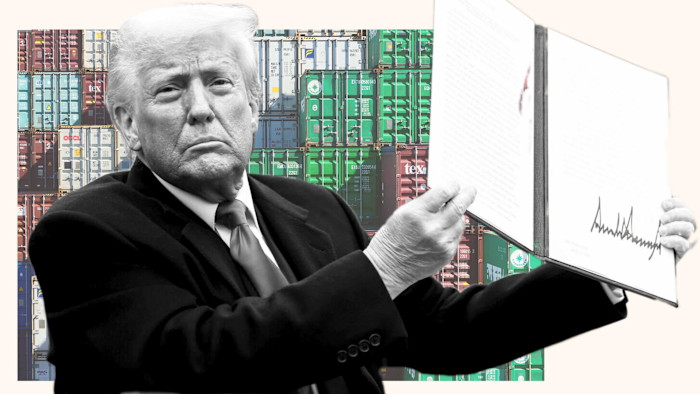
Governments around the world are unlikely to back out of the trade deal signed with Donald Trump last year, despite the Supreme Court ruling that several tariffs imposed by the US were illegal, according to international analysts and legal experts.
Sectors like auto and steel were not affected by the Supreme Court’s decision. The hope is that US influence in other areas such as defense and security, as well as fear of retaliation in those areas by Trump’s eccentric White House, will prevent countries from trying to renege on their deals.
Andrew Wilson, deputy secretary general of the International Chamber of Commerce, said that, although the court’s decision raised important questions about the ultimate sustainability of Trump’s deals, it did not mean they were in imminent danger of collapse.
“From our recent conversations with governments, we are not expecting any jurisdictions to immediately walk away from the agreements made in recent months,” he said.
Since returning to the White House, Trump has signed so-called “reciprocating tariff” deals, imposing blanket tariffs of between 15 and 20 percent on most countries that export more goods to the US than they import.
On Friday, the US Supreme Court ruled that tariffs imposed using the International Emergency Economic Powers Act (IEEPA) were illegal, but other tariffs on autos and steel that used a different legal basis remain intact.
Trump immediately hit back after the ruling, using another piece of legislation – Section 122 of the Trade Act of 1974 – to impose 10 percent tariffs across the board, although these are only valid for 150 days without the approval of the US Congress.
On Saturday he said that he would increase the levy to 15 percent.
Despite the fresh legal uncertainty and the fact that many countries will now pay lower tariffs, analysts said existing deals are unlikely to be broken, although some may be delayed until the legal picture becomes clearer.
Simon Evenet, a professor of geopolitics and strategy at the IMD Business School in Lausanne, Switzerland, said the decision did not reduce the leverage available to the US administration, but rather replaced one set of threats with another.
“For countries that are currently negotiating, or have interim deals in place with the United States – such as Switzerland – the threat of higher tariffs after the 150-day period remains, and has arguably intensified, pressure to make concessions. Overall, little change is expected,” he wrote in a blog post.
The unconventional nature of Trump’s trade deals, sometimes known as “napkin deals” – where heads of terms are hastily agreed upon and then implemented in subsequent negotiations – is expected to increase uncertainty.
Analysts said completion of recently agreed deals, such as the US-India deal announced this month, in which Trump reduced tariffs on Indian goods from 50 to 18 percent, may now move more slowly as governments try to take advantage of Trump’s legal difficulties.
India’s trade ministry issued a non-committal statement after the decision, saying it was “studying all these developments”, while Trump appeared to caution New Delhi when asked about a deal with India on Friday. “Nothing changes,” he said.
Pratik Dattani, founder of the Bridge India think-tank, said the decision could provide India room for soft talks, perhaps awaiting a legal challenge to the new tariffs, or a change in the balance of power in the US Congress after the November midterm elections.
“This improves the bargaining position of trading partners like India and promotes the ‘TACO’ (Trump always chickens out) narrative,” he said.
During a visit to New Delhi on Sunday, Brazilian President Luiz Inacio Lula da Silva told reporters that he was “relieved that I was not rushed” when it came to signing the trade deal with the US, adding that he would like to talk to Trump “in person”.
Trump’s latest tariff salvo “provides relief for many countries that were previously charged 50 or 40 percent tariffs,” Lula said, adding that their rates “will now be 15 percent.”
Trump initially imposed a 40 percent tariff on Brazil, which has a trade deficit with the U.S., although it was later lifted on some Brazilian agricultural products, including coffee, beef and fruits. The initial fee, combined with a 10 percent reciprocal tariff, brought the headline rate to 50 percent, sparking the worst diplomatic crisis in memory between the two largest countries in the Americas.
Analysts expect fear of retaliation to limit the impact on close deals such as the European Union, Japan and South Korea.
Trump’s tariffs on steel, auto, semiconductor and medical goods were imposed using Sections 232 and 301 of the U.S. trade law – legal tools that are still available to the administration to punish partners that try to opt out of concessions already granted.
The European Parliament will meet on Monday to discuss postponing the ratification of the so-called Turnberry Agreement – an agreement struck last year between Brussels and Washington that imposed 15 percent tariffs on most European goods imported into the US.
Despite some opposition to the agreement, Nicolas Kohler-Suzuki, an adviser on trade and economic security at the Jacques Delors Institute, said he expects the EU-US deal to survive because of the threat of “substitute deterrence”.
He said, “The stick is alternative statutory threats, particularly … automotive tariffs. The European Parliament will be encouraged by the decision, but the economic risk of reinstated auto tariffs remains and neutralizes the incentive for (a) full challenge.”
As the US tries to broker a peace deal between Moscow and Kiev, Europe must also assess the risks of Trump withdrawing security aid to Ukraine – a key factor in Brussels’ original decision to sign the Turnberry deal despite political opposition, Event said.
silent response Across Asia, similar realities are reflected in countries like Korea and Japan, whose auto sectors are at risk of significant retaliation.
Still, Eli Rennison, a former UK trade department official who is now at consultancy SEC Newgate, warned that although the US retains leverage in ongoing trade talks, Washington will now need to tread more carefully.
He said, “The White House will hope that renegotiation efforts should be put on hold by President Trump’s unpredictable approach to foreign relations – but it will also depend on reviving Washington’s diplomacy skills.”
With additional reporting from Andres Schipani in New Delhi
