
Databricks has introduced AppKit, a TypeScript framework for building production-ready applications on its platform, together with an integration that lets developers build in Replit and deploy to Databricks. The combination is aimed at closing the gap between fast, AI-assisted prototyping and the governance and reliability that enterprise applications require. This article summarises what the tools do and the practical caveats to keep in mind.
The context: Databricks Apps
Databricks Apps lets teams build, deploy and scale data- and AI-driven applications natively on Databricks. Since entering public preview in October 2024, Databricks reports that customers have built tens of thousands of apps on the platform, ranging from interactive dashboards to business-process and data-workflow automations and custom sales-companion agents. Databricks cites examples including Comcast, which turned complex forecasting models into interactive apps so sales and strategy teams could explore revenue scenarios, and Alpura, a Mexican dairy producer that built a suite of production apps spanning real-time factory monitoring and predictive “what-if” scenarios for retail partnerships. These are vendor-provided examples rather than independently audited case studies.
Databricks AppKit
AppKit is described as a TypeScript framework with a plugin-based architecture, offering opinionated defaults, built-in observability and integration with Databricks services such as SQL warehouses, model serving endpoints and Lakebase. It is positioned for AI-assisted development, with end-to-end TypeScript, automatic query type generation, and production features including caching, telemetry, retry logic and error handling.
The framework uses a layered design. A data layer integrates with governed Databricks services, including structured and unstructured data, SQL warehouses, Lakebase Postgres databases, model serving endpoints and agents. A server layer provides a Node.js backend organised around plugins for different use cases. For Lakebase specifically, a plugin handles online transactional database operations with automatic OAuth token management and returns a connection pool compatible with common ORMs such as Prisma, Drizzle and TypeORM. Applications built this way are hosted in Databricks and inherit Databricks authentication, Unity Catalog-enforced governance and existing network restrictions.
The Replit integration
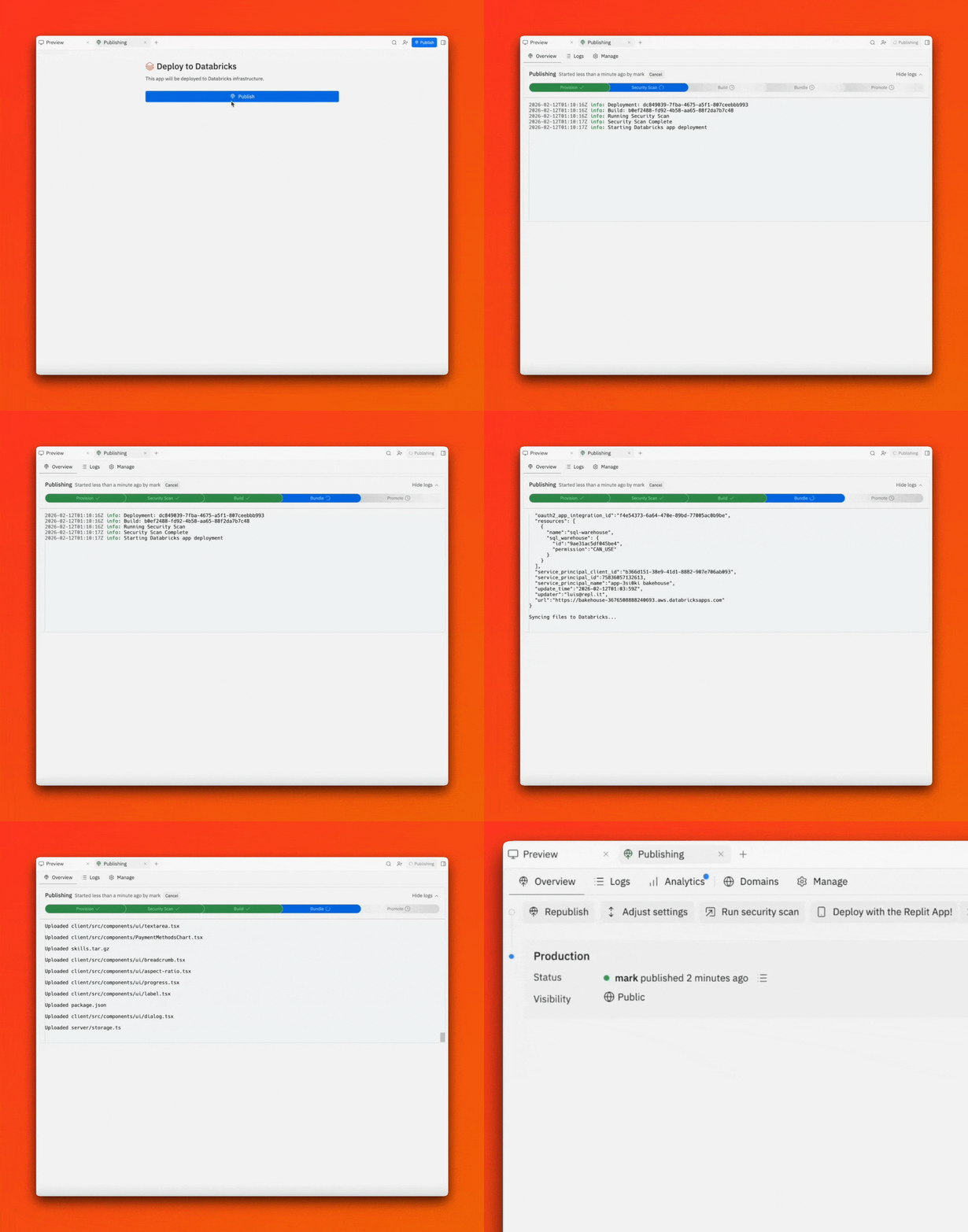
The Replit integration lets developers start in Replit and build an application that is aware of their data using natural-language prompts. According to the companies, the Replit agent can inspect the kinds of data a user can access without that data leaving Databricks, and the finished app can be deployed from Replit directly into Databricks. The stated goal is to combine rapid, conversational “vibe coding” with the backend governance enterprises expect, so teams can build production-grade applications against controlled data more quickly.
Limitations and what to watch
Several practical points are worth noting. AppKit is a young, TypeScript- and Node.js-based framework, so teams standardised on other languages or frameworks may find it a poor fit, and its APIs may still change as it matures. The Replit integration was offered through an early-access waitlist rather than general availability, so capabilities, pricing and terms can evolve. Performance and cost claims, and the customer examples above, come from the vendors and should be validated against a team’s own workloads. Because apps run inside Databricks and rely on Unity Catalog and Databricks authentication, the approach is best suited to organisations already committed to that platform rather than those seeking a portable, cloud-agnostic stack. Current capabilities should be confirmed in the official documentation.
For teams already building on Databricks, AppKit and the Replit integration extend the platform further into application development. Related coverage on the same stack includes how Databricks system tables support observability and best practices for high-QPS model serving. Full details are available on the Databricks blog and the AppKit GitHub repository.
