
The US top court on Friday dealt a painful blow to Donald Trump’s second term, striking at the core of his economic plans by invalidating most of his tariffs, as the president lashed out at “disloyal” judges beholden to “foreign interests”.
The 6-3 Supreme Court opinion, written by Chief Justice John Roberts, was damaging for Trump, blocking his key trade policy moves and setting new constraints on the use of executive power, which he has sought to expand since returning to the White House last year.
The president blasted the judges as “disloyal to our Constitution,” vowed to continue his trade wars, and on Friday night signed a 10 percent global tariff set to take effect next week, threatening more turmoil and uncertainty.
But those tariffs are time-limited and his administration now faces the prospect of being forced to repay the billions of dollars raised by his invalid tariff regime.
The decision ahead of next week’s State of the Union address comes after disappointing GDP data and consistently poor approval ratings for the president, which have set off alarm bells among Republicans about his prospects in the November midterm elections.
It also marked the latest sign of expanding resistance domestically and internationally to Trump and his plans, from fellow Western leaders shunning his threats against Greenland, to members of Congress forcing the release of documents related to late pedophile Jeffrey Epstein, to Federal Reserve Chairman Jay Powell fighting the criminal investigation against him as an attack on the central bank’s independence.
The decision was especially powerful given the Supreme Court’s conservative majority, which has given Trump wide freedom to act with fewer restrictions in other areas, including his immunity from prosecution and his immigration crackdown.
But on trade policy, the court drew a clear red line in the opposite direction, saying that the President’s use of emergency tariffs, which he deployed extensively to reshape America’s relationship with the global economy and exert diplomatic influence on countries, violated the US Constitution.
“It’s a huge blow to the centrality of his thinking about power… trying to bully other countries into making deals with him,” said Sarah Binder, a professor of political science at George Washington University. “Supreme Court at one stroke says ‘not so fast, not so easy’.”
Although oral arguments in the case late last year showed the court was leaning against Trump’s tariffs, their reaction was sharp.
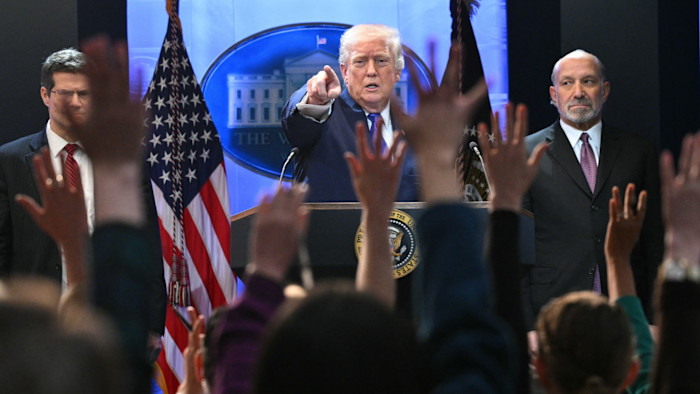
Trump, speaking at a hastily arranged news conference at the White House, said the judges were “stupid and stupid” as well as “traitors and disloyal.” The President alleged that they were “influenced by foreign interests” and said that other countries were “dancing in the streets”.
“I am ashamed of some members of the court, absolutely ashamed of them for not having the courage to do what is right for our country,” he said.
Placing clear limits on Trump’s power would hurt his ego, just as he seeks to put his personal stamp on Washington. He added his name to the Kennedy Center and demolished part of the White House to build a new ballroom. On Thursday, the Justice Department unfurled a large banner bearing the president’s face at its headquarters.
It’s also a humbling moment for Trump as he launches a special operation on Venezuela and wages war on Iran just weeks after seizing the country’s oil — disregarding Congress’s constitutional authority to approve the use of force against America’s enemies.
Julian Zelizer, a professor of political history at Princeton University, said the tariff decision was “the biggest decision he has ever made that rejects his broad view of presidential power”.
Zelizer said: “Does this mean the royal presidency is put on hold? No. Other Supreme Court decisions have empowered him and he will now try to find new ways to achieve the same goals. But it comes at a time when there is a significant backlash against his administration at many levels of government.”
The Supreme Court opinion left Trump scrambling to implement a backup plan to use other legislation to preserve some tariffs. The 10 percent tariff he announced Friday to address what the White House described as “fundamental international payments problems” is based on Section 122 of a 1974 law that allows the president to impose an import embargo for up to 150 days. It is scheduled to come into effect one minute after midnight on Tuesday, with a limited number of exemptions for goods such as critical minerals, some metals and pharmaceuticals.
Trump also vowed to launch new trade investigations, which could lead to more tariffs later, and explicitly said these could be more severe than the ruling the court has ruled illegal.
US Trade Representative Jameson Greer said the administration intends to “honor” deals made with trading partners – and expects them to do the same.
“For a year I’ve been telling them that no matter the direction of this litigation, we will impose tariffs at the levels they agree to,” Greer told Fox News.
Treasury Secretary Scott Besant claimed the new measures mean there will be “little change” to the amount the Finance Ministry will receive in tariff revenue this year.
But already, American businesses are gearing up to demand refunds from the Trump administration.
According to the Budget Lab at Yale, tariff revenue was based on emergency powers. $142 billion In 2025 – about 80 percent of all new tariff revenue projected to be raised last year.
Trump waived the imminent threat of repayment. “They take months to write an opinion and they don’t even discuss that point,” he told reporters. “We will be in court for the next five years.”
The president’s political career has been shaped by his unapologetic embrace of tariffs, while defying mainstream Republican orthodoxy to protect American workers left behind by globalization.
He used established US trade laws to launch a fight against China and others in his first term, but in his second term the president has taken his protectionist agenda to a new level, including using emergency powers to impose taxes.
“This is our declaration of economic independence,” Trump said on his so-called Emancipation Day last April, when he set high tariffs that spooked global markets.
Within weeks, Trump halted several tariffs amid market turmoil, and then eased them with trade agreements and waivers.
On Friday he suffered a serious legal defeat.
“The President took a serious risk in using (emergency powers) as the legal basis for many of his tariff threats and increases, and that gamble did not pay off,” said Wendy Cutler, a former U.S. trade official and senior vice president of the Asia Society Policy Institute.
Even some Republicans were relieved that the judges had set limits for the president.
“Nearly 250 years later, the Founders’ system of checks and balances remains strong,” said Republican Senator John Curtis of Utah.
