
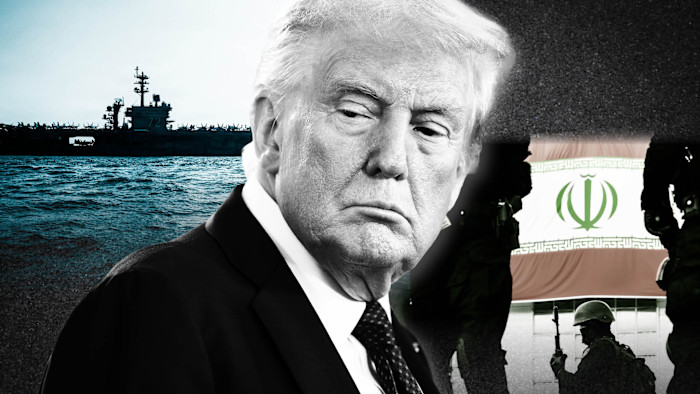
After weeks of urging Iran to compromise, Donald Trump on Monday posted a video of Fox News host Mark Levin suggesting that negotiations with Iran are now futile.
The clip reflects the US president’s growing frustration that his barrage of threats has so far failed to bring any real concessions from the Islamic Republic.
It also summed up the corner Trump finds himself in as he pursues the biggest foreign policy gamble of his second term: a full-scale attack on Iran.
“I think the reality is that the president has put himself in a box,” said Aaron David Miller, a Middle East expert at the Carnegie Endowment for International Peace and a former US-Middle East peace negotiator.
Trump has cornered himself by promising aid to Iran’s protesters and deploying an array of military assets near Tehran, Miller said.
Moreover, the successful US operation to remove Venezuela’s Nicolas Maduro from power has convinced Trump of his constraints in Iran.
“He’s put himself in a situation where, unless he manages to extract enough concessions from the Iranians to avoid a war he doesn’t want, he’s going to be forced into a war,” Miller said. “This is a crisis of their own making.”
What began as a promise in December to “protect” Iranian protesters from the regime’s deadly crackdown has turned into a pressure tactic — even if Trump’s intentions are unclear.
Over the past two months, Trump had cited “a carousel list of rationales” for attacking Iran, said Rosemary Kalanick, a political scientist and Middle East expert at Defense Priorities, a Washington think-tank that warns against interventionism.
Motivations range from the imperative to dismantle a nuclear program that Trump has already claimed to have “destroyed,” to disabling Iranian proxy militants, whom U.S. and Israeli officials say have also been dramatically weakened.
Another objective is to damage Iran’s ballistic missiles – although they do not have the range to reach the US. And for a period in January, the argument expressed on Truth Social was a pledge to protesters that “help is on its way”.
“I think there are very big questions about why the United States is doing this,” Kelanick said.

Hard-liners like Levin, a Trump supporter, have made clear that the goal should be regime change and that the US should act now, while Tehran is “weaker than ever”.
America cannot “leave it to the next generation” to take action. “That regime needs to be dismantled,” he urged Trump on his Fox News show, video of which Trump shared online.
The president in recent weeks has deployed the largest collection of US military assets to the Middle East since the Iraq War. On Monday, a second aircraft carrier group, the USS Gerald R. Ford, was spotted off the coast of Crete in the eastern Mediterranean.
Despite Trump’s repeated threats to use up the military buildup and assets – including potentially limited strikes – Iran has yet to agree to any kind of deal, puzzling US officials.
“(Trump) is curious … why, under this kind of pressure, despite the sea power that we have there, the naval power that we have there, they don’t come to us and say, ‘We say we don’t want weapons?'” Trump’s special envoy Steve Wittkoff said on Fox News on Saturday.
Witkoff also claimed that Iran is “probably a week away from obtaining the material to make an industrial grade bomb”, although experts disagree with that assessment.

A White House official said Monday that Trump has made clear that Iran cannot have nuclear weapons or the capability to make them and that they cannot enrich uranium.
“The President wants to negotiate a deal, but he has made it clear that either we will make a deal or we will have to take some very tough steps like last time.”
However, despite the rapid escalation, Trump also faces risks that would bring new attacks or all-out war against Iran.
Regional experts and administration officials have warned that Iran could target US military assets, allies and energy infrastructure in the region in any retaliation.
Trump on Monday hit back at reports that Gen. Dan Kaine, chairman of the Joint Chiefs of Staff, had argued against attacking Iran.
“Everything that has been written about a potential war with Iran has been written falsely and knowingly,” Trump wrote on Truth Social. “I am the one who decides, I would rather have a deal than not, but if we don’t make a deal, it will be a very bad day for that country and very sadly for its people.”
Defense Secretary Pete Hegseth also urged Iran to compromise on Monday, but said any strikes would ultimately depend on Trump. “Our job is to provide alternatives, and if Iran decides not to make a deal, we will have alternatives to the president,” he said. “Everything is on the table, it’s the president’s decision.”
But Israeli intelligence has concluded that even with the imminent arrival of the USS Gerald R. Ford this weekend, the US only has the military capacity to withstand four to five days of intense airstrikes, or a week of low-intensity attacks, an Israeli intelligence official told the FT.

US casualties would also risk domestic blowback to Trump’s MAGA constituency and among voters generally more wary of war than inaction toward Iran. A quarter of Republicans say they oppose U.S. military intervention in Iran under current circumstances, while 40 percent support it, according to a new poll from the University of Maryland. The vast majority of Democrats said they oppose it.
“Who wants this? Nobody wants this,” said Miller at the Carnegie Endowment. “We are sleepwalking toward war, looking for a strategy.”
But analysts say Trump is encouraged by his success in Venezuela and his advisers view a muted response to Tehran’s moves as too risky. These include its withdrawal from the nuclear deal with Iran in 2018, the US assassination of Revolutionary Guards commander Qassem Soleimani in 2020 and the bombing of Iranian nuclear sites last year.
On each occasion, Trump rolled the dice on Iran and felt vindicated, said Karim Sadjadpour, an Iran and US policy expert at the Carnegie Endowment.
“For him, serious warnings about starting a regional war proved superfluous, and Iran proved to be a paper tiger. I don’t think his ideal outcome is military confrontation, but he probably likes his chances if he chooses that path.”
Additional reporting by Mehul Srivastava in London. Data Visualization and Cartography by Steven Bernard
