
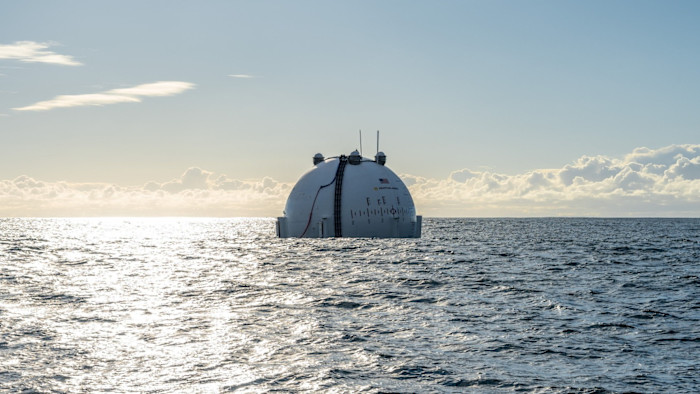
Peter Thiel is leading a $140 million investment in a US start-up that plans to use wave energy to fuel vast fleets of floating data centres, as Silicon Valley’s quest for AI power moves to exotic new frontiers.
Panthalassa, which has spent a decade developing its marine energy technology, uses the buoyant motion of waves to force water through a turbine to produce electricity and power AI chips.
Co-founder and chief executive Garth Sheldon-Coulson told the FT that the new money will allow the company to scale up a pilot manufacturing facility with the aim of starting commercial deployment next year. The deal values Panthalassa at about $1 billion, including new capital, according to a person familiar with the terms.
Thiel, co-founder of Palantir and PayPal, said: “The future demands more computation than we can imagine. Extraterrestrial solutions are no longer science fiction. Panthalassa has opened the ocean frontier.”
The company’s “nodes” are almost as tall as London’s Big Ben or New York’s Flatiron Building. Most of the 85-meter-long solid-steel structure lies beneath the surface, including a hermetic container housing the AI servers, which is cooled by seawater. Ships can propel themselves to their destination by using the shape of their hull among the waves without engines.
As demand for AI computing capacity continues to exceed supply, a growing number of long-running efforts to ease the energy bottleneck are getting funding, from rebooting old nuclear power stations to launching solar-powered data centers into space.
Sheldon-Coulson, formerly an AI and energy researcher at hedge fund Bridgewater, believes wave and wind energy – along with solar and nuclear – are the only clean sources capable of generating “tens of terawatts” of energy.
“Energy from open ocean waves is low-cost, sustainable, abundant and we now have the technology to make it accessible to people,” he said.
Thiel has previously supported and invested in “Seasteading”, a libertarian project to launch maritime communities in international waters, beyond the jurisdiction of any sovereign state. He is investing in Panthalassa through his personal funds. Founders Fund, the VC firm he co-founded, had backed the company in a previous financing in 2018.
Other new investors in the round include Marc Benioff, chief executive of Salesforce.com; Max Levchin, co-founder of PayPal and Affirm; and John Doerr, an early investor in Google, Amazon, Uber and Netscape, who praised Panthalassa as a “game changer in addressing global energy needs and clean energy production.”
Panthalassa is staffed by former engineers from SpaceX, Boeing, NASA, Tesla and Apple. Co-founder Brian Moffatt previously worked at Disney’s Imagineering unit and Google, while engineering director Dan Place worked on the “drone ships” that SpaceX uses to launch its reusable rockets.
The system’s AI chips receive and respond to users’ questions via SpaceX’s Starlink satellite connection.
Sheldon-Coulson said Panthalassa’s lollipop-shaped system could eventually produce much more energy than tidal or wind power because it works in remote areas and does not need to be tied to the seabed or mainland.
“One of the key insights we had was that it is very important to put electricity in the right place,” he said. “We will never send electricity back to shore. This makes us very different from all the other marine energy we have tried in the past.”
Panthalassa’s nodes are largely solid, with no hinges, flaps or gearboxes that could break in adverse sea conditions. This also makes it easier to manufacture on a large scale.
The Oregon-based start-up plans to build its pilot manufacturing facility in the US, but depending on where it deploys the larger fleet, it may move elsewhere.

Its system is “extremely fast to build” and uses only “Earth-abundant materials” such as steel, Sheldon-Coulson said. “The supply chains for this particular energy technology are extremely robust. We think that’s really important for scalability and for environmental and ecological reasons.”
The nodes of the Panthalassa would be towed horizontally out to sea behind a boat before being flipped into a vertical position and themselves launched into the open sea.
The company has not disclosed where it plans to deploy its fleet, but it will be located somewhere with perfect wave conditions and far enough away to avoid shipping routes. The nodes, which recirculate the same water inside to power generators, have no emissions or engines, minimizing impact on marine life.
“In our target areas … waves are created by wind and the wind is created by the sun’s heat,” Sheldon-Coulson said. “So the waves are double concentrated sunlight and they keep going even when the wind stops. The waves are like a battery for sunlight and we can capture from it 24/7.”
illustration by ian bot
