
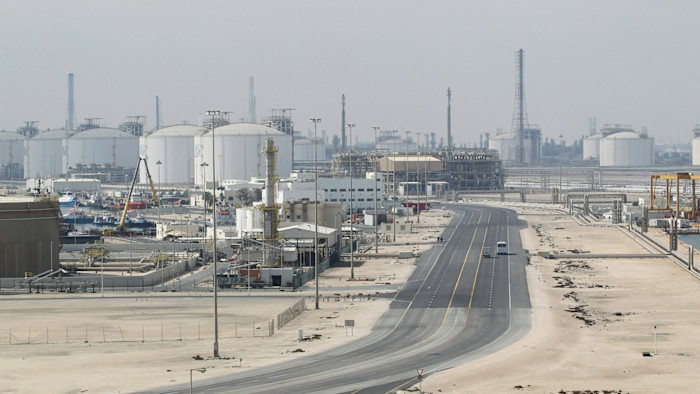
Iran launched a ballistic missile attack on the site of the world’s largest liquefied natural gas facility in Qatar, causing “extensive damage” in response to an attack on the Islamic republic’s South Pars gasfield.
Wednesday’s attack marks a significant escalation in the Middle East war and threatens to have a major impact on global energy markets. Qatar is the second largest exporter of LNG in the world and the largest supplier in Asia.
Qatar’s Defense Ministry said on x Iran fired five ballistic missiles, four of which were intercepted and one targeted Ras Laffan, a vast industrial complex that is home to state-owned QatarEnergy’s LNG plants and a fuel refinery. It is also the location of Shell’s $18 billion Pearl GTL plant, which turns gas into chemical feedstock and fuel.
“Emergency teams were immediately deployed to control the fire as it caused extensive damage,” QatarEnergy said. on x.
Analysts said the attack was likely to cause a “permanent global gas shortage” depending on the scale of the damage, as Ras Laffan typically accounts for about a fifth of global LNG supply.
“Even when the war ends, the impact on supply could last for months or years as reparations are initiated,” said Saul Kavonik, energy analyst at MST Financial.
The war waged by the US and Israel against Iran has already caused massive disruptions to global energy supplies, with Iranian shelling bringing shipping in the Strait of Hormuz to a near halt.
All Gulf oil and gas producers have been forced to reduce their production. Some Asian countries were already facing potential energy shortages or rationing before the latest round of attacks.
“If the Ras Laffan LNG production capacity is damaged, the gas supply balance is very tight,” said Tom Marzek-Manser, director of European gas and LNG at Wood Mackenzie.
Iran vowed to retaliate against oil and gas facilities across the Gulf after Wednesday’s attack on South Pars, the world’s largest gas field and the backbone of the Islamic republic’s domestic energy system.
Iranian state media said it was the first attack against Iranian energy production facilities since the US and Israel launched the war on February 28, and that petrochemical facilities fed by South Pars were also targeted. Neither the US nor Israel immediately claimed responsibility for the attack, and both countries declined to comment.
Oil and gas prices jumped on Wednesday as Iran’s Revolutionary Guards warned they would attack some of the region’s biggest energy facilities, including Ras Laffan, as well as UAE plants and a Saudi Arabian refinery on the Red Sea.
Brent crude rose 7 percent to more than $110 a barrel. European gas prices jumped 6 percent to €54 per megawatt.
Saudi Arabia’s Defense Ministry said on Wednesday evening it had intercepted drones and ballistic missiles in its oil-rich Eastern Province. It also intercepted four ballistic missiles launched towards the capital Riyadh.
Mohammad Bagher Ghalibaf, Iran’s parliament speaker and one of the Islamic republic’s most senior wartime leaders, said the attacks on the country’s energy infrastructure had triggered “a new level of conflict.” He vowed that Tehran would respond with “an eye for an eye.”
Qatar, which has better relations with Iran than other Gulf states and previously mediated between Tehran and Washington, condemned the attack on Ras Laffan as a “dangerous escalation and a gross violation of the state’s sovereignty.”
Qatar’s Foreign Ministry on Wednesday evening declared Iran’s military and security attaché “persona non grata” and directed him to leave the Gulf state within 24 hours.
International oil companies including ExxonMobil, TotalEnergies and Shell have invested billions of dollars in Ras Laffan, in partnership with QatarEnergy.
A Shell spokesperson, noting QatarEnergy’s statement about the attack, said the UK company is “currently assessing any potential impact on any assets operated or used by Shell at Ras Laffan”.
Qatar and the UAE had earlier condemned the attack on South Pars, with Doha calling it “dangerous” and “irresponsible”. The UAE “stressed the need to avoid targeting critical facilities under any circumstances”.
South Pars is part of the world’s largest natural gas field and an extension of Qatar’s northern region.
Torbjorn Soltvedt, associate director at risk agency Verisk Maplecroft, said the attack on Iran’s gasfields had reinforced his view that the war would “probably escalate into May, with no immediate clear off-ramp visible”.
US President Donald Trump, who has made keeping energy costs low a key issue for US voters, has authorized the release of strategic oil reserves in coordination with other International Energy Agency members to keep prices low.
But the risk of prolonged disruption to shipping in the Strait of Hormuz or escalating attacks on Gulf energy infrastructure could push oil and gas prices even higher.
Iran had already attacked energy facilities across the region during the war, including targeting oil and gas fields in the United Arab Emirates and Saudi Arabia.
Iraq, which relies on imports of Iranian gas to generate power, said flows from Iran had completely stopped on Wednesday afternoon and warned it would “impact the grid”.
Additional reporting by Raya Jalabi in Beirut and Steph Chavez in Washington
