
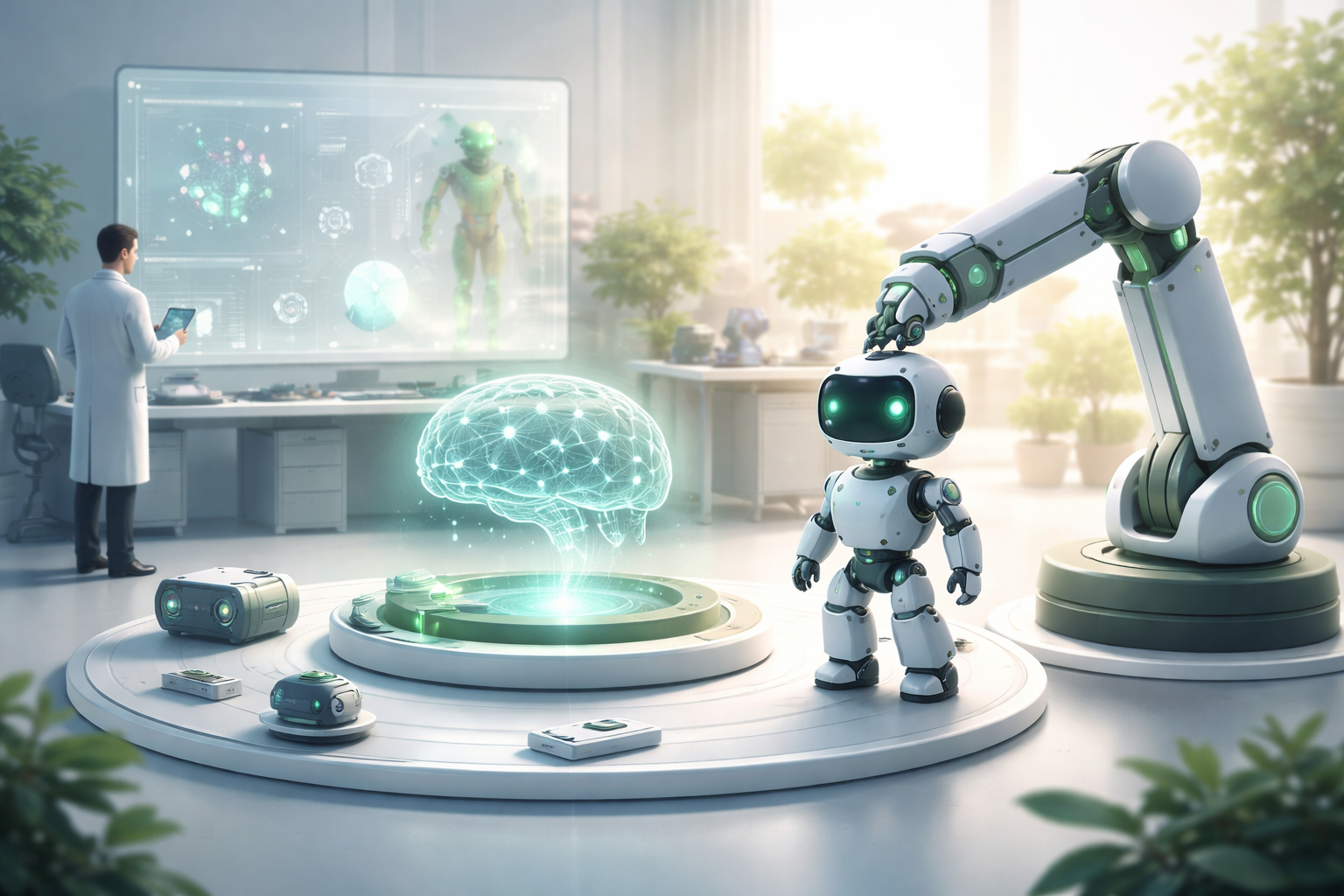
Nvidia has introduced a new set of physical AI research tools, agent workflows, and open-source models aimed at training more capable AI systems for the real world. The release was presented at the Computer Vision and Pattern Recognition (CVPR) conference in Denver and builds on the company’s Cosmos 3 World Foundation Model.
What physical AI covers
Physical AI refers to systems that perceive and act in the physical world, including self-driving vehicles, industrial robots, and embedded AI agents. The new capabilities are designed to help researchers automate key stages of physical AI development, including simulation, synthetic data production, policy training, and evaluation.
According to Nvidia, the central difficulty in the field is not only building accurate models but assembling everything around them: “The main challenge in physical AI research is not just developing robust models. It is building a complete workflow around them.” The update targets that gap by giving engineers more scalable ways to train and test systems before deployment.
Autonomous driving
For driving, Nvidia’s AI agents can now reconstruct real-world driving environments from fleet data and generate synthetic edge-case scenarios for testing. The company also introduced Alpamayo 2 Super, a 32-billion-parameter vision-language-action model built with advanced reasoning capabilities so it can operate across the full driving stack.
Vision AI and video analytics
In vision AI, Nvidia expanded its Metropolis platform with tools for video search, summarization, and synthetic data generation. The company said these additions help developers build agents that understand complex scenes, identify events, and generate alerts from live video streams.
Robotics and agent workflows
Robotics was another focus, with new agent skills that automate simulation and training workflows. The aim is to reduce the manual effort usually needed to create virtual environments and train robots within them. This emphasis on orchestrated, autonomous workflows mirrors a wider industry move toward governed AI agents running inside production systems.
Availability
The models are available through GitHub, while the synthetic data generation tools — neural reconstruction, video augmentation, and defect image generation — are offered on Nvidia Brev with free trial credits for researchers. Taken together, the release underlines Nvidia’s growing focus on physical AI as a core development area.
