
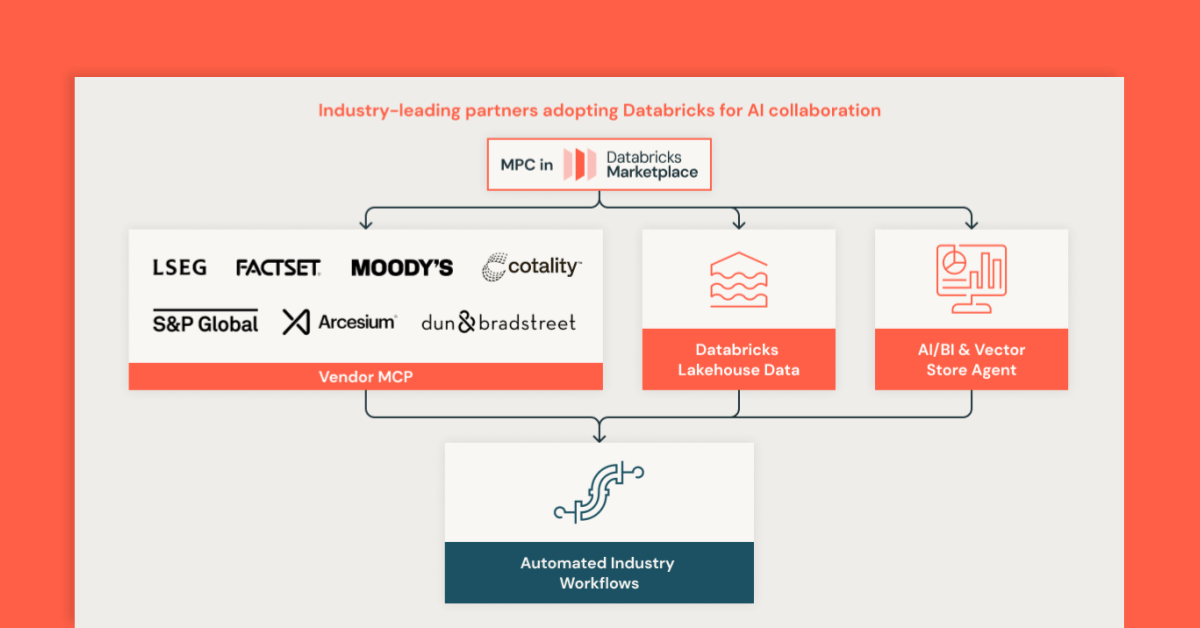
In financial services, AI rarely fails because the models are weak. It fails at the gate — entangled in integration complexity, data silos and compliance red tape. Industry surveys consistently rank integration among the top obstacles to enterprise AI adoption, and for banks and asset managers built around risk minimisation, every unmanaged integration is a liability. That is the problem Databricks says the Model Context Protocol (MCP) on its platform is meant to solve: letting proprietary data, models and compliance mandates finally speak the same language.
Smarter agents, governed workflows
On Databricks, MCP extends the platform’s existing vector stores, document search and data-science agents by letting those components securely interact with external APIs and live enterprise data. Teams can build domain-aware agents that combine proprietary and third-party data, automate research, respond to market events and produce real-time insights — all inside a single governance framework. Orchestration comes from Agent Bricks and its multi-agent supervisor, which coordinates multiple specialised agents on one task.
Governance is the recurring theme: Databricks supports managed MCP servers, external connections and custom deployments, all controlled through Unity Catalog, which enforces permissions, lineage and auditability across every agent interaction.
A marketplace of financial data partners
The Databricks MCP Marketplace launched with financial data and analytics partners including LSEG, FactSet, Nasdaq, Moody’s, Dun & Bradstreet, Cotality, Arcesium, and S&P Global Commodity Insights and Market Intelligence — MCP servers aimed at capital markets, banking and insurance. LSEG’s own announcement frames the goal as AI-ready access to curated financial datasets.
Capital markets use cases
For trading teams, MCP agents bring live market data, pricing analytics and curve calculations into real-time workflows. Instead of stitching together feeds, APIs and spreadsheets, an agent can retrieve instrument prices, yields and credit curves, reprice bonds or swaps, and fold in breaking news — all through natural-language requests against the LSEG MCP server.

In multi-asset fund analysis, agents using FactSet market data through Databricks’ AI/BI Genie can pull time-series inputs, earnings trends, holdings, sector flows and alternative signals to spot early changes such as unusual fund movements or estimate-revision drift. Agent Bricks then maps those signals to portfolio exposures, runs scenarios across macro or sector shocks, and estimates impact on NAV, weights and counterparty risk — ending in a dashboard and a natural-language summary with suggested adjustments.
On the operations side, the buy side can query fund, position and transaction datasets in natural language via the Nasdaq Data Link MCP server: the agent retrieves schemas, executes live queries and analyses NAV movements, cash flows and benchmark deviations, supporting intraday reconciliation and liquidity checks without manual data engineering.
Banking and insurance use cases
A credit-risk agent connected to the Moody’s MCP server gives analysts secure access to current rating outlooks, credit opinions and research inside Databricks, supporting portfolio review, underwriting and regulatory reporting through plain-language queries grounded in governed data.

For collateral and asset risk, an agent connected to property, appraisal and hazard data through the Cotality CLIP MCP server can automate valuation and eligibility checks during underwriting and continuously monitor portfolio asset risk. In M&A work, agents drawing on S&P Global data combine live commodity curves, supply forecasts and company fundamentals to run scenario analysis on deal economics — modelling impacts on EBITDA, cash flow and leverage in minutes rather than days. Insurers get similar patterns for underwriting, claims and fraud analysis, while Dun & Bradstreet positions its MCP offering as agent-ready business data for real-time decisioning.

Limitations and what to watch
This is a vendor-described architecture, and the caveats matter. The use cases above are Databricks’ own illustrations, not audited case studies with published results. MCP is a young protocol: server quality varies, security practices around tool permissions are still maturing, and regulated institutions will need their own validation before agents touch production risk systems. Marketplace access to premium data (LSEG, FactSet, S&P) still requires commercial licences — MCP simplifies the plumbing, not the pricing. Worth watching: independent benchmarks of MCP-based workflows in finance, and how quickly compliance teams accept agent-generated analysis in regulated reporting.
The bottom line
MCP aims to turn disconnected data silos and static tools into secure, interoperable agent systems. On Databricks, every dataset, API and model can in principle be invoked through governed agents — automating research, streamlining compliance and acting on live insight. The pattern of governed, tool-connected agents is the same one appearing across the industry, from research on compression-native retrieval to the governance questions that stall smaller AI agent projects.
