
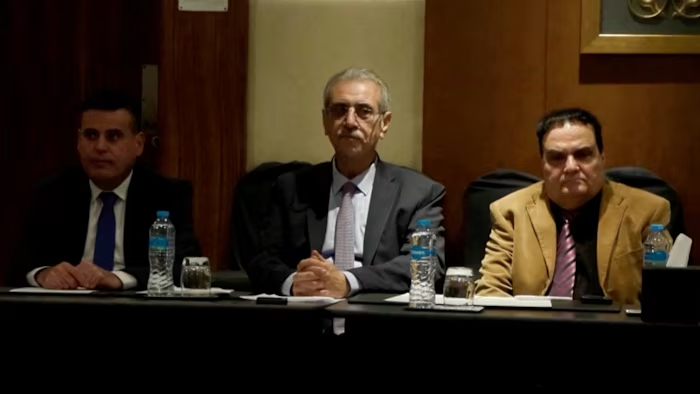
Ali Abdel Hamid Shaath was an unknown Palestinian businessman and former official until this week. Now he may take on one of the toughest jobs in the world: head of Gaza’s new transitional government.
The Trump administration this week formally announced Shaath as chair of the National Committee for the Administration of Gaza (NCAG), a 15-person body tasked with managing day-to-day governance for the 2 million people in the war-torn Palestinian territory.
US officials see the body composed of Palestinian technocrats like Shaath as a form of Gaza government that would operate under a “peace board” chaired by Donald Trump, which is set to be filled by as-yet-unnamed world leaders.
The executive board advising the peacekeeping force was also unveiled on Friday, and includes prominent international players such as US envoys Jared Kushner and Steve Witkoff, former British Prime Minister Tony Blair, Mark Rowan, head of private equity firm Apollo Global Management, and Nikolay Mladenov, Bulgaria’s former defense minister and UN envoy.
Mladenov will serve as High Representative of the Executive Board, overseeing the work of the Palestinian Technocratic Committee.
“It is rare to have the opportunity to set up a new government from scratch,” a US official told reporters on Wednesday. “This really has the potential to be the beginning of a new era.”
That Shaath, a civil engineer and former deputy minister in the Western-backed Palestinian Authority, was chosen to lead this new era seemed unlikely from the outside. Yet many people with knowledge of the complex negotiations between the US, Israel, Hamas, the PA, Egypt and many other regional actors say Shaath meets all the requirements.
Born in the southern Gazan city of Khan Younis, 68-year-old Shath received a degree from Cairo’s Ain Shams University before moving to the UK and earning a doctorate from Queen’s University in Belfast.
He later lectured at Strathclyde and Abertay universities, before being recalled to the Palestinian territories by then Palestinian leader Yasser Arafat in 1994 after the signing of the Oslo Peace Accords with Israel.
Shaath worked in various development roles for the PA, including the construction of Gaza’s port and airport – which was destroyed in the subsequent Israeli–Palestinian wars – and various industrial zones. He eventually became Deputy Minister of Planning and International Cooperation.
Despite Israeli pledges that the PA would have no role in Gaza after the war, Shaath is from a prominent clan with close ties to the secular nationalist Fatah party, which controls the PA and participated in previous rounds of Israeli-Palestinian peace talks.
A person with knowledge of his appointment said, “He is a good man, capable and not corrupt, and well known to Ramallah (the de facto capital of the PA) and Gaza.” “Israel and the US approved them without any problems.”
According to Diana Buttu, a lawyer and former adviser to the Palestinian presidency who has known Shaath for two decades, the man given the difficult task of rebuilding Gaza is a skilled engineer rather than a political operator.
Yet he “understands the different levers that can and can’t be pulled. He’s bright in that sense… He knows how to get the message across about what needs to be done”, she said.
The PA and Hamas, along with all other Palestinian factions, welcomed the appointment of the NCAG, clearing in principle a political path for it to begin its work. But the reality of Gaza after a devastating two-year war makes this task almost impossible.
At a minimum, estimates suggest that rebuilding the enclave will require tens of billions of dollars and many years. About 85 percent of homes have been destroyed or damaged, hundreds of thousands of people have been displaced, and food insecurity continues to plague the population.
The thorny issues of Hamas disarmament and Israel’s withdrawal from the Strip remain to be negotiated, as required in the US-brokered ceasefire agreement in October. Israeli troops still control half of Gaza, while Hamas controls the other half, and almost daily clashes continue amid mutual claims of ceasefire violations by both sides.
According to a person with knowledge of the matter, $1 billion has been raised to pay NCAG to deploy staff to Gaza. The new Palestinian committee, including Shaath, intends to move from Cairo, where they are currently based, although no timeline has yet been released.
How the group’s safety will be guaranteed once inside the strip is also unclear, the person said, as no foreign government has yet committed to sending peacekeeping forces.
“All my colleagues in the committee and I are technocrats. We are committed to the mission of building the Palestinian national economy and facilities,” Shaath told Egyptian television.
“Our people have endured two and a half years (of war) and we must stand with them. We look forward to seeing the smiles of our children in the days to come,” he said.
According to Samir Sinijlawi, a prominent Palestinian activist in East Jerusalem, “Everyone is looking for something positive and a message of hope”.
Despite the myriad challenges, Sinijlawi said, Shaath’s committee will soon begin to deploy its new diplomatic status in the service of the Gazan people, supported by the UN Security Council resolution and increased financial assistance.
“And the most important thing is that Donald Trump is the head of all this,” he said.
