
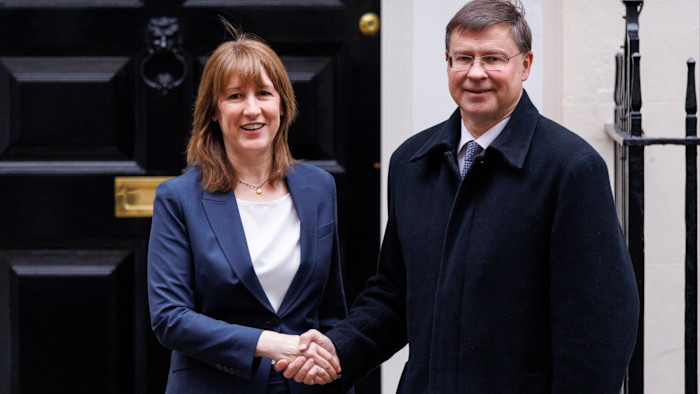
British Chancellor Rachel Reeves on Monday called on Britain and the European Union to “speak with one voice” to defend shared values on the economy, trade and defence, as she hit out at the turmoil unleashed by US President Donald Trump.
Reeves was speaking at the end of a day-long meeting in London between UK ministers and EU commissioners, where both sides focused on deepening economic integration, including getting Brexit done.
At talks at 11 Downing Street, the UK government said Reeves told the group that “we are moving towards a world where the rules are less clear”, in an apparent reference to Trump’s tariffs and security threats.
“Against that backdrop the UK and EU see shared values and objectives when it comes to the economy, trade and security, and they stressed the need to work together and – as far as possible – speak with one voice,” the government said.
EU Economy Commissioner Valdis Dombrovskis also said Trump was bringing the two sides closer together after Brexit when he said: “In the changing geopolitical order, cooperation with like-minded partners is essential to tackle shared global challenges.”
In a sign of the new relationship, Britain’s chief EU negotiator, Nick Thomas-Symonds, vowed to abandon “inflexible ideology” and accept Brussels rules in key areas to boost trade, which he said was part of a “fair Brexit”.
Writing in the Financial Times, Thomas-Symonds defended the UK government’s plan to overrule Brexit, declaring: “The UK is making a sovereign choice to engage with another high-standards jurisdiction – the EU – because it is in our economic interests to do so.”
But EU relations minister Thomas-Symonds gave a veiled warning to Labor colleagues who want to get Brexit done quickly – possibly by joining a new customs union with the bloc – saying it was important to be honest with voters that progress would take time.
Referring to promises made by a pro-Brexit campaign on the side of a bus during the 2016 referendum, Thomas-Symonds said: “There are temptations to reach beyond what is realistic or deliverable.” He added: “We cannot create our own version of the Red Bus Promise.”
Wes Streeting, the health secretary and Starmer’s potential leadership rival, has talked about the benefits of Britain joining a customs union with the EU, while the prime minister favors greater alignment with the single market.
Three EU diplomats said the planned reset of Britain’s ties with the bloc would take time and further integration with the single market would prove difficult because countries such as Norway and Switzerland pay heavily for access.
The meeting on Monday included Dombrovskis and EU Trade Commissioner Maros Sefcovic, who discussed progress towards the next summit between the two sides.
Thomas-Symonds was joined by Business Secretary Peter Kyle. Reeves joined the talks to discuss trade barriers, defense and easing Ukraine.
In his article, Thomas-Symonds said the deal agreed in principle last May with the EU – including breaking down barriers to food and energy trade and a youth mobility scheme – would increase the size of the UK economy by £9 billion a year by 2040.
However, John Springford, a trade economist at the Center for European Reform think-tank, said the promised additional growth was only 0.3 percent of UK GDP.
The British Chambers of Commerce said it hoped Monday’s meeting would lay the groundwork for “real impetus” in reset talks.
William Benn, head of trade policy at the business lobby group, said: “From carbon border taxes to food checks, there are a wide range of regulatory compliance issues that are hurting cross-border trade.
“Progress on these, along with defence, youth mobility and electricity markets, is needed to deliver high economic growth.”
Britain is pushing for a summit in May to sign a deal with Brussels on key parts of the reset, including removing border checks on food and drink exports, reintegrating carbon pricing and rejoining the EU internal market for electricity.
However, the two sides remain at odds over the size of a youth mobility scheme for 18-30-year-olds and whether Britain should contribute to the EU budget as the price of rejoining the bloc’s electricity market.
EU officials said Šefčovič warned that compromises needed to be reached before any future summits, rather than waiting for last-minute intervention from politicians.
One of the toughest issues is whether EU students should return to UK universities at the same price as their British counterparts – currently £9,535 a year – or at a lower rate than current international fees, which can be three times that amount.
The UK government has rejected “home” fees for EU students, while UK universities have warned that such a move would be ineffective at a time when the sector is laying off staff and facing many financial difficulties.
