
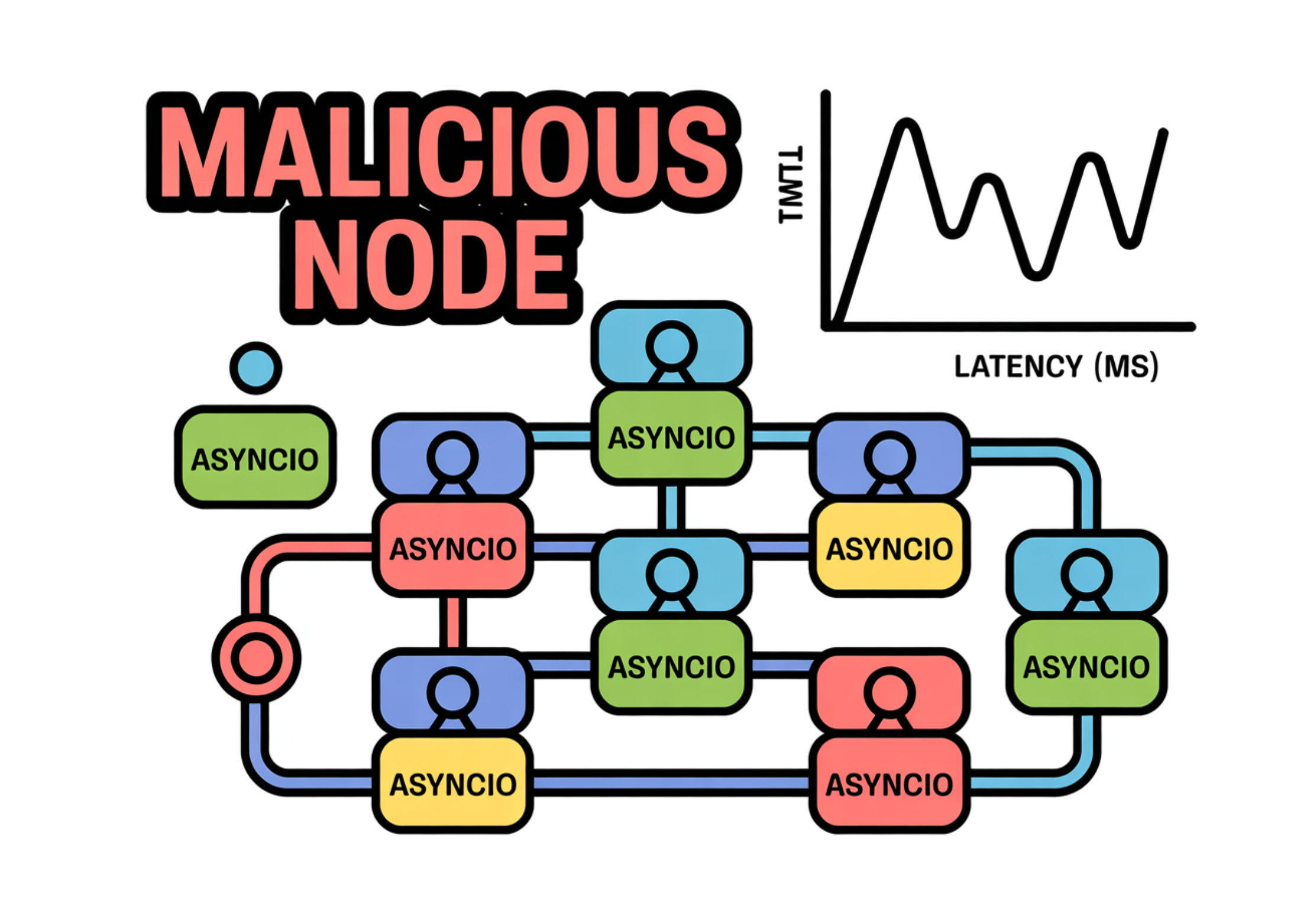
Practical Byzantine Fault Tolerance (PBFT) is a consensus algorithm that lets a group of distributed computers agree on a single result even when some of them are faulty or actively malicious. It is one of the foundations of modern blockchains and other distributed-trust systems. This walkthrough covers an end-to-end PBFT simulator written in Python using asyncio, the standard library for asynchronous programming. The simulator models a realistic network with asynchronous message passing, configurable delays, and “Byzantine” nodes that deliberately break the rules, and it implements the protocol’s three messaging phases, pre-prepare, prepare, and commit, explicitly.
A key property of PBFT is the so-called 3f+1 bound: to tolerate f faulty nodes, the network needs at least 3f+1 total participants. The simulation uses this setup to measure consensus latency and success rate as the number of malicious nodes increases, making it possible to observe empirically where Byzantine fault tolerance breaks down.
Step 1: Message types and protocol stages
import asyncio
import random
import time
import hashlib
from dataclasses import dataclass, field
from typing import Dict, Set, Tuple, Optional, List
import matplotlib.pyplot as plt


PREPREPARE = "PREPREPARE"
PREPARE    = "PREPARE"
COMMIT     = "COMMIT"


@dataclass(frozen=True)
class Msg:
   typ: str
   view: int
   seq: int
   digest: str
   sender: int


@dataclass
class NetConfig:
   min_delay_ms: int = 5
   max_delay_ms: int = 40
   drop_prob: float = 0.0
   reorder_prob: float = 0.0
The first block establishes the foundation of the simulator. It imports the required libraries and defines the main PBFT message types, formalising network messages and parameters with Python dataclasses so that communication is structured and consistent. It also defines constants for the three PBFT stages used throughout the system.
Step 2: The asynchronous network layer
class Network:
   def __init__(self, cfg: NetConfig):
       self.cfg = cfg
       self.nodes: Dict(int, "Node") = {}


   def register(self, node: "Node"):
       self.nodes(node.nid) = node


   async def send(self, dst: int, msg: Msg):
       if random.random() < self.cfg.drop_prob:
           return


       d = random.uniform(self.cfg.min_delay_ms, self.cfg.max_delay_ms) / 1000.0
       await asyncio.sleep(d)


       if random.random() < self.cfg.reorder_prob:
           await asyncio.sleep(random.uniform(0.0, 0.02))


       await self.nodes(dst).inbox.put(msg)


   async def broadcast(self, src: int, msg: Msg):
       tasks = ()
       for nid in self.nodes.keys():
           tasks.append(asyncio.create_task(self.send(nid, msg)))
       await asyncio.gather(*tasks)
This block implements an asynchronous network layer that simulates real-world message delivery, including delays, reordering, and potential degradation. Nodes are registered dynamically, and asyncio tasks broadcast messages across the simulated network. Modelling this non-deterministic communication is what allows the simulation to capture how latency and unreliable delivery affect consensus.
Step 3: Node configuration and state
@dataclass
class NodeConfig:
   n: int
   f: int
   primary_id: int = 0
   view: int = 0
   timeout_s: float = 2.0


class Node:
   def __init__(self, nid: int, net: Network, cfg: NodeConfig, byzantine: bool = False):
       self.nid = nid
       self.net = net
       self.cfg = cfg
       self.byzantine = byzantine


       self.inbox: asyncio.Queue(Msg) = asyncio.Queue()


       self.preprepare_seen: Dict(int, str) = {}
       self.prepare_votes: Dict(Tuple(int, str), Set(int)) = {}
       self.commit_votes: Dict(Tuple(int, str), Set(int)) = {}


       self.committed: Dict(int, str) = {}
       self.running = True


   @property
   def f(self) -> int:
       return self.cfg.f


   def _q_prepare(self) -> int:
       return 2 * self.f + 1


   def _q_commit(self) -> int:
       return 2 * self.f + 1


   @staticmethod
   def digest_of(payload: str) -> str:
       return hashlib.sha256(payload.encode("utf-8")).hexdigest()
Here the code defines the configuration and internal state of each PBFT node. It introduces data structures to track pre-prepare, prepare, and commit votes for both honest and Byzantine nodes, and implements the quorum-threshold logic and deterministic digest generation used to validate requests.
Step 4: The core protocol, pre-prepare and prepare
 async def propose(self, payload: str, seq: int):
       if self.nid != self.cfg.primary_id:
           raise ValueError("Only the primary can propose in this simplified simulator.")


       if not self.byzantine:
           dig = self.digest_of(payload)
           msg = Msg(PREPREPARE, self.cfg.view, seq, dig, self.nid)
           await self.net.broadcast(self.nid, msg)
           return


       for dst in self.net.nodes.keys():
           variant = f"{payload}::to={dst}::salt={random.randint(0,10**9)}"
           dig = self.digest_of(variant)
           msg = Msg(PREPREPARE, self.cfg.view, seq, dig, self.nid)
           await self.net.send(dst, msg)


   async def handle_preprepare(self, msg: Msg):
       seq = msg.seq
       dig = msg.digest


       if self.byzantine:
           if random.random() < 0.5:
               return
           fake_dig = dig if random.random() < 0.5 else self.digest_of(dig + "::fake")
           out = Msg(PREPARE, msg.view, seq, fake_dig, self.nid)
           await self.net.broadcast(self.nid, out)
           return


       if seq not in self.preprepare_seen:
           self.preprepare_seen(seq) = dig
           out = Msg(PREPARE, msg.view, seq, dig, self.nid)
           await self.net.broadcast(self.nid, out)


   async def handle_prepare(self, msg: Msg):
       seq, dig = msg.seq, msg.digest
       key = (seq, dig)
       voters = self.prepare_votes.setdefault(key, set())
       voters.add(msg.sender)


       if self.byzantine:
           return


       if self.preprepare_seen.get(seq) != dig:
           return


       if len(voters) >= self._q_prepare():
           out = Msg(COMMIT, msg.view, seq, dig, self.nid)
           await self.net.broadcast(self.nid, out)


   async def handle_commit(self, msg: Msg):
       seq, dig = msg.seq, msg.digest
       key = (seq, dig)
       voters = self.commit_votes.setdefault(key, set())
       voters.add(msg.sender)


       if self.byzantine:
           return


       if self.preprepare_seen.get(seq) != dig:
           return


       if seq in self.committed:
           return


       if len(voters) >= self._q_commit():
           self.committed(seq) = dig
This block contains the core PBFT logic, including proposal management and the pre-prepare and prepare phases. Crucially, it models Byzantine behaviour by allowing malicious nodes to send conflicting digests to different peers. Once the required prepare quorum is reached, the protocol advances to the commit phase.
Step 5: Commit and finalisation
 async def run(self):
       while self.running:
           msg = await self.inbox.get()
           if msg.typ == PREPREPARE:
               await self.handle_preprepare(msg)
           elif msg.typ == PREPARE:
               await self.handle_prepare(msg)
           elif msg.typ == COMMIT:
               await self.handle_commit(msg)


   def stop(self):
       self.running = False


def pbft_params(n: int) -> int:
   return (n - 1) // 3


async def run_single_consensus(
   n: int,
   malicious: int,
   net_cfg: NetConfig,
   payload: str = "tx: pay Alice->Bob 5",
   seq: int = 1,
   timeout_s: float = 2.0,
   seed: Optional(int) = None
) -> Dict(str, object):
   if seed is not None:
       random.seed(seed)


   f_max = pbft_params(n)
   f = f_max


   net = Network(net_cfg)
   cfg = NodeConfig(n=n, f=f, primary_id=0, view=0, timeout_s=timeout_s)


   mal_set = set(random.sample(range(n), k=min(malicious, n)))
   nodes: List(Node) = ()
   for i in range(n):
       node = Node(i, net, cfg, byzantine=(i in mal_set))
       net.register(node)
       nodes.append(node)


   tasks = (asyncio.create_task(node.run()) for node in nodes)


   t0 = time.perf_counter()
   await nodes(cfg.primary_id).propose(payload, seq)


   honest = (node for node in nodes if not node.byzantine)
   target = max(1, len(honest))


   committed_honest = 0
   latency = None


   async def poll_commits():
       nonlocal committed_honest, latency
       while True:
           committed_honest = sum(1 for node in honest if seq in node.committed)
           if committed_honest >= target:
               latency = time.perf_counter() - t0
               return
           await asyncio.sleep(0.005)


   try:
       await asyncio.wait_for(poll_commits(), timeout=timeout_s)
       success = True
   except asyncio.TimeoutError:
       success = False
       latency = None


   for node in nodes:
       node.stop()
   for task in tasks:
       task.cancel()
   await asyncio.gather(*tasks, return_exceptions=True)


   digest_set = set(node.committed.get(seq) for node in honest if seq in node.committed)
   agreed = (len(digest_set) == 1) if success else False


   return {
       "n": n,
       "f": f,
       "malicious": malicious,
       "mal_set": mal_set,
       "success": success,
       "latency_s": latency,
       "honest_committed": committed_honest,
       "honest_total": len(honest),
       "agreed_digest": agreed,
   }
This block completes the PBFT state machine by processing commit messages and finalising a decision once the commit quorum is satisfied. Each node runs an event loop that continuously processes incoming messages asynchronously, with lifecycle controls to stop nodes cleanly after each experiment.
Step 6: Running experiments and measuring results
async def latency_sweep(
   n: int = 10,
   max_malicious: Optional(int) = None,
   trials_per_point: int = 5,
   timeout_s: float = 2.0,
   net_cfg: Optional(NetConfig) = None,
   seed: int = 7
):
   if net_cfg is None:
       net_cfg = NetConfig(min_delay_ms=5, max_delay_ms=35, drop_prob=0.0, reorder_prob=0.05)


   if max_malicious is None:
       max_malicious = n


   results = ()
   random.seed(seed)


   for m in range(0, max_malicious + 1):
       latencies = ()
       successes = 0
       agreements = 0


       for t in range(trials_per_point):
           out = await run_single_consensus(
               n=n,
               malicious=m,
               net_cfg=net_cfg,
               timeout_s=timeout_s,
               seed=seed + 1000*m + t
           )
           results.append(out)
           if out("success"):
               successes += 1
               latencies.append(out("latency_s"))
               if out("agreed_digest"):
                   agreements += 1


       avg_lat = sum(latencies)/len(latencies) if latencies else None
       print(
           f"malicious={m:2d} | success={successes}/{trials_per_point} "
           f"| avg_latency={avg_lat if avg_lat is not None else 'NA'} "
           f"| digest_agreement={agreements}/{successes if successes else 1}"
       )


   return results


def plot_latency(results: List(Dict(str, object)), trials_per_point: int):
   by_m = {}
   for r in results:
       m = r("malicious")
       by_m.setdefault(m, ()).append(r)


   xs, ys = (), ()
   success_rate = ()
   for m in sorted(by_m.keys()):
       group = by_m(m)
       lats = (g("latency_s") for g in group if g("latency_s") is not None)
       succ = sum(1 for g in group if g("success"))
       xs.append(m)
       ys.append(sum(lats)/len(lats) if lats else float("nan"))
       success_rate.append(succ / len(group))


   plt.figure()
   plt.plot(xs, ys, marker="o")
   plt.xlabel("Number of malicious (Byzantine) nodes")
   plt.ylabel("Consensus latency (seconds) — avg over successes")
   plt.title("PBFT Simulator: Latency vs Malicious Nodes")
   plt.grid(True)
   plt.show()


   plt.figure()
   plt.plot(xs, success_rate, marker="o")
   plt.xlabel("Number of malicious (Byzantine) nodes")
   plt.ylabel("Success rate")
   plt.title("PBFT Simulator: Success Rate vs Malicious Nodes")
   plt.ylim(-0.05, 1.05)
   plt.grid(True)
   plt.show()


async def main():
   n = 10
   trials = 6
   f = pbft_params(n)
   print(f"n={n} => PBFT theoretical max f = floor((n-1)/3) = {f}")
   print("Theory: safety/liveness typically assumed when malicious <= f and timing assumptions hold.n")


   results = await latency_sweep(
       n=n,
       max_malicious=min(n, f + 6),
       trials_per_point=trials,
       timeout_s=2.0,
       net_cfg=NetConfig(min_delay_ms=5, max_delay_ms=35, drop_prob=0.0, reorder_prob=0.05),
       seed=11
   )
   plot_latency(results, trials)


await main()
The final block runs large-scale experiments, sweeping across different numbers of malicious nodes and collecting latency statistics. It aggregates the results to analyse the consensus success rate and plots the system’s behaviour, revealing how PBFT degrades once the number of Byzantine faults exceeds the theoretical limit.
What the results show
The simulation offers practical insight into how PBFT behaves beyond its textbook guarantees, and how adversarial pressure affects both latency and liveness. It shows how quorum limits enforce safety, why consensus fails when Byzantine nodes exceed the tolerable threshold, and how asynchronous networks amplify these effects. As a foundation, it can be extended toward more advanced distributed-systems concepts such as view change, leader rotation, and authenticated messaging, helping build intuition for the design trade-offs behind modern blockchains and distributed-trust systems. Readers comfortable with this style of hands-on build may also find value in a longer production-grade implementation walkthrough.
Limitations and what to watch
A simulation like this is a learning tool, not a production consensus engine. Several caveats are worth noting. The model abstracts away cryptography: real PBFT relies on authenticated, signed messages to prevent spoofing, so a teaching simulator that simplifies signatures will not reflect the security of a real deployment. Network conditions are generated with randomised delays rather than measured from a live system, so the latency figures illustrate trends rather than absolute performance. Classic PBFT also scales poorly because message complexity grows roughly with the square of the number of nodes, which is why production systems add optimisations the simulation does not include. And the 3f+1 bound is a worst-case guarantee: staying within it ensures safety in theory, but real systems must also handle timing assumptions, view changes, and implementation bugs that a simplified model does not capture. Used with those limits in mind, and alongside disciplined testing of the kind described in this guide to automated data-quality checks, the simulator is a useful way to build intuition before moving to more complete frameworks.
