
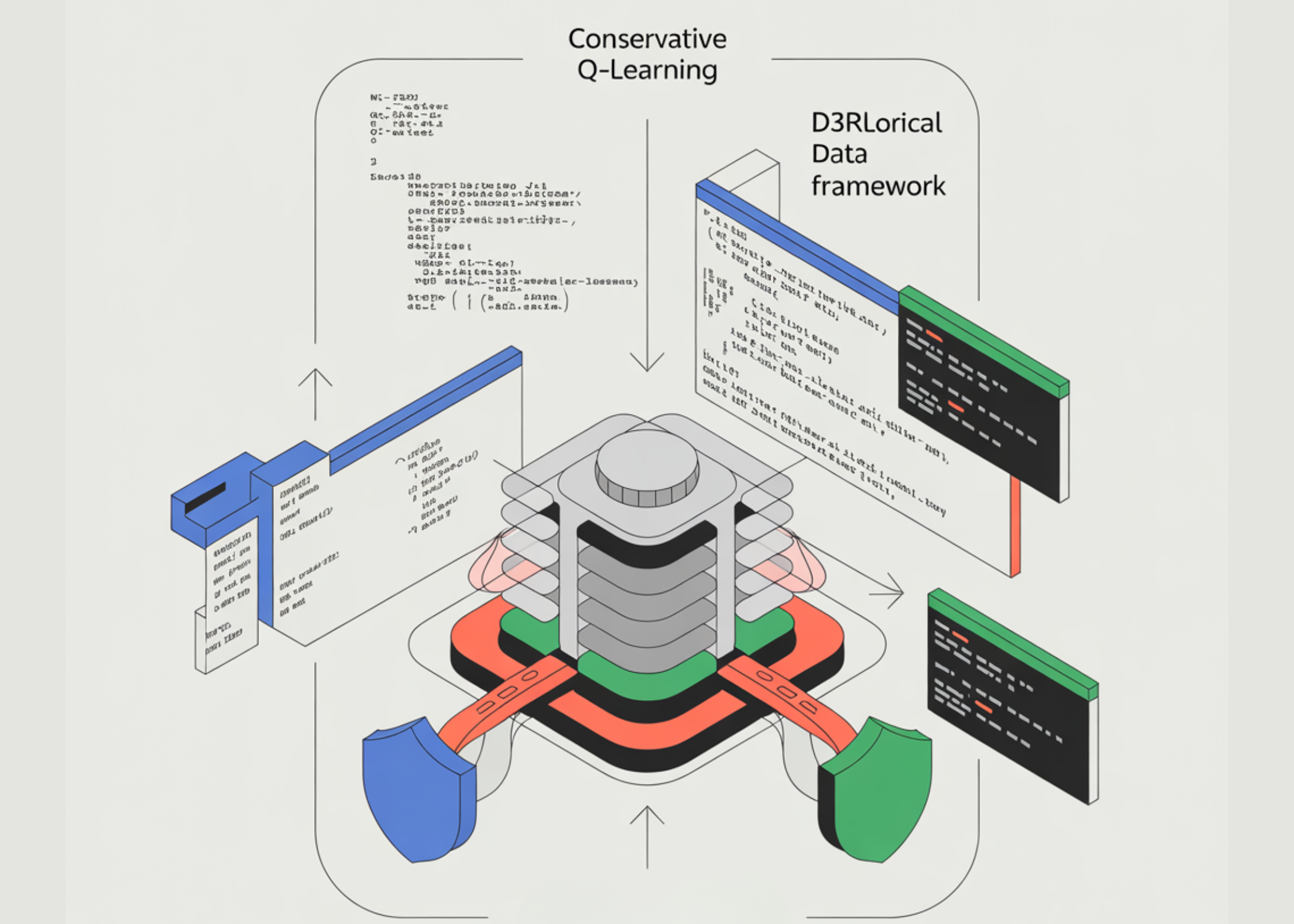
This tutorial builds a safety-critical reinforcement learning (RL) pipeline that learns entirely from fixed, offline data rather than live trial-and-error exploration. It designs a custom environment, generates a dataset from a restricted “behaviour” policy, and then trains two agents – a behaviour-cloning baseline and a Conservative Q-Learning (CQL) agent – using the open-source library d3rlpy. The aim is to show how robust decision-making policies can be trained in settings where free exploration is not an option.
In plain terms, offline RL matters wherever letting an agent experiment freely would be unsafe or impractical – for example in healthcare, industrial control, finance or robotics – so the agent must instead learn from historical logs of past behaviour.
Setting up the environment
The first step installs dependencies, imports libraries and fixes random seeds for reproducibility. It also detects and configures the available compute so results are consistent across systems, and defines a small utility to create configuration objects safely across different versions of d3rlpy.
!pip -q install -U "d3rlpy" "gymnasium" "numpy" "torch" "matplotlib" "scikit-learn"


import os
import time
import random
import inspect
import numpy as np
import matplotlib.pyplot as plt


import gymnasium as gym
from gymnasium import spaces


import torch
import d3rlpy


SEED = 42
random.seed(SEED)
np.random.seed(SEED)
torch.manual_seed(SEED)


def pick_device():
   if torch.cuda.is_available():
       return "cuda:0"
   return "cpu"


DEVICE = pick_device()
print("d3rlpy:", getattr(d3rlpy, "__version__", "unknown"), "| torch:", torch.__version__, "| device:", DEVICE)


def make_config(cls, **kwargs):
   sig = inspect.signature(cls.__init__)
   allowed = set(sig.parameters.keys())
   allowed.discard("self")
   filtered = {k: v for k, v in kwargs.items() if k in allowed}
   return cls(**filtered)
A safety-critical gridworld
Next, the workflow defines a safety-critical gridworld environment with hazards, terminal states and stochastic transitions. Penalties are assigned to unsafe situations and rewards to successful task completion, and movement is tightly constrained to reflect the kind of real-world safety limits an agent would face.
class SafetyCriticalGridWorld(gym.Env):
   metadata = {"render_modes": ()}


   def __init__(
       self,
       size=15,
       max_steps=80,
       hazard_coords=None,
       start=(0, 0),
       goal=None,
       slip_prob=0.05,
       seed=0,
   ):
       super().__init__()
       self.size = int(size)
       self.max_steps = int(max_steps)
       self.start = tuple(start)
       self.goal = tuple(goal) if goal is not None else (self.size - 1, self.size - 1)
       self.slip_prob = float(slip_prob)


       if hazard_coords is None:
           hz = set()
           rng = np.random.default_rng(seed)
           for _ in range(max(1, self.size // 2)):
               x = rng.integers(2, self.size - 2)
               y = rng.integers(2, self.size - 2)
               hz.add((int(x), int(y)))
           self.hazards = hz
       else:
           self.hazards = set(tuple(x) for x in hazard_coords)


       self.action_space = spaces.Discrete(4)
       self.observation_space = spaces.Box(low=0.0, high=float(self.size - 1), shape=(2,), dtype=np.float32)


       self._rng = np.random.default_rng(seed)
       self._pos = None
       self._t = 0


   def reset(self, *, seed=None, options=None):
       if seed is not None:
           self._rng = np.random.default_rng(seed)
       self._pos = (int(self.start(0)), int(self.start(1)))
       self._t = 0
       obs = np.array(self._pos, dtype=np.float32)
       return obs, {}


   def _clip(self):
       self._pos(0) = int(np.clip(self._pos(0), 0, self.size - 1))
       self._pos(1) = int(np.clip(self._pos(1), 0, self.size - 1))


   def step(self, action):
       self._t += 1


       a = int(action)
       if self._rng.random() < self.slip_prob:
           a = int(self._rng.integers(0, 4))


       if a == 0:
           self._pos(1) += 1
       elif a == 1:
           self._pos(0) += 1
       elif a == 2:
           self._pos(1) -= 1
       elif a == 3:
           self._pos(0) -= 1


       self._clip()


       x, y = int(self._pos(0)), int(self._pos(1))
       terminated = False
       truncated = self._t >= self.max_steps


       reward = -1.0


       if (x, y) in self.hazards:
           reward = -100.0
           terminated = True


       if (x, y) == self.goal:
           reward = +50.0
           terminated = True


       obs = np.array((x, y), dtype=np.float32)
       return obs, float(reward), terminated, truncated, {}
Generating offline data from a restricted policy
A restricted behaviour policy then generates the offline dataset without risky exploration. Trajectories are collected, structured into episodes, and converted into the format expected by d3rlpy’s offline-learning API. This mirrors the real situation in offline RL, where the only data available is whatever a cautious existing policy has already produced.
def safe_behavior_policy(obs, env: SafetyCriticalGridWorld, epsilon=0.15):
   x, y = int(obs(0)), int(obs(1))
   gx, gy = env.goal


   preferred = ()
   if gx > x:
       preferred.append(1)
   elif gx < x:
       preferred.append(3)
   if gy > y:
       preferred.append(0)
   elif gy < y:
       preferred.append(2)


   if len(preferred) == 0:
       preferred = (int(env._rng.integers(0, 4)))


   if env._rng.random() < epsilon:
       return int(env._rng.integers(0, 4))


   candidates = ()
   for a in preferred:
       nx, ny = x, y
       if a == 0:
           ny += 1
       elif a == 1:
           nx += 1
       elif a == 2:
           ny -= 1
       elif a == 3:
           nx -= 1
       nx = int(np.clip(nx, 0, env.size - 1))
       ny = int(np.clip(ny, 0, env.size - 1))
       if (nx, ny) not in env.hazards:
           candidates.append(a)


   if len(candidates) == 0:
       return preferred(0)
   return int(random.choice(candidates))


def generate_offline_episodes(env, n_episodes=400, epsilon=0.20, seed=0):
   episodes = ()
   for i in range(n_episodes):
       obs, _ = env.reset(seed=int(seed + i))
       obs_list = ()
       act_list = ()
       rew_list = ()
       done_list = ()


       done = False
       while not done:
           a = safe_behavior_policy(obs, env, epsilon=epsilon)
           nxt, r, terminated, truncated, _ = env.step(a)
           done = bool(terminated or truncated)


           obs_list.append(np.array(obs, dtype=np.float32))
           act_list.append(np.array((a), dtype=np.int64))
           rew_list.append(np.array((r), dtype=np.float32))
           done_list.append(np.array((1.0 if done else 0.0), dtype=np.float32))


           obs = nxt


       episodes.append(
           {
               "observations": np.stack(obs_list, axis=0),
               "actions": np.stack(act_list, axis=0),
               "rewards": np.stack(rew_list, axis=0),
               "terminals": np.stack(done_list, axis=0),
           }
       )
   return episodes


def build_mdpdataset(episodes):
   obs = np.concatenate((ep("observations") for ep in episodes), axis=0).astype(np.float32)
   acts = np.concatenate((ep("actions") for ep in episodes), axis=0).astype(np.int64)
   rews = np.concatenate((ep("rewards") for ep in episodes), axis=0).astype(np.float32)
   terms = np.concatenate((ep("terminals") for ep in episodes), axis=0).astype(np.float32)


   if hasattr(d3rlpy, "dataset") and hasattr(d3rlpy.dataset, "MDPDataset"):
       return d3rlpy.dataset.MDPDataset(observations=obs, actions=acts, rewards=rews, terminals=terms)


   raise RuntimeError("d3rlpy.dataset.MDPDataset not found. Upgrade d3rlpy.")
Inspecting dataset coverage and bias
Because an offline agent can only learn from what the dataset contains, the pipeline includes utilities that iterate correctly over episodes rather than assuming flat arrays, and it visualises state visitation to reveal how much of the environment the data actually covers. Examining the reward distribution shows what learning signal is available. This step surfaces coverage gaps and data bias that would otherwise silently limit the trained policy.
def _get_episodes_from_dataset(dataset):
   if hasattr(dataset, "episodes") and dataset.episodes is not None:
       return dataset.episodes
   if hasattr(dataset, "get_episodes"):
       return dataset.get_episodes()
   raise AttributeError("Could not find episodes in dataset (d3rlpy version mismatch).")


def _iter_all_observations(dataset):
   for ep in _get_episodes_from_dataset(dataset):
       obs = getattr(ep, "observations", None)
       if obs is None:
           continue
       for o in obs:
           yield o


def _iter_all_transitions(dataset):
   for ep in _get_episodes_from_dataset(dataset):
       obs = getattr(ep, "observations", None)
       acts = getattr(ep, "actions", None)
       rews = getattr(ep, "rewards", None)
       if obs is None or acts is None:
           continue
       n = min(len(obs), len(acts))
       for i in range(n):
           o = obs(i)
           a = acts(i)
           r = rews(i) if rews is not None and i < len(rews) else None
           yield o, a, r


def visualize_dataset(dataset, env, title="Offline Dataset"):
   state_visits = np.zeros((env.size, env.size), dtype=np.float32)
   for obs in _iter_all_observations(dataset):
       x, y = int(obs(0)), int(obs(1))
       x = int(np.clip(x, 0, env.size - 1))
       y = int(np.clip(y, 0, env.size - 1))
       state_visits(y, x) += 1


   plt.figure(figsize=(6, 5))
   plt.imshow(state_visits, origin="lower")
   plt.colorbar(label="Visits")
   plt.scatter((env.start(0)), (env.start(1)), marker="o", label="start")
   plt.scatter((env.goal(0)), (env.goal(1)), marker="*", label="goal")
   if len(env.hazards) > 0:
       hz = np.array(list(env.hazards), dtype=np.int32)
       plt.scatter(hz(:, 0), hz(:, 1), marker="x", label="hazards")
   plt.title(f"{title} — State visitation")
   plt.xlabel("x")
   plt.ylabel("y")
   plt.legend()
   plt.show()


   rewards = ()
   for _, _, r in _iter_all_transitions(dataset):
       if r is not None:
           rewards.append(float(r))
   if len(rewards) > 0:
       plt.figure(figsize=(6, 4))
       plt.hist(rewards, bins=60)
       plt.title(f"{title} — Reward distribution")
       plt.xlabel("reward")
       plt.ylabel("count")
       plt.show()
Controlled evaluation and safety metrics
Evaluation is done through controlled routines that measure policy performance without uncontrolled exploration. Alongside average return, the code computes safety-oriented metrics such as risk and target-reach rates, and adds a mismatch diagnostic that measures how often the learned policy’s actions deviate from those in the dataset – an important signal in offline RL, where straying too far from the data can be dangerous.
def rollout_eval(env, algo, n_episodes=25, seed=0):
   returns = ()
   lengths = ()
   hazard_hits = 0
   goal_hits = 0


   for i in range(n_episodes):
       obs, _ = env.reset(seed=seed + i)
       done = False
       total = 0.0
       steps = 0
       while not done:
           a = int(algo.predict(np.asarray(obs, dtype=np.float32)(None, ...))(0))
           obs, r, terminated, truncated, _ = env.step(a)
           total += float(r)
           steps += 1
           done = bool(terminated or truncated)
           if terminated:
               x, y = int(obs(0)), int(obs(1))
               if (x, y) in env.hazards:
                   hazard_hits += 1
               if (x, y) == env.goal:
                   goal_hits += 1


       returns.append(total)
       lengths.append(steps)


   return {
       "return_mean": float(np.mean(returns)),
       "return_std": float(np.std(returns)),
       "len_mean": float(np.mean(lengths)),
       "hazard_rate": float(hazard_hits / max(1, n_episodes)),
       "goal_rate": float(goal_hits / max(1, n_episodes)),
       "returns": np.asarray(returns, dtype=np.float32),
   }


def action_mismatch_rate_vs_data(dataset, algo, sample_obs=7000, seed=0):
   rng = np.random.default_rng(seed)
   obs_all = ()
   act_all = ()
   for o, a, _ in _iter_all_transitions(dataset):
       obs_all.append(np.asarray(o, dtype=np.float32))
       act_all.append(int(np.asarray(a).reshape(-1)(0)))
       if len(obs_all) >= 80_000:
           break


   obs_all = np.stack(obs_all, axis=0)
   act_all = np.asarray(act_all, dtype=np.int64)


   idx = rng.choice(len(obs_all), size=min(sample_obs, len(obs_all)), replace=False)
   obs_probe = obs_all(idx)
   act_probe_data = act_all(idx)
   act_probe_pi = algo.predict(obs_probe).astype(np.int64)


   mismatch = (act_probe_pi != act_probe_data).astype(np.float32)
   return float(mismatch.mean())


def create_discrete_bc(device):
   if hasattr(d3rlpy.algos, "DiscreteBCConfig"):
       cls = d3rlpy.algos.DiscreteBCConfig
       cfg = make_config(
           cls,
           learning_rate=3e-4,
           batch_size=256,
       )
       return cfg.create(device=device)
   if hasattr(d3rlpy.algos, "DiscreteBC"):
       return d3rlpy.algos.DiscreteBC()
   raise RuntimeError("DiscreteBC not available in this d3rlpy version.")


def create_discrete_cql(device, conservative_weight=6.0):
   if hasattr(d3rlpy.algos, "DiscreteCQLConfig"):
       cls = d3rlpy.algos.DiscreteCQLConfig
       cfg = make_config(
           cls,
           learning_rate=3e-4,
           actor_learning_rate=3e-4,
           critic_learning_rate=3e-4,
           temp_learning_rate=3e-4,
           alpha_learning_rate=3e-4,
           batch_size=256,
           conservative_weight=float(conservative_weight),
           n_action_samples=10,
           rollout_interval=0,
       )
       return cfg.create(device=device)
   if hasattr(d3rlpy.algos, "DiscreteCQL"):
       algo = d3rlpy.algos.DiscreteCQL()
       if hasattr(algo, "conservative_weight"):
           try:
               algo.conservative_weight = float(conservative_weight)
           except Exception:
               pass
       return algo
   raise RuntimeError("DiscreteCQL not available in this d3rlpy version.")
Training and comparing the agents
Finally, both a behaviour-cloning agent and a Conservative Q-Learning agent are trained entirely on the offline data and compared using controlled rollouts and the diagnostic metrics above, after which the trained policies are saved. The exercise illustrates why CQL, which deliberately penalises overconfident value estimates for actions poorly represented in the data, tends to produce a more reliable policy than simple imitation when learning from fixed historical data in safety-critical settings.
def main():
   env = SafetyCriticalGridWorld(
       size=15,
       max_steps=80,
       slip_prob=0.05,
       seed=SEED,
   )


   raw_eps = generate_offline_episodes(env, n_episodes=500, epsilon=0.22, seed=SEED)
   dataset = build_mdpdataset(raw_eps)


   print("dataset built:", type(dataset).__name__)
   visualize_dataset(dataset, env, title="Behavior Dataset (Offline)")


   bc = create_discrete_bc(DEVICE)
   cql = create_discrete_cql(DEVICE, conservative_weight=6.0)


   print("nTraining Discrete BC (offline)...")
   t0 = time.time()
   bc.fit(
       dataset,
       n_steps=25_000,
       n_steps_per_epoch=2_500,
       experiment_name="grid_bc_offline",
   )
   print("BC train sec:", round(time.time() - t0, 2))


   print("nTraining Discrete CQL (offline)...")
   t0 = time.time()
   cql.fit(
       dataset,
       n_steps=80_000,
       n_steps_per_epoch=8_000,
       experiment_name="grid_cql_offline",
   )
   print("CQL train sec:", round(time.time() - t0, 2))


   print("nControlled online evaluation (small number of rollouts):")
   bc_metrics = rollout_eval(env, bc, n_episodes=30, seed=SEED + 1000)
   cql_metrics = rollout_eval(env, cql, n_episodes=30, seed=SEED + 2000)


   print("BC :", {k: v for k, v in bc_metrics.items() if k != "returns"})
   print("CQL:", {k: v for k, v in cql_metrics.items() if k != "returns"})


   print("nOOD-ish diagnostic (policy action mismatch vs data action at same states):")
   bc_mismatch = action_mismatch_rate_vs_data(dataset, bc, sample_obs=7000, seed=SEED + 1)
   cql_mismatch = action_mismatch_rate_vs_data(dataset, cql, sample_obs=7000, seed=SEED + 2)
   print("BC mismatch rate :", bc_mismatch)
   print("CQL mismatch rate:", cql_mismatch)


   plt.figure(figsize=(6, 4))
   labels = ("BC", "CQL")
   means = (bc_metrics("return_mean"), cql_metrics("return_mean"))
   stds = (bc_metrics("return_std"), cql_metrics("return_std"))
   plt.bar(labels, means, yerr=stds)
   plt.ylabel("Return")
   plt.title("Online Rollout Return (Controlled)")
   plt.show()


   plt.figure(figsize=(6, 4))
   plt.plot(np.sort(bc_metrics("returns")), label="BC")
   plt.plot(np.sort(cql_metrics("returns")), label="CQL")
   plt.xlabel("Episode (sorted)")
   plt.ylabel("Return")
   plt.title("Return Distribution (Sorted)")
   plt.legend()
   plt.show()


   out_dir = "/content/offline_rl_artifacts"
   os.makedirs(out_dir, exist_ok=True)
   bc_path = os.path.join(out_dir, "grid_bc_policy.pt")
   cql_path = os.path.join(out_dir, "grid_cql_policy.pt")


   if hasattr(bc, "save_policy"):
       bc.save_policy(bc_path)
       print("Saved BC policy:", bc_path)
   if hasattr(cql, "save_policy"):
       cql.save_policy(cql_path)
       print("Saved CQL policy:", cql_path)


   print("nDone.")


if __name__ == "__main__":
   main()
Limitations and what to watch
This is an illustrative pipeline, not a production system. The gridworld is a simplified stand-in for real hazards, and results on a toy environment do not transfer directly to real-world safety-critical domains, which demand domain-specific validation, testing and human oversight. Offline RL is fundamentally limited by its dataset: an agent cannot reliably learn about situations the data never covers, so coverage and bias analysis are essential rather than optional. Conservative methods such as CQL reduce, but do not eliminate, the risk of poor decisions on out-of-distribution states, and their behaviour depends on hyperparameters that need careful tuning. Library APIs such as d3rlpy’s also change between versions, so code should be checked against the version in use. In any genuinely safety-critical deployment, learned policies should be treated as candidates for rigorous evaluation, not as trustworthy by default. For related context on deploying autonomous systems responsibly, see how enterprises are preparing for agentic AI. The library itself is documented in the d3rlpy project repository.
