
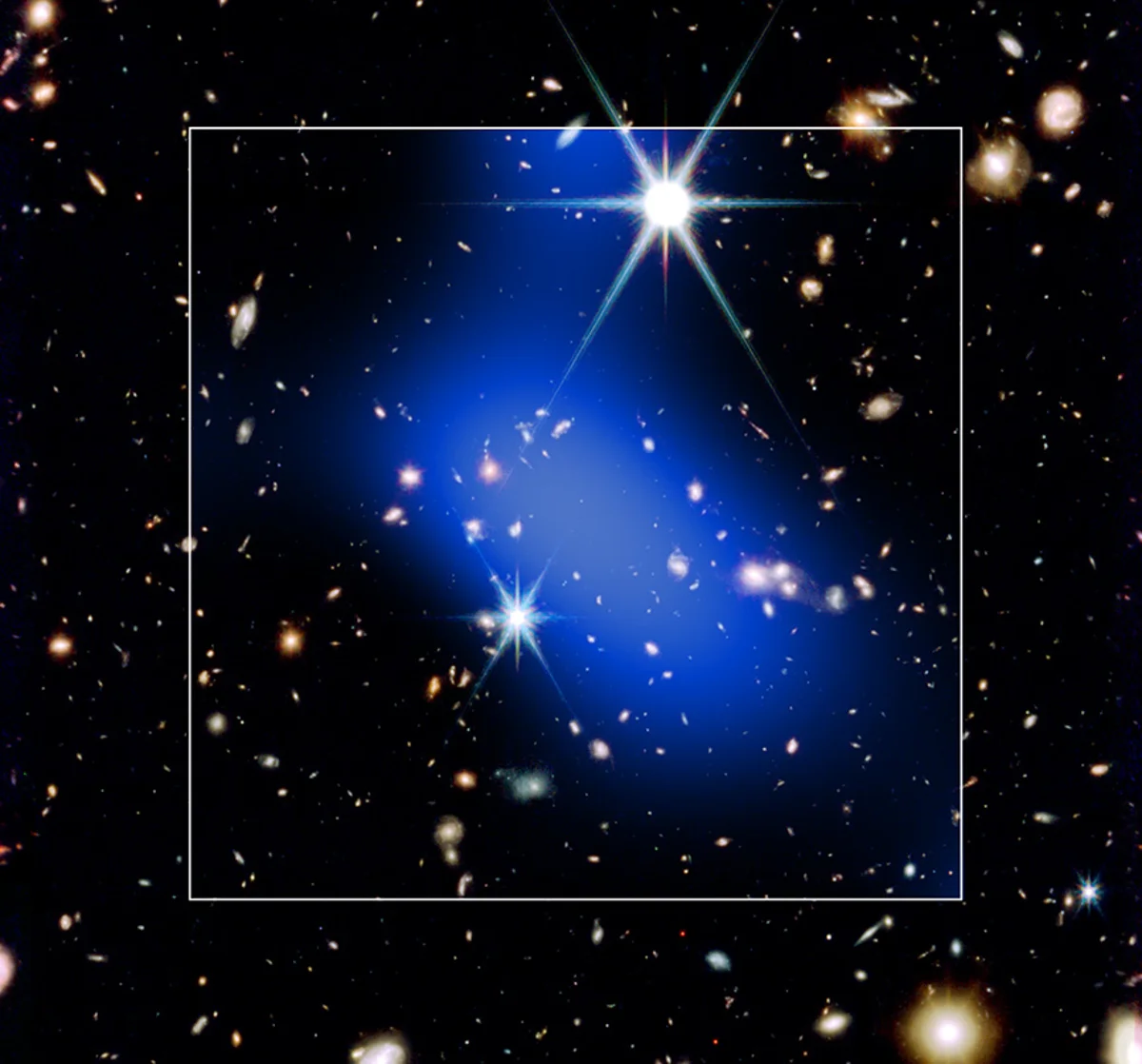
Astronomers have identified a surprisingly mature “baby cluster” of galaxies in the early universe, dating to barely a billion years after the Big Bang. Named JADES-ID1, the object is not yet a full galaxy cluster but a protocluster – and it appears larger and more evolved than most models of cosmic structure formation can easily explain, making it a potential challenge to current theory.
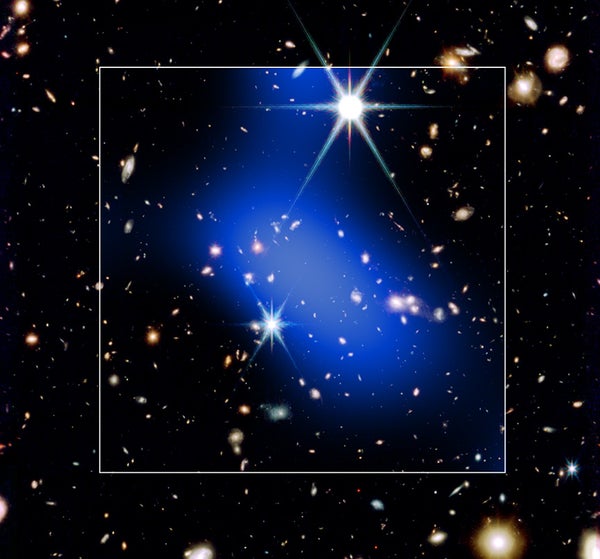
A composite infrared and X-ray image of JADES-ID1, a growing protocluster of galaxies observed about a billion years after the Big Bang. The white box shows a view from the Chandra X-ray Observatory (Blue) overlaid on an infrared image from the James Webb Space Telescope.
X-ray: NASA/CXC/CfA/Á Bogdan; Infrared: NASA/ESA/CSA/STScI; Image Processing: NASA/CXC/SAO/P. Edmonds and L. Frattare
What was found
The discovery, announced in late January 2026 and described in a study in the journal Nature, combined deep observations from NASA’s Chandra X-ray Observatory and the James Webb Space Telescope (JWST). Webb identified at least 66 candidate member galaxies bound together by gravity, while Chandra detected a vast cloud of hot gas surrounding them. That diffuse hot gas, known as the intracluster medium, is normally a hallmark of a mature, organised cluster, which is part of what makes finding it around such a young system so striking. The protocluster is estimated to lie about 12.7 billion light-years away and to hold a mass of roughly 20 trillion suns.
Why it challenges cosmic models
According to the researchers, most models of the universe predict that a structure this massive should not assemble until somewhere between two and three billion years after the Big Bang. JADES-ID1 appears to have already existed when the universe was only about one billion years old, which is why the team describes it as difficult for standard models to account for. The lead author, astrophysicist Akos Bogdan of the Center for Astrophysics | Harvard & Smithsonian, has described it as the youngest cluster yet found with an X-ray-emitting atmosphere, pushing the boundary for such objects to an earlier cosmic time than previous examples. The find was made possible partly because the JADES survey field overlaps with the Chandra Deep Field South, the site of the deepest X-ray observations ever taken.
What to watch
Extraordinary claims in cosmology warrant caution, and a single result – however carefully made – is a starting point rather than a settled conclusion. Key quantities such as the protocluster’s mass and distance are estimates derived from models and observations, and they carry uncertainties that independent follow-up will need to test. Describing an object as one that “could break” cosmic models is a statement about tension with current predictions, not proof that the underlying theory is wrong; such tensions have often been resolved by refined measurements or improved models rather than by overturning the framework. The James Webb telescope has repeatedly surfaced early-universe objects that looked surprisingly mature, and understanding whether these represent a genuine problem for cosmology or a gap in the models is an active area of research. Confirmation will depend on further observations and independent analyses. Detailed accounts are available from NASA and Scientific American.
