
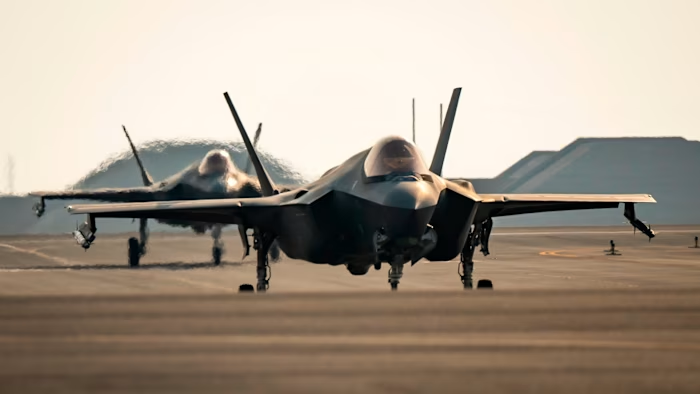
The US is removing personnel from a military base in Qatar, as the prospect of an imminent US attack on Iran raises fears of wider conflict across the region.
On Wednesday, a US official said “some people” were leaving Washington’s regional military command, Al Udeid air base, which hosts about 10,000 troops.
An Arab official described the partial withdrawal as “a precaution for the time being”, while the Qatari government said the measure was “in response to existing regional tensions”.
The move comes amid growing concerns that instability in Iran could spill over into neighboring countries if US President Donald Trump follows through on his pledge to intervene in support of anti-regime protests that have rocked the Islamic republic since December.
Tehran’s neighbors have stepped up mediation efforts in recent days, and Iranian officials have held talks with countries including Qatar, the United Arab Emirates and Turkey, all of which host significant US military bases.
The US is also moving air force assets out of the region in an apparent effort to “avoid being within range” of retaliation by Iran in the event of a US attack, a Gulf official said.
US Central Command, which oversees military operations in the Middle East, declined to comment.
Foreign human rights groups estimate that thousands of people have been killed in the demonstrations in Iran, which have turned into the most serious anti-regime unrest since the Islamic Revolution in 1979.
Trump posted on his Truth social platform on Tuesday that US action in Iran was imminent, saying “help is on the way”.
He said he had canceled all meetings with Iranian officials until the “senseless killing of protesters” ended and would take “very strong action” if the regime executed those detained during the unrest.
An Iranian official said the Islamic Republic was monitoring developments at the Al Udeid military base and was prepared to “retaliate”.
He said that mediation by Qatar or any other country is futile in the current circumstances and claimed that the US is “not serious” about talks.
The Iranian official urged regional states not to “allow their territory to be used for aggression by one country against another”.
The US has few military assets in the region, with fewer than 40,000 troops spread out across bases and ships since attacking Iran’s nuclear sites in June.
The US has no aircraft carriers after sending the Gerald R Ford Carrier Strike Group from the Mediterranean Sea to the Caribbean late last year. But it has six warships in the region, including three guided-missile destroyers – one in the Red Sea and two in the Gulf.
Gulf officials have stressed that they would reject a US request to use their territory in any attack against Iran.
Despite tensions with the Islamic Republic in recent years, Saudi Arabia and its Gulf neighbors prefer a weaker Iran, but they remain concerned about the destabilizing effect of U.S. intervention.
Regional officials fear that any action by Washington targeting the regime rather than nuclear facilities, like last June’s attacks, could trigger a serious Iranian response.
Ali Shamkhani, security adviser to the supreme leader, warned the US not to underestimate “Iran’s real determination and ability to respond to any aggression” in a post on Twitter.
The Gulf official said that although Iran’s ability to inflict damage in response to potential US attacks is more limited than before, “I think the Americans are also cautious, because you never know how (Iran) will respond.”

Iran has previously threatened to disrupt shipping lanes in the Strait of Hormuz, a global chokepoint for oil supplies.
Another Arab official said, “The diplomatic effort is to cool things down – if Iran plays the Hormuz card: that’s where the real threat comes from.”
Turkish Foreign Minister Hakan Fidan has spoken to his Iranian counterpart Abbas Araghchi twice in the last 24 hours. During both telephone calls, Fidan stressed the need to resolve existing regional tensions.
Ankara and Tehran have long been regional rivals, but Turkey is concerned that a violent overthrow of the Iranian government could lead to instability in its neighbor and lead to mass refugee migration.
The US has several military bases in Türkiye, many of them used for NATO operations.
Protests in Iran appeared to have subsided by Wednesday, with the regime reasserting control and threatening to sharply “punish” those detained during demonstrations.
A senior police commander in Tehran, who declined to be named, said that “terrorist acts have ended and will never happen again”.
He claimed that those who led the riots and carried out violence were trained for armed conflict in foreign countries.
A person close to the Saudi government said Riyadh did not expect the protests to lead to a revolution. But the person echoed broader regional concerns that Tehran, under internal and external pressure, could respond militarily against its neighbors.
“No one wants a wounded tiger in the corner, lashing out at everyone,” he said. “The fall of the regime would really make a difference – but that’s not in the plan. There’s very little we can do to topple the regime with American air power.”
Additional reporting by Beita Ghaffari, Ahmed Al Omran, Raya Jalabi and Charles Clover. Cartography by Steven Bernard
