
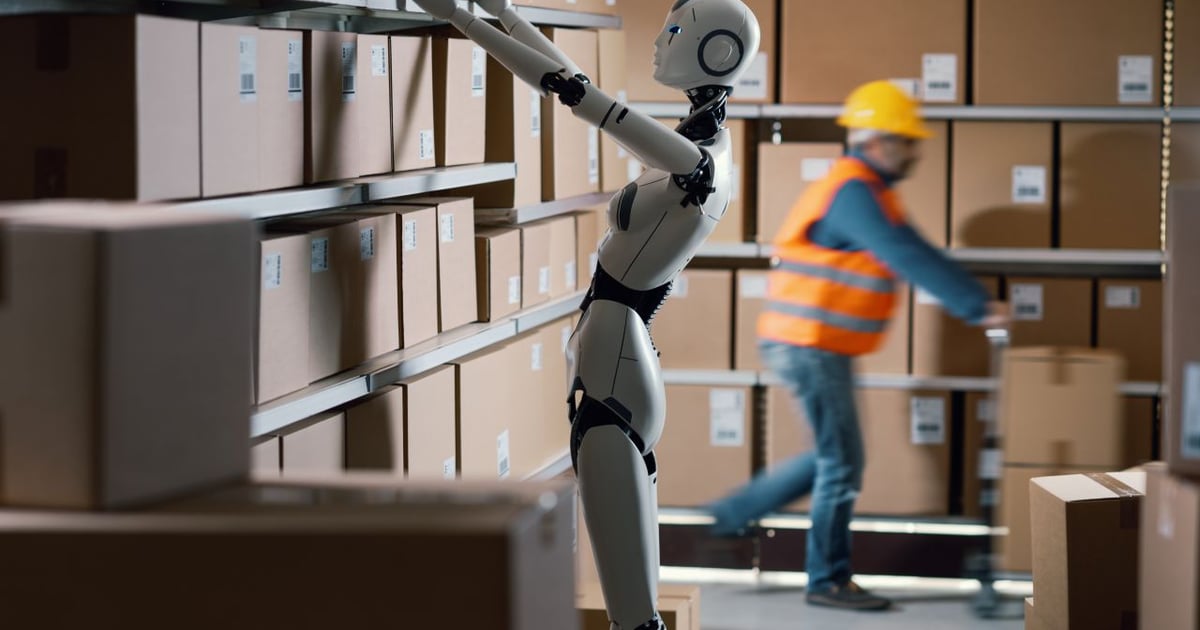
This year is proving to be a momentous one for robotics as humanoids become increasingly sophisticated, with models moving from pilot projects and lab-based demos to real-world deployment.
Here, experts provide an idea of where the industry is headed next year, and how companies can stay ahead.
Combination of hardware and software
For one thing, the convergence of advanced foundation models with mature hardware is transforming robots from single-purpose machines into adaptive, general-purpose systems.
“Robotics is not new,” said Jan Liphart, CEO of robotics software company OpenMind. “But what is fundamentally different now is that the hardware for universal and humanoid robots is maturing very quickly, which means that low-cost, reliable hardware is finally here.”
At the same time, software has evolved beyond narrowly defined functions.
“We realized that large language models could be built on physical hardware and could be controlled,” Liphart said. “We now have a clear vision for humanoid robots that can remember, learn, navigate places and share skills with other robots.”
Together, falling hardware costs, increasing reliability and more capable software are giving robots new levels of interactive capabilities, expanding their use cases and improving accessibility.
“The idea is not new, the visibility is new,” says Liphart. “The barrier has been broken. We now know how to create general-purpose robots that people can connect with emotionally, that can teach, help, and adapt.”
increase in domestic deployment
One of the most obvious results of this convergence is a renewed push into the consumer environment.
While the potential for humanoid models has historically remained a much-discussed possibility, experts said 2026 is the year designs will move from factories to homes.
“This will be the year when humanoid companies focus on consumer and home applications,” said George Choudhury, an analyst at ABI Research. “Traditional OEMs with ‘physical AI’ products already have strong customer bases within logistics and manufacturing – as well as developing mobile manipulator products, which are existing OEMs’ answer to humanoids. These vendors already have a strong hold on commercial markets.
“More companies will enter these markets, taking advantage of teleoperation to create viable products today,” he said. “This will drive down the price of humanoids but provide investors with reassurance that the technology is market ready.”
Further testing will continue
Tim Ensor, General Manager of Intelligence Services at Cambridge Consultants, said: AI business Despite the potential, robotics still has a lot to prove as it moves from pilot projects to wider scale.
“There was a lot of excitement in the lab about 2025,” he said. “But by the end of the year, many people realized there was still more work to be done.”
“(This year) is when major business users will start to engage with these robots,” he said. “We will see more testing, more experimentation and more clarity about where the challenges lie in delivering real value.”
After high-profile pilots such as Figure AI’s work with BMW, logistics and manufacturing will remain the primary testing grounds, he said.
In this scenario, the companies best placed to benefit will be those that are building both mechanical and AI platforms, while companies that fail to keep up with the rapid proliferation of technology risk being left behind.
further risk
Despite the industry’s potential, the path to widespread adoption is not entirely clear.
Chaudhary warned that security, privacy and technological immaturity remain major hurdles. Teleoperation raises concerns about surveillance, while robotics foundation models still lack the robustness needed for widespread deployment. Integration expertise is also in short supply.
He also highlighted macroeconomic risks.
“Humanoids and smart robots are intrinsically linked to the success of AI,” he said. “If AI bubble bursts, robotics innovators left highly exposed.”
Regulation presents another challenge, and Ensor pointed to the tension between productivity and safety. Robots must move fast enough to justify the investment but be safe enough to work with humans.
“When we’re thinking about the latest generation of robotics, the expectation is obviously to get the most out of those technology platforms,” he said. “Businesses have to decide how we get them to move faster and get their work done faster, while also guaranteeing safety.”
For Liphart, the challenge is ultimately social.
“The technology question has been largely resolved,” he said. “The big question is what society does with it.”
He added, “For the first time, we have a clear path to humanoids in homes, hospitals, schools, and workplaces.” “No previous technology had the possibility of performing human tasks in this way. It’s incredibly exciting, and of course, it’s also scary.”
Indeed, as robots become more capable, the industry is no longer asking whether the technology will work, but rather how quickly businesses – and society – can adapt.
