
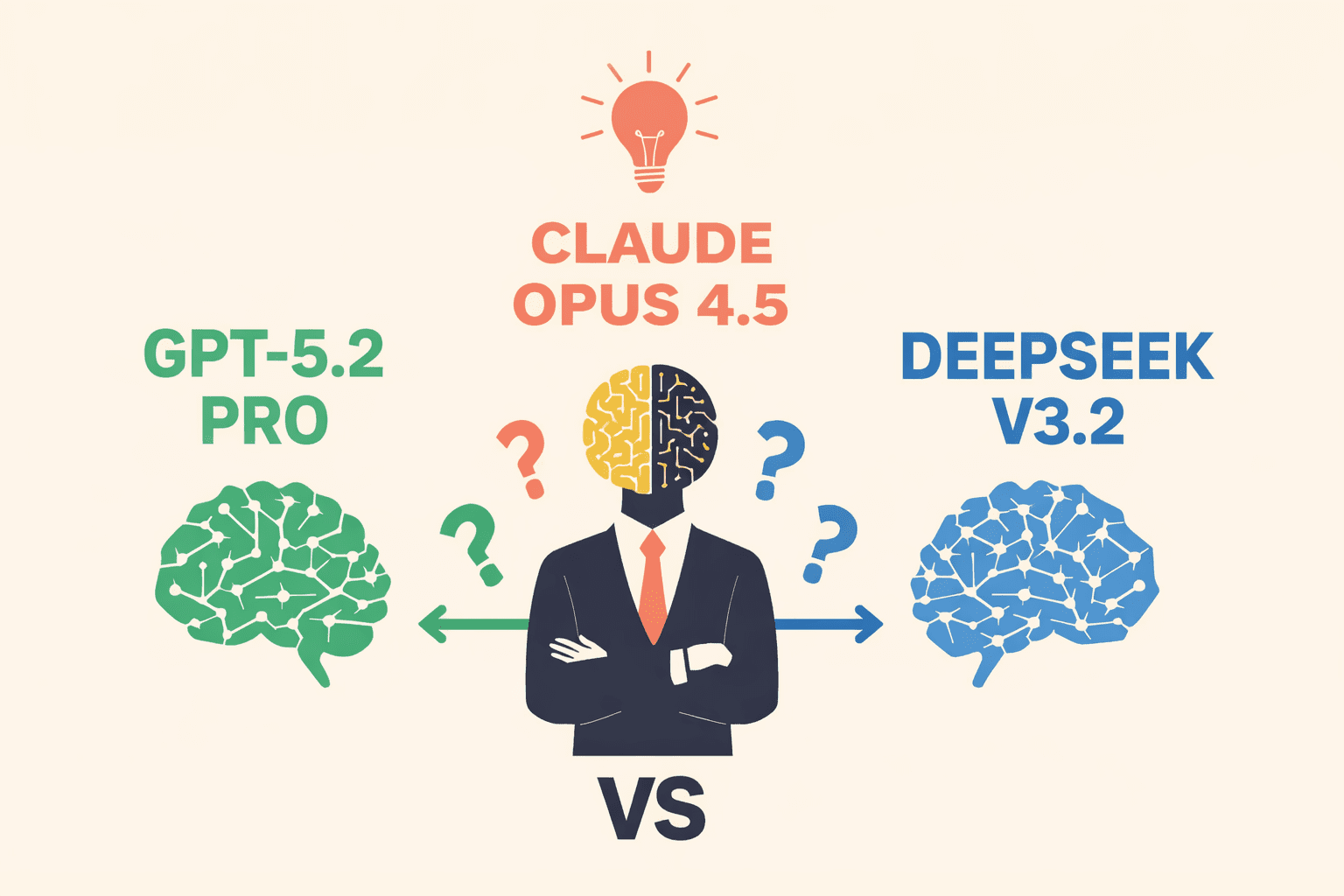
Image by author
Introduction
New models claiming state-of-the-art results arrive almost every week, but benchmark wins do not always translate into practical usefulness. For developers building self-funded software destined for production, the real question is which model best balances cost and reliability.
To probe that, this hands-on test compared three flagship models on the same practical task shortly after the release of GPT-5.2, to see whether the hype matched real-world performance.
Specifically, the test covered each provider’s flagship models: Claude Opus 4.5 (Anthropic’s most efficient model), GPT-5.2 Pro (OpenAI’s latest extended reasoning model), and DeepSeek V3.2 (One of the latest open-source options).
Each model was asked to create a playable Tetris game using the same prompt.
The following metrics were used to evaluate each model:
| criteria | Description |
|---|---|
| first attempt successful | With only a hint, did the model deliver working code? Multiple debugging iterations lead to higher costs over time, which is why this metric was chosen. |
| feature completion | Were all the features mentioned in the prompt created by the model, or was anything missing? |
| ability to play | Technical implementation aside, was the game actually easy to play? Or were there issues that created friction in the user experience? |
| cost effectiveness | How much did it cost to get production-ready code? |
The prompt
The following prompt was entered into each model:
Create a fully functional Tetris game as a single HTML file that I can open directly in my browser.
Requirements:
Game Mechanics:
– All 7 Tetris piece types
– Smooth piece rotation with wall kick collision detection
– Pieces should fall automatically, speed up gradually as user’s score increases
– Line clearing with visual animation
– “Next piece” preview box
– The game is over when the pieces reach the topControl:
– Arrow keys: left/right to move, down to skip, up to rotate
– Touch controls for mobile: swipe left/right to move, swipe down to skip, tap to rotate
– Spacebar to pause/repause
– Enter key to restart after game endsVisual Design:
– gradient color for each piece type
– Smooth animations as pieces move and lines become clear
– Clean UI with rounded corners
– Update scores in real time
– level indicator
– Game on screen with final score and restart buttonGameplay Experience and Polish:
– Smooth 60fps gameplay
– Particle effect when lines are cleared (optional but effective)
– Increase score based on number of lines cleared simultaneously
– grid background
– responsive designMake it visually sophisticated and feel satisfying to play. Code should be clean and organized.
Results
1. Claude Opus 4.5
The Opus 4.5 model produced exactly what was requested.
The UI was clean, on-screen instructions were clear, the controls were responsive and the game was enjoyable to play.
The gameplay was intuitive enough to be genuinely distracting from the rest of the testing.
Claude Opus 4.5 also produced a working game in under two minutes on the first attempt.
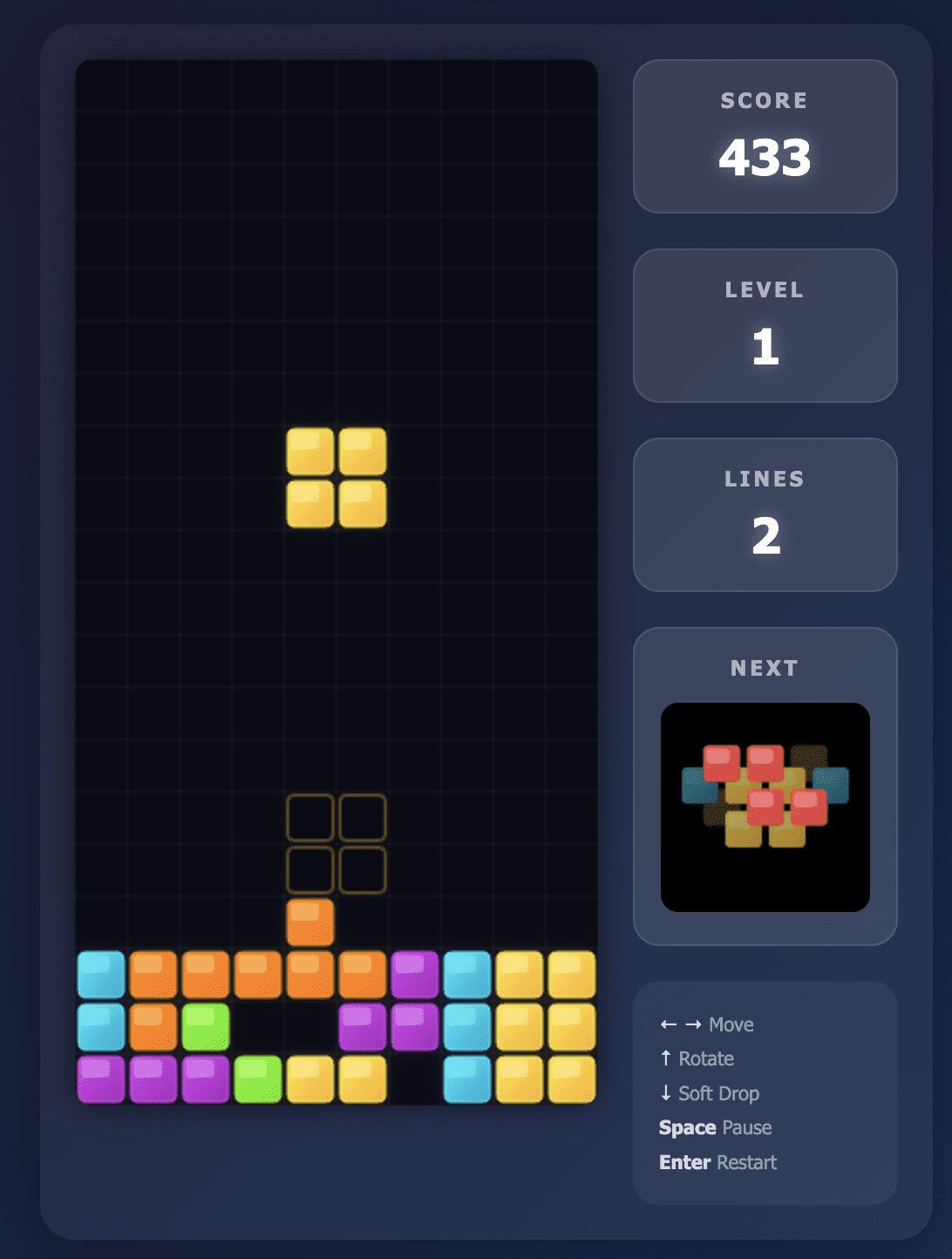
Tetris game created by Opus 4.5
2. GPT-5.2 Pro
GPT-5.2 Pro is OpenAI’s latest model with extended logic. For reference, GPT-5.2 has three levels: Instant, Thinking, and Pro. At the time of writing this article, GPT-5.2 Pro is their most intelligent model, offering extended thinking and reasoning capabilities.
It is also 4 times more expensive than Opus 4.5.
Despite the surrounding hype, the games this model produced were underwhelming.
On the first attempt, GPT-5.2 Pro produced a Tetris game with a layout bug. The bottom rows of the game fell outside the viewport, making it impossible to see where the pieces were landing.
This rendered the game unplayable, as shown in the screenshot below:
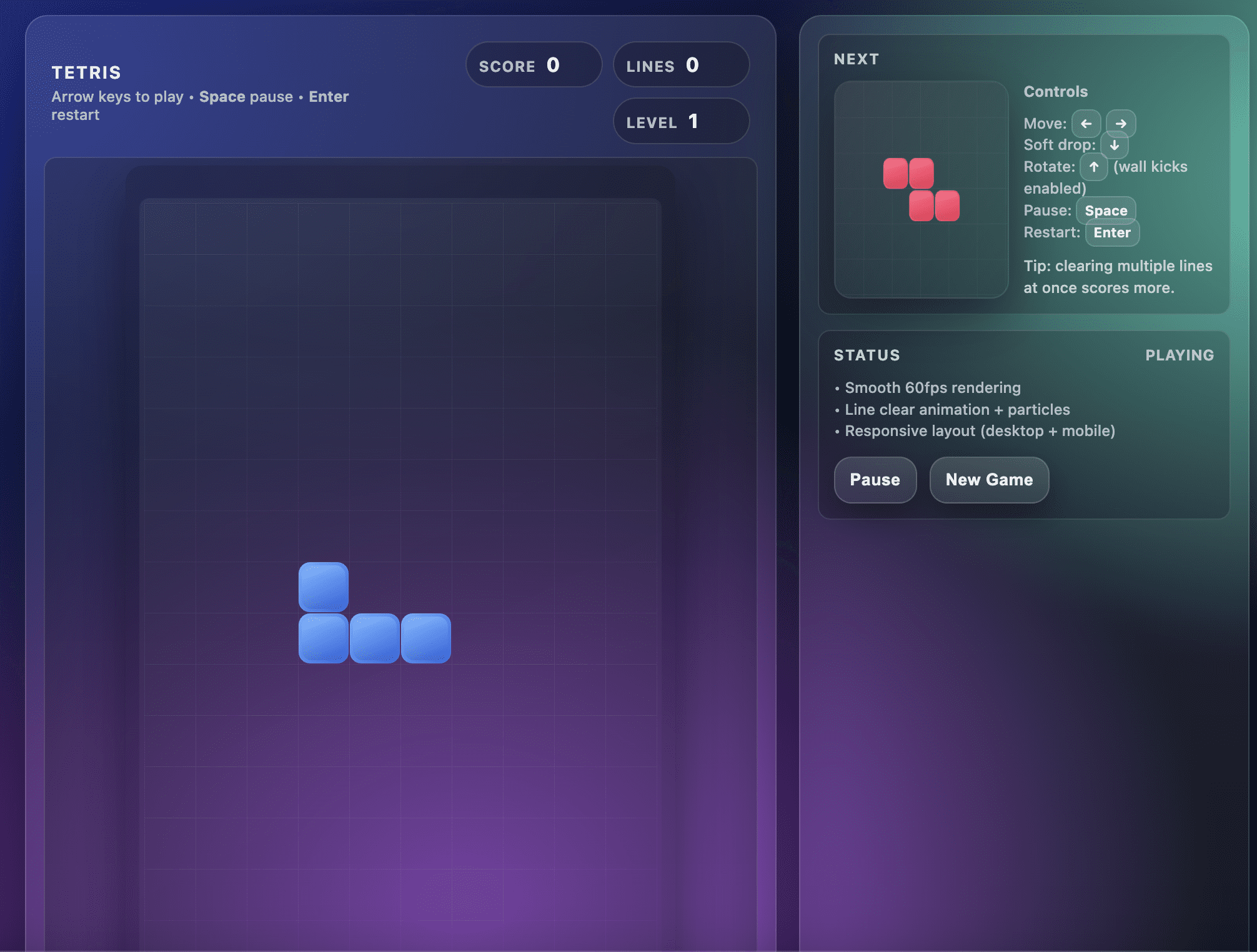
Tetris game created by GPT-5.2
This bug was notable because it took the model about 6 minutes to generate this code.
A follow-up prompt was used to fix the viewport issue:
The game works, but there is a bug. The bottom lines of the Tetris board are cut off from the bottom of the screen. I can’t see the pieces when they land on the ground and the canvas stretches beyond the visible viewport.
Please fix this:
1. Making sure the entire game board fits in the viewport
2. Adding proper centering so that the entire board is visibleThe game must fit the screen and all lines must be visible.
Following the follow-up prompt, the GPT-5.2 Pro model produced a functional game, as seen in the screenshot below:

Second attempt at Tetris by GPT-5.2
However, game play was not as smooth as games produced by the Opus 4.5 model.
Pressing the “down” arrow to drop a piece would sometimes cause the next piece to fall immediately at high speed, leaving little time to position it.
The game was only comfortably playable if each piece was left to fall on its own.
(The GPT-5.2 standard model produced equally buggy code on the first try.)
3. DeepSeek V3.2
DeepSeek’s first attempt at creating this game had two issues:
- The pieces started disappearing as soon as they hit the bottom of the screen.
- The “down” arrow, used to drop pieces faster, scrolls the entire webpage instead of moving the game pieces.
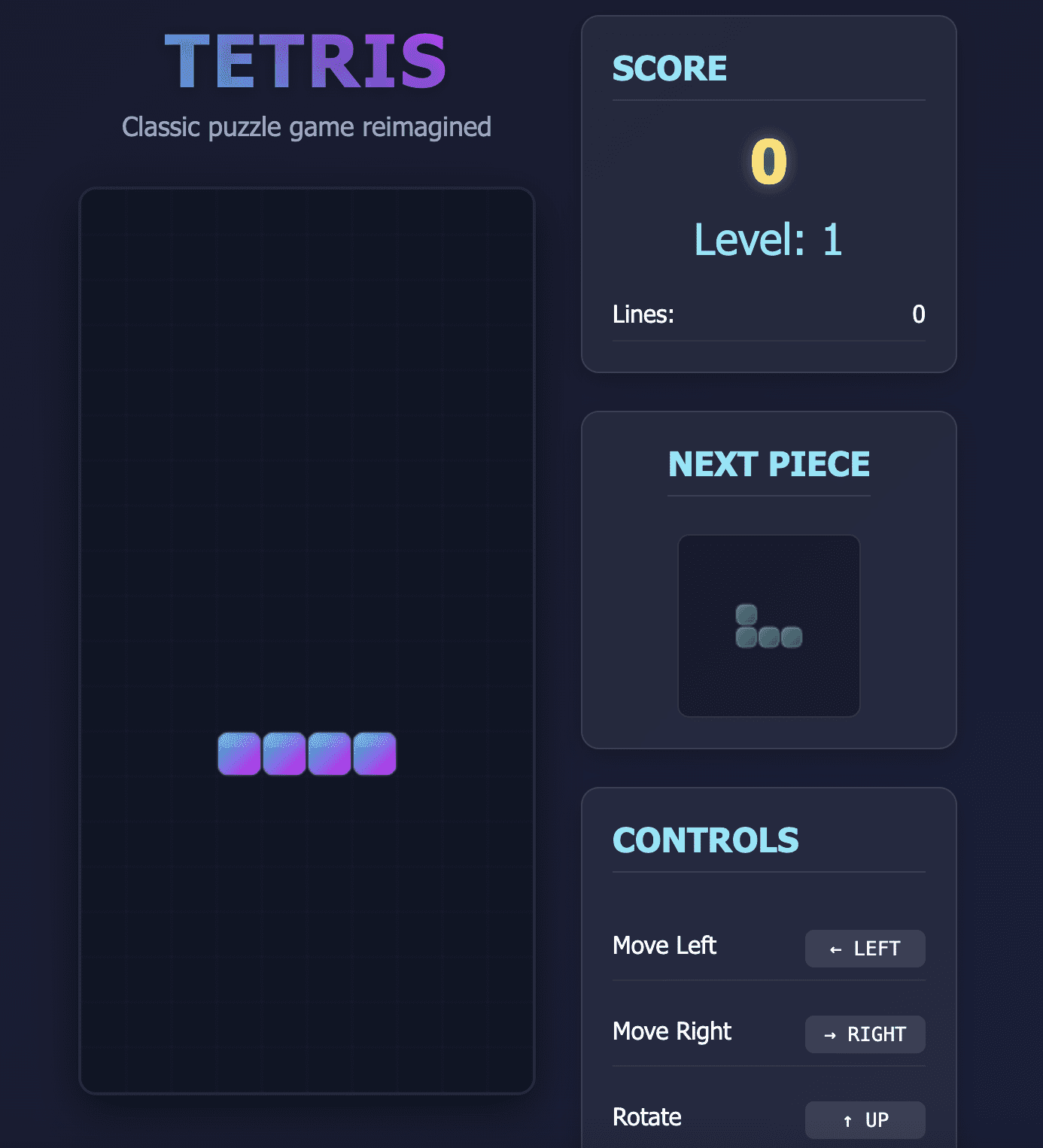
Tetris game created by DeepSeek V3.2
After a re-prompt to fix the problem, the gameplay controls started working correctly.
However, some pieces disappeared before they could land. This left the game completely unplayable even after the second iteration.
This problem could likely be fixed with two or three more prompts, and given the low price of DeepSeek, you can afford 10+ debugging rounds and still spend less than a successful Opus 4.5 attempt.
Summary: GPT-5.2 vs Opus 4.5 vs DeepSeek 3.2
Cost breakdown
Here’s a cost comparison between the three models:
| Sample | Input (per 1M token) | Output(per 1M token) |
|---|---|---|
| DeepSeek V3.2 | $0.27 | $1.10 |
| GPT-5.2 | $1.75 | $14.00 |
| cloud opus 4.5 | $5.00 | $25.00 |
| GPT-5.2 Pro | $21.00 | $84.00 |
DeepSeek v3.2 is the cheapest option, and you can also download weights of the model for free and run it on your infrastructure.
GPT-5.2 is about 7 times more expensive than DeepSeek V3.2, followed by Opus 4.5 and GPT-5.2 Pro.
For this specific task (creating a Tetris game), we consumed approximately 1,000 input tokens and 3,500 output tokens.
For each additional iteration, we will estimate an additional 1,500 tokens per additional round. Here’s the total cost per model:
| Sample | total cost | Result |
|---|---|---|
| DeepSeek V3.2 | ~$0.005 | Game is not playable |
| GPT-5.2 | ~$0.07 | Playable, but bad user experience |
| cloud opus 4.5 | ~$0.09 | Playable and good user experience |
| GPT-5.2 Pro | ~$0.41 | Playable, but bad user experience |
Takeaways
On the basis of this test, Claude Opus 4.5 was the strongest choice for everyday coding tasks.
Although GPT-5.2 is cheaper than Opus 4.5 per token, the extra iterations needed to reach a comparable result could erase that saving.
However, the DeepSeek V3.2 is much more affordable than the other models on this list.
For a developer on a budget with time to spend on debugging, DeepSeek V3.2 can still work out cheaper even if it takes many attempts to reach working code.
Notably, GPT-5.2 Pro failed to produce a working game on the first try and took around six minutes of “thinking” — unexpected for a flagship model on a task as well-established as Tetris.
However, GPT-5.2 Pro’s strengths lie in mathematics and scientific research, and it is specifically designed for problems that do not rely on pattern recognition from training data. Perhaps this model is over-engineered for simple day-to-day coding tasks, and should instead be used when building something that is complex and requires innovative architecture.
Practical conclusions from this experiment:
- Opus 4.5 performs best in everyday coding tasks.
- DeepSeek v3.2 is a budget option that gives reasonable output, although it does require some debugging effort to reach your desired results.
- GPT-5.2 (Standard) did not perform as well as Opus 4.5, while GPT-5.2 (Pro) is probably better suited for complex logic than quick coding tasks like this.
The test can be reproduced using the prompts shared above.
 
 
Limitations and what to watch
This is a single, informal comparison on one task — building a browser-based Tetris game — so the results reflect that specific use case rather than overall model quality. Coding assistants vary widely by task, prompt and the number of iterations allowed, and a game with clear, well-known mechanics favours pattern-heavy generation over the kind of novel reasoning some models are tuned for. Model versions, pricing and capabilities also change quickly, so today’s ranking may not hold. The cost figures are rough estimates based on approximate token counts. Anyone choosing a model for production work should run their own benchmarks on tasks that resemble their real workload rather than relying on any single head-to-head test.
Natasha Selvaraj He is a self-taught data scientist and has a passion for writing. Natasha writes on everything related to data science, she is a true expert on all data topics. you can join him Linkedin or check it out Youtube channel,
