
Donald Trump said he has received assurances that Iran has stopped killing protesters, striking a more measured tone towards Tehran but not ruling out US military action.
The president’s comments on Wednesday came as the US began evacuating some personnel from its largest military base in the region, as the prospect of a US attack on Iran raised fears of wider conflict across the Middle East.
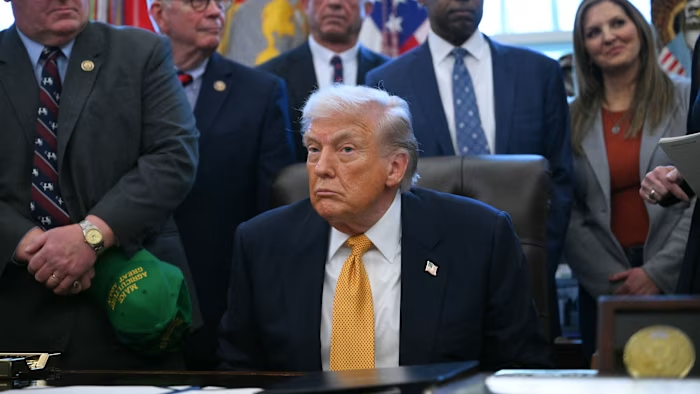
“We have been told that the killings in Iran are stopping, and it is stopping. It is stopping, and there are no plans for executions or executions,” Trump said in the Oval Office, referring to the Iranian regime’s plan to begin executing arrested protesters. He did not reveal the source of his information.
Iranian Foreign Minister Abbas Araghchi told Fox News later on Wednesday that “I have not heard about any executions” and that “today or tomorrow or anything, there are no executions”.
Asked if there would be an execution on Friday, Araghchi said, “You know I can’t tell you, but I’m sure of this, there are no plans for an execution.”
Trump’s comments earlier in the day eased market concerns that a US attack on Iran was imminent, sending oil prices lower. International benchmark Brent crude fell 4 percent to $63.78 a barrel in New York trading on Wednesday afternoon.
Asked whether US military intervention was off the table, he said “We’ll look and see what the process is. But we’ve been given very good statements by people who know what’s going on.” Trump said he hopes it is “true” that executions have been halted.
“It’s a big deal,” he said, adding that he would “find out more” later Wednesday.
Trump told Reuters in an interview published Wednesday night that Iran’s regime could fall due to the protests, although he added that “any regime can fail”.
“Whether it falls or not, it’s going to be an interesting period of time.”
He downplayed the potential role of Reza Pahlavi, the exiled son of the former Iranian shah, who has established himself as a leader of opponents of the regime in Tehran.
Trump said he was not sure Pahlavi could have the necessary support in Iran to lead the nation in the event of the regime’s collapse. “I don’t know whether his country will accept his leadership or not, and certainly if they do, that would be fine by me.”
The president’s comments come amid growing concerns that instability in Iran could spill over into neighboring countries if it follows through on its pledge to intervene in support of anti-regime protests that have been ongoing in the Islamic republic since December.
A US official said on Wednesday that “some people” were leaving Al Udeid air base in Qatar, Washington’s regional military command center that hosts about 10,000 troops. The State Department advised US Embassy personnel in Doha and other US citizens in Qatar to “exercise increased caution and limit non-essential travel to Al Udeid Air Base”.
Tehran previously targeted Al Udeid with a missile strike after the US bombed its nuclear facilities during Israel’s 12-day war against Iran in June. Britain also withdrew some personnel from the base and temporarily closed its embassy in Tehran.
Iran’s neighbors have stepped up mediation efforts in recent days and Iranian officials have held talks with countries including Qatar, the United Arab Emirates and Turkey, all of which host significant US military bases.
The US is also moving air force assets out of the region in an apparent effort to “avoid being within range” if Iran retaliates in the event of a US attack, a Gulf official said.
US Central Command, which oversees military operations in the Middle East, declined to comment.
Human rights groups estimate that thousands of people have been killed in the demonstrations in Iran, which have turned into the most serious anti-regime unrest since the Islamic Revolution in 1979.
Trump posted on his Truth social platform on Tuesday that US action in the country was imminent, saying “help is on the way”. He said he had canceled all meetings with Iranian officials until the “senseless killing of protesters” ended and would take “very strong action” if the regime executed those detained during the unrest.
An Iranian official said Tehran was monitoring developments in Al Udeid and was prepared to “retaliate”. He said that under these circumstances, diplomacy by Qatar or any other country is futile and claimed that the US is “not serious” about talks.
The Iranian official urged regional states not to “allow their territory to be used for aggression by one country against another”.
The US has few military assets in the region, with fewer than 40,000 troops spread out across bases and ships since attacking Iran’s nuclear sites in June.
Washington also has no aircraft carriers after moving the Gerald R. Ford Carrier Strike Group from the Mediterranean to the Caribbean Sea late last year. But it has six warships in the region, including three guided-missile destroyers, two in the Gulf and one in the Red Sea.
Gulf officials have stressed that they would reject any US request to use their territory in an attack against Iran.
Despite tensions with the Islamic Republic in recent years, Saudi Arabia and its Gulf neighbors prefer a weaker Iran, but they remain concerned about the destabilizing effect of U.S. intervention.
Regional officials fear that any action by Washington targeting the regime rather than nuclear facilities, as happened during last June’s attacks, could provoke a serious Iranian response.
Additional reporting by Shimon Kerr and Najmeh Bozorgmehr
