
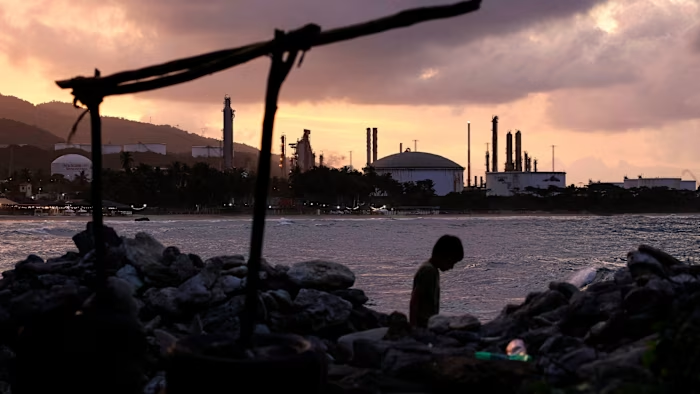
Donald Trump has said Venezuelan officials will hand over 30 million to 50 million barrels of sanctioned crude to the US, a sign that his administration is stepping up its effort to control the South American country’s oil sector.
Trump said on Tuesday that about $3 billion worth of oil would be sold at market price and would be controlled by the “President of the United States” to ensure it benefits Venezuelans and the American people.
“It will be transported by storage ships, and brought directly to unloading docks in the United States,” Trump said in a post on his Truth Social social media platform. “I have asked Energy Secretary Chris Wright to immediately implement this plan.”
The comments come as a fleet of US oil tankers is headed to Venezuelan waters to begin loading the country’s oil, which is stuck at ports as a result of Washington’s naval blockade.
Analysts have warned that Venezuelan production “will collapse” unless Washington ends its naval blockade and enables some oil to leave the country due to storage shortages.
But Trump’s announcement that he will take control of 50 million barrels of Venezuela’s oil — which is less than 50 days of the country’s production — will intensify criticism that his administration is bullying the country into taking oil concessions.
“This is seizure, imperialist, and has no justification,” said Jeffrey Sonnenfeld, a professor at Yale’s business school who has advised previous U.S. administrations on sanctions policy. “There is no need for this oil either because we have global oil in abundance.”
The Venezuelan government did not immediately respond to Trump’s statement.
Global oil benchmark Brent crude fell 1.7 percent on Tuesday, while US oil marker West Texas Intermediate dropped 2 percent. Following Trump’s announcement, Brent fell 1 per cent to $60.10 a barrel in Asian trading on Wednesday morning, while WTI fell 1.3 per cent to $56.40 a barrel.
Chevron, the most prominent U.S. company operating in Venezuela, was in talks with the country’s state oil company PDVSA and U.S. officials about sending some of the stranded crude to U.S. refineries to ease pressure on the country’s creaking oil infrastructure, a person familiar with the matter said.
About a dozen tankers chartered by the US supermajor are headed to Venezuela or are already at its ports. These ships could begin transporting some oil within a few days, according to commodity data group Kpler.
US sanctions imposed in mid-December have halted Venezuelan exports, leaving oil transported from the Orinoco Belt, one of the world’s largest crude oil fields, stuck in dilapidated storage facilities that are at or near capacity.
Analysts have warned that if the country is forced to halt further production, it will face long delays in restarting.
“Venezuela faces such a difficult task to get its oil sector back on track,” said Jason Bordoff, founding director of Columbia University’s Center on Global Energy Policy. “Closing production will make it even more difficult,
Any shutdown would jeopardize Trump’s efforts to quickly deliver a windfall to the U.S. oil sector, which he said followed a brazen U.S. raid over the weekend to oust strongman leader Nicolas Maduro.
Chevron Chief Financial Officer Aimer Bonner and other senior U.S. oil executives are expected to meet with Energy Secretary Wright on the sidelines of an energy conference in Miami on Wednesday for talks about the White House strategy for Venezuela.
Trump said Tuesday he planned to “meet with oil companies.” A person familiar with the matter said the talks would include Chevron as well as other U.S. oil companies. The White House did not immediately respond to a request for comment.
People familiar with Venezuela’s energy sector have warned that its oil production could fall by a third to 600,000 barrels per day in the next four weeks if it is not possible to move oil out of storage.
Venezuelan crude oil exports – most of which were shipped to China until recently – have fallen by more than 30 percent since Trump imposed a “complete and total shutdown” on sanctioned tankers transporting oil through the country’s ports.
Industry access to naphtha, a so-called diluent that thins heavy oil like molasses, allowing it to be transported through pipes, has also been disrupted. Russia is the primary supplier of naphtha to Venezuela, although it previously obtained it from the US.
Due to the closure of export routes, Venezuela is rapidly depleting storage facilities for oil, said a PDVSA engineer.
“Most heavy crude oil fields will have to reduce their production,” this person said, adding that only the country’s light and medium-grade oil fields and those run by Chevron will continue to pump at full capacity.
Chevron is able to continue exporting crude oil, including from US refineries, through special licenses from Washington.
Schreiner Parker, head of emerging markets at consultancy Rystad Energy, warned there could be a “short-term production decline”, with tankers also at risk of filling offshore floating storage.
“There is only so much temporary storage, and where Venezuela will reach the reactor is a big question,
Production, which stood at about 900,000 b/d, has fallen 8 percent since the blockade began and could fall to 600,000 b/d by February, according to Kpler data. Production has been cut in a joint venture with China National Petroleum Corporation.
Mark Bianchi, senior energy analyst at TD Cowen, said Venezuela’s “rusted” oil infrastructure has suffered in recent decades from underinvestment, mismanagement and a brain drain of skilled workers.
“Their oil field industry is gone,” he said. “I will admit that everything is lacking.”
Additional reporting by Joe Daniels in Bogota
