
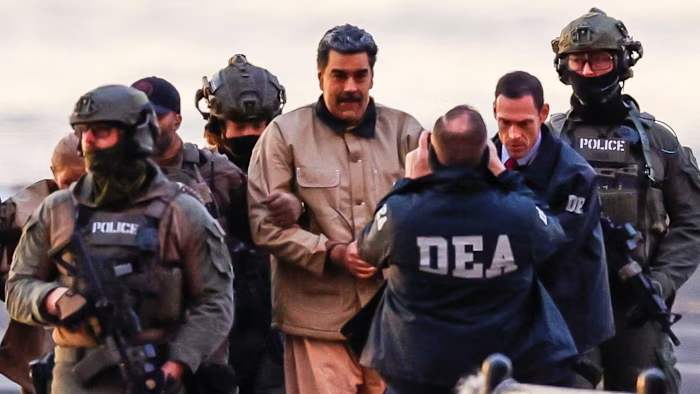
Venezuela’s ousted strongman Nicolas Maduro faces widespread drug trafficking charges, but analysts say US prosecutors will need to focus on proving he brought in weapons, drugs and laundered money to convict him.
US President Donald Trump has portrayed Maduro as the head of the so-called “Cartel of the Sons”, who were seized by US forces in a pre-dawn raid on his compound at a military base in Caracas on Saturday. In a New York court on Monday, he pleaded not guilty to four charges of narco-terrorism, conspiracy to import cocaine and weapons possession.
The indictment alleges Maduro distributed diplomatic passports to drug traffickers, met with guerrillas at the Miraflores presidential palace and discussed drug trafficking routes with top officials after a major bust of cocaine shipped to Paris on a commercial plane from Venezuela.
“We can talk about the legality of his arrest, but the charges seem pretty solid,” said Adam Isaacson of the think-tank’s Washington office on Latin America. “Nothing really strains credibility for me.”
A former U.S. Drug Enforcement Administration official said that such drug conspiracy cases can make it “much easier to obtain a conviction.”
But the Trump administration’s case will still depend on demonstrating to the court that Venezuela and Maduro pose a significant drug trafficking threat to the US – allegations Maduro denies.
Brian Naranjo, a former senior US diplomat who was expelled from Venezuela by Maduro’s regime, said prosecutors would need to avoid Trump’s “increasing rhetoric of being a drug kingpin” and focus on proving allegations that Maduro “actually had a hand in bringing in drugs, carrying weapons or laundering money”.
The main sources of illegal drugs entering the US are Mexico for the synthetic opioid fentanyl and Colombia for cocaine. Despite being an important transit country for Colombian cocaine, Venezuela is not known for producing or shipping fentanyl.
In the indictment, the US alleged that “between 200 and 250 tons of cocaine were trafficked annually through Venezuela” in and around 2020. By comparison, Colombia’s total cocaine production was estimated to be 2,660 tonnes in 2023, according to the United Nations Office on Drugs and Crime (UNODC).
Former US officials say what distinguishes Venezuela is the degree of state control and involvement in the drug trade.
US authorities began legal action against top members of the Venezuelan military in 2011. Hugo “El Polo” Carvajal, a former head of Caracas’ military intelligence, was convicted in New York of conspiring with Colombian Marxist guerrillas to ship 5.6 tons of cocaine from Venezuela to Mexico so it could be distributed in the US. Carvajal later pleaded guilty and is awaiting sentencing.

in Monday indictment – brought an update on the allegations in 2020 – The US alleged that Maduro “abused” his public roles for more than 25 years and “partnered with his co-conspirators to use his illegally obtained authority to transport thousands of tons of cocaine into the United States”.
The Trump administration says Maduro is the leader of the “Cartel de los Soles” or Cartel of the Sons, which Washington in November designated a foreign terrorist organization responsible for “violence in our hemisphere” and drug trafficking to the US and Europe.
The name is believed to have been coined by journalists in the early 2000s to reflect the small yellow sun that senior Venezuelan military officers wear to denote rank. It is widely considered to be a state-embedded drug trafficking operation focusing on the military rather than traditionally structured cartels.
“The real, fundamental problem that U.S. prosecutors are facing here is this: Does the Cartel de los Soles really exist?” Naranjo said.
Yet most experts agree that cocaine production and trafficking has benefited Maduro’s regime.
The indictment included specific allegations – such as that between 2006 and 2008, while serving as Foreign Minister, Maduro sold Venezuelan diplomatic passports to people he knew were drug traffickers to help them transfer drug proceeds from Mexico to Venezuela under diplomatic cover.
“When drug traffickers needed to move drug money from Mexico back to Venezuela… (Maduro) telephoned the Venezuelan Embassy in Mexico to advise them that a diplomatic mission would arrive by private plane,” the indictment says.
The US also alleges that Maduro called a high-level meeting to discuss drug trafficking routes following the seizure of 1.3 tonnes of cocaine from a commercial flight at Paris’s Charles de Gaulle airport a few months after assuming the presidency in 2013.
The indictment says Maduro had since 1999 “partnered with narco-terrorists” from Colombia’s FARC and ELN guerrilla groups, as well as Mexico’s Sinaloa and Los Zetas cartels and Tren de Aragua, a gang that Trump has also designated a foreign terrorist organization. It said Venezuela had become “a safe haven for drug traffickers willing to pay for protection.”
Maduro also reportedly called top-level meetings to discuss drug transit routes and used armed military escort to smuggle cocaine seized by Venezuelan law enforcement.

Relatives of the former leader have been cited as telling the US Drug Enforcement Administration about alleged cocaine shipments of several hundred kilos from Maduro’s presidential hangar at Caracas’s Macquetia Airport, secret airstrips being used and drug transshipments being made through Honduras, Guatemala and Mexico.
“There are a lot of allegations in it (the indictment),” said Carl Tobias, a law professor at the University of Richmond in Virginia. “But whether they can be proven and who the witnesses will be – all this is really not very clear.”
In August, Trump doubled the reward for information leading to Maduro’s arrest and conviction to $50 million. In January last year, former President Joe Biden’s administration increased the reward to $25 million from an initial $15 million awarded in Trump’s first term, following cross-party consensus that Maduro was involved in drug trafficking.
The case is being heard by Senior Judge Alvin Hellerstein, 92, who was appointed by former President Bill Clinton. Maduro told the court that he had been kidnapped.
“I’m not guilty,” he said. “I’m a decent man.”
