
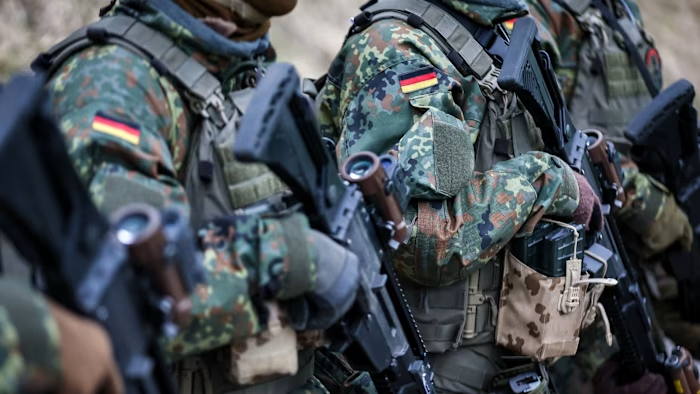
The German armed forces have been embroiled in a scandal over sexual harassment, far-right extremism and drug use in an elite regiment, threatening to undermine efforts to strengthen the army and boost recruitment.
Government prosecutors are investigating more than a dozen charges against soldiers from the 26th Parachute Regiment, an airborne division of the army based in the city of Zweibrücken in the southwestern state of Rhineland-Palatinate.
The investigation has examined allegations of soldiers from the elite unit wearing Nazi-style uniforms and using drugs.
Defense Minister Boris Pistorius has said he is “appalled” by the revelations, saying the revelations are completely contrary to the “core values of the Bundeswehr”, the German armed forces.
But they have cast doubt on the launch this month of a new scheme aimed at attracting 18-year-olds to a new form of voluntary military service, as Germany seeks to strengthen its armed forces amid fears of Russian aggression.
The scandal has raised questions about the culture in the army at a time when it is seeking a bigger role domestically and internationally, with Chancellor Friedrich Merz promising to make the Bundeswehr the strongest conventional army in Europe.
Agnieszka Brugger, a Green parliamentarian who sits on the Bundestag’s defense committee, warned that the allegations tarnished not only a unit but “the important service performed by so many soldiers”.
He said: “This represents a major problem at a critical moment, when the Bundeswehr and our politicians need to recruit the most capable people for military service.”
The 26th Parachute Regiment is one of the most elite units of the German Armed Forces. Composed of approximately 1,700 soldiers, it has been called upon for overseas deployments and war zone evacuations in countries such as Afghanistan, Mali and Sudan.
The allegations first became public in October when a local newspaper received an anonymous tip that some soldiers of the regiment were being investigated for saluting Hitler and photographing male and female colleagues in the shower, as well as for drug use and wearing Nazi-style uniforms.
The Army later confirmed that it was quietly investigating the matter in June this year after receiving complaints from female paratroopers, who constitute about 5 per cent of the regiment.
It also emerged that the unit’s commander, Colonel Oliver Henkel, had been removed from his post. A local broadcaster who obtained a copy of Henkel’s departure speech said he denied that his job change had any connection to the allegations and said: “My conscience is clear and I am confident that in the end truth and justice will prevail.”
Since then the series of allegations has intensified.
Frankfurter Allgemeine Zeitung published a long and scathing exposé last week, citing army insiders, saying that there was a “far-right, openly anti-Semitic faction” in Zweibrücken that used insults such as “Jewish pig”. Women faced obscene jokes and rape threats, and male colleagues were subjected to exposure of their genitals.
Three-star General Harald Gante told the newspaper that he was “practically speechless” when he learned what was happening at Zweibrücken. “Not just about the incidents, but also about how to deal with them.”
Gante said good conduct and an embrace of democratic values is what “sets the Bundeswehr apart from Russian troops”, a warning that came just days before Merz promised that German troops would play a role in securing any future ceasefire in Ukraine.
On Thursday, news magazine Der Spiegel reported further allegations, claiming that a company commander pointed a partially loaded pistol at the faces of two soldiers. It said another soldier required surgery after suffering “repeated blows to the genital area and head” at the hands of his trainers.
As the scale of the allegations became clear, Defense Minister Pistorius has been criticized by some members of the Bundestag and the German press for waiting until December to speak publicly about it.
In total, the Bundeswehr has investigated a total of 55 suspects, an army spokesman told the FT. Three soldiers have already been dismissed and another 19 are facing dismissal proceedings. Sixteen cases have been referred to government prosecutors for criminal investigation, mostly related to drug crimes but also related to the use of hate and banned extremist symbols.
The Army has also launched the “Airborne Forces Action Plan” aimed at promoting better leadership and clear education about values in the armed forces.
“Violence, sexism and extremism have no place in our Bundeswehr,” the spokesman said. “We expect our military and civilian personnel to actively stand up for and defend the free democratic fundamentals. Where this is not the case, we act decisively.”
This episode is not the first such scandal to surface in the Bundeswehr.
In 2020, the Defense Ministry disbanded an entire elite special forces unit, warning that its “toxic leadership” had “developed and promoted extremist tendencies”.
In 2022, a former soldier posing as a Syrian refugee was sentenced to more than five years in prison for plotting to assassinate politicians.
Parliamentarian Thomas Rovekamp, who heads the defense committee, said in an interview with public broadcaster Deutschlandfunk that the allegations were “horrible” and “unacceptable”. But he also stressed that they were not representative of Germany’s 180,000 troops.
A study published last year by the Army’s own Center of Military History and Social Sciences found that only 0.4 percent of soldiers displayed right-wing extremist attitudes — lower than the more than 5 percent rate that the authors applied to the general population.
