
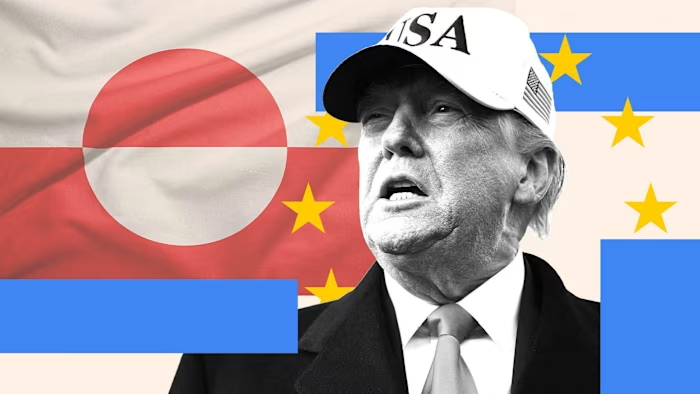
EU capitals are considering imposing €93bn worth of tariffs on the US or banning US companies from the bloc’s market in response to Donald Trump’s threats to NATO allies who oppose his campaign to annex Greenland. The move marks the most serious crisis in transatlantic relations in decades.
Officials involved in the preparations said the retaliatory measures were being prepared to give European leaders leverage in crucial meetings with the US president at the World Economic Forum in Davos this week.
They are trying to find an agreement that would avoid a deep breakdown in the Western military alliance, which would pose an existential threat to Europe’s security.
The tariff list was prepared last year but was suspended till February 6 to avoid a full-fledged trade war. The EU’s 27 ambassadors on Sunday discussed its reactivation of the so-called anti-coercion instrument (ACI), which could limit US companies’ access to the internal market, as the bloc wrestled with how to respond to the US president’s threat with punitive tariffs.
Trump, who has asked Denmark for permission to take control of Greenland, vowed on Saturday evening to impose 10 percent tariffs by Feb. 1 on goods from the U.K., Norway and the six European Union countries that sent troops to the Arctic island for military exercises this week.
“There are clear means of retaliation if this continues… (Trump’s) using pure mafia methods,” said a European diplomat briefed on the discussions. “At the same time we want to publicly call for calm and give him a chance to climb down the ladder.”
He added, “The message is… the carrot and the stick.”
France has called on the bloc to strike back on the ACI, which has never been used since its adoption in 2023. The instrument includes investment restrictions and could reduce exports of services provided by US Big Tech companies to the EU.
A French ministry aide said Paris and Berlin were coordinating a joint response, with their respective finance ministers meeting in Berlin on Monday before traveling to Brussels with their European counterparts. “This issue will also have to be discussed with all G7 partners under the French presidency,” the person said.
While several other EU member states have expressed support for exploring how ACI could be deployed against the US, the majority called for talks with Trump before issuing direct threats of retaliation, diplomats briefed on the discussions told the FT.
“We need to lower the temperature,” said a second EU diplomat.
In a move toward retaliation, the largest parties in the European Parliament this weekend said they would delay a planned vote on measures that would have reduced EU tariffs on US goods as part of a trade deal struck last year.
Trump, who will be at the Swiss Forum on Wednesday and Thursday, is set to hold private talks with European leaders, including European Commission President Ursula von der Leyen, in addition to taking part in broader discussions among Western countries that support Ukraine.
Danish Prime Minister Mette Frederiksen said, “We want to cooperate, and it is not us who want conflict.”
National security advisers of Western countries will meet in Davos on Monday afternoon. The talks initially focused on Ukraine and ongoing peace talks to end Russia’s invasion of the country, but have been changed to allow time to discuss the crisis over Greenland, two officials briefed on the preparations said.
The Swiss Foreign Ministry, which is hosting the gathering, said it would “not comment on the participants or the topics”.
Trump’s threats “certainly warrant ACI because it would be textbook coercion,” a third European official said.
“But we need to use the time until February 1 to see if Trump is interested in an off-ramp,” he said, adding that much would depend on the outcome of the talks in Davos.
European officials said they hoped their threats of retaliation would increase bipartisan pressure in the US against Trump’s actions and result in him walking back his tariff promises.
A fourth European official said, “It is already a situation that no agreement is allowed anymore, because we cannot hand over Greenland.” “Reasonable Americans also know that they have just opened Pandora’s Box.”
But on Sunday US Treasury Secretary Scott Besant said Europe was too weak to guarantee Greenland’s security and refused to back down from US demands to take control of the strategically important island.
“The President believes that increased security is not possible without Greenland becoming part of the United States,” he told NBC News.
EU leaders are preparing for an emergency meeting on Thursday to discuss the crisis, according to an official briefed on the plans.
European Council President Antonio Costa, who organizes such summits, said on Sunday evening: “Given the importance of recent developments and for further coordination, I have decided to convene an extraordinary meeting of the European Council in the coming days.
The EU is “ready to defend itself against any form of coercion,” Costa said.
Additional reporting by Barbara Moens, Alice Hancock, Andy Bounds and Laura Dubois in Brussels, Sarah White in Paris, Laura Pittel in Berlin and Richard Milne in Oslo.
