
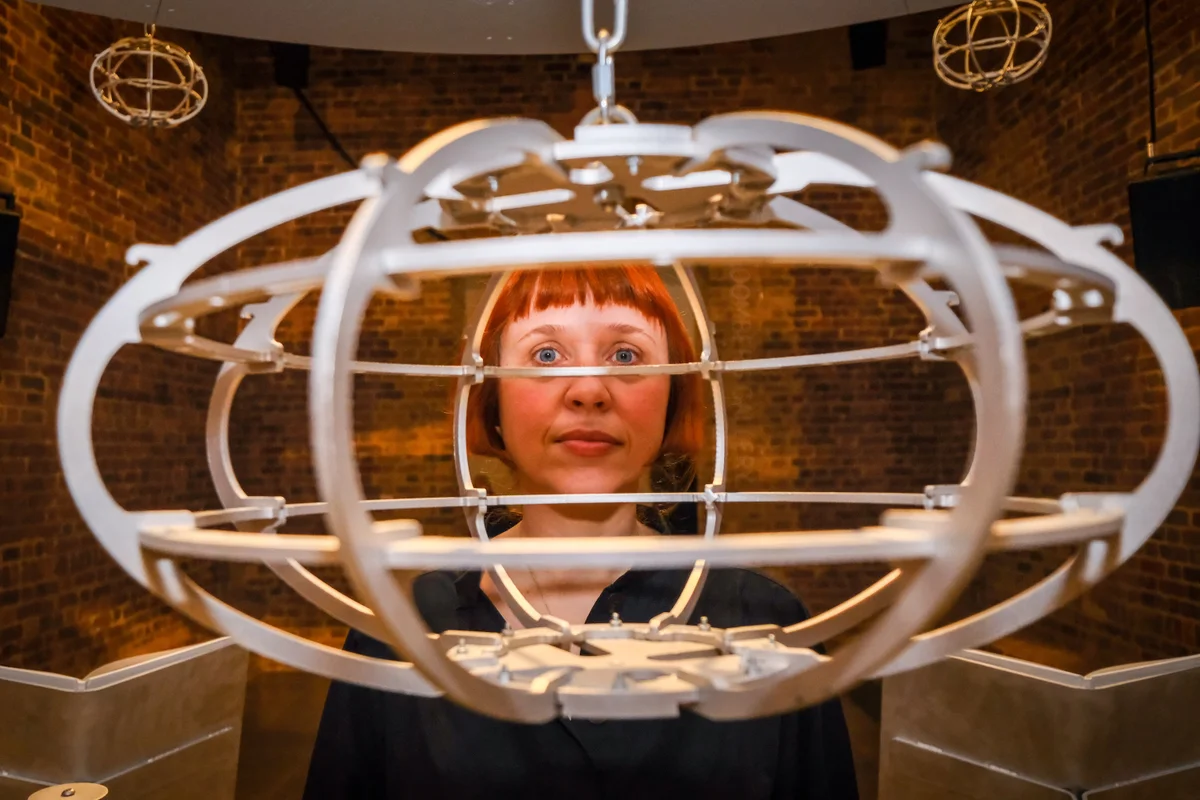
The experimental composer Holly Herndon has spent years arguing that artificial intelligence belongs in the studio not as a replacement for musicians but as a new kind of collaborator. Her best-known demonstration of that idea is Holly+, an AI voice clone of her own singing that she has made freely available, allowing anyone to transform an audio file into a performance rendered in her voice.
Holly Herndon at the Serpentine North Gallery in London in October 2024.
Matthew Chattel/Future Publishing via Getty Images
An instrument made from a voice
Herndon came to electronic music after singing in churches and choirs in East Tennessee, later earning a master’s degree from Mills College and a doctorate from Stanford University. Holly+ grew out of that background and out of years of machine-learning experiments. Built in collaboration with the audio research company Voctro Labs, the tool lets users upload audio and receive a version sung in Herndon’s voice, which can then be downloaded and re-edited. Rather than treating the clone as a threat to her identity as a performer, she has framed it as an instrument others can play.
Sharing the upside
To handle the questions of ownership and revenue that a shared voice inevitably raises, Herndon established the Holly+ DAO, a community organization through which artists who create work with the voice model can submit it for collective review. When a piece is approved and minted, proceeds are split among Herndon, the creating artist, and members of the organization. The structure is an attempt to answer a problem that mainstream voice-cloning tools have largely left open: who is compensated when a recognisable voice becomes a public instrument.
Building her own data
A defining feature of Herndon’s practice is that she trains her own models rather than relying on systems built from material scraped broadly across the internet. She has described composing music specifically for machines to learn from — material intended for a model rather than the human ear. One recent project drew on the medieval composer Hildegard von Bingen, generating polyphony in a comparable style and then handing those outputs to human singers to interpret within a large public installation. The emphasis throughout is on using the technology to bring people together in physical space rather than to automate songwriting.
Why it matters
Herndon’s work is often cited in debates over voice deepfakes and artists’ rights because it models a consent-based, revenue-sharing alternative to scraping and imitation. It does not resolve the wider legal questions around synthetic voices, but it offers a concrete example of an artist setting the terms for how a digital likeness is used.
Limitations and what to watch
Holly+ reflects one artist’s deliberately non-commercial approach, and its DAO-and-NFT model is experimental rather than a proven template for the music industry. The harder, unsettled issues — how to protect performers whose voices are cloned without permission, and how rights and royalties should work at scale — remain open across the sector. Herndon’s project is best read as a thoughtful prototype of consent-first voice AI rather than a finished solution.
This account draws on reporting by Scientific American and earlier coverage from NPR. For related themes, see this site’s coverage of how people adopt AI tools.
