
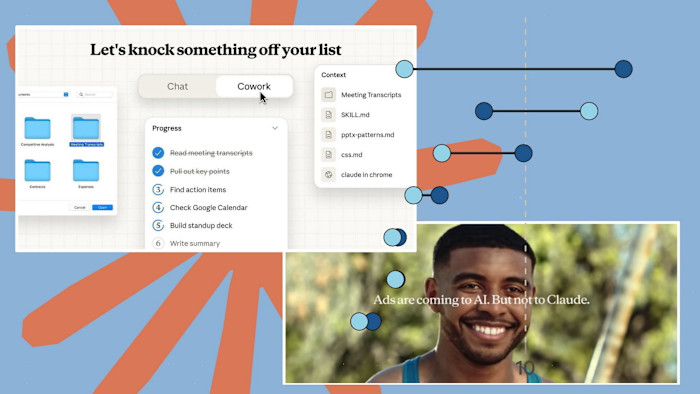
Anthropic had a breakout week in early February 2026, as investors bet that the start-up has cornered the market for selling AI to businesses — a segment now generating enormous revenue expectations across the industry. The AI lab has long kept a lower profile than OpenAI, Google, and Meta, which built consumer-facing products while Anthropic sold its models as tools for developers and companies. That strategy snapped into focus when a run of enterprise product releases rattled public markets, and a set of pointed Super Bowl ads drew a sharp response from OpenAI chief executive Sam Altman.
The five-year-old San Francisco company was, at the time, finalizing a funding round of roughly $30–35 billion at a valuation around $350 billion, while moving toward a possible blockbuster initial public offering. Its annual revenue trajectory explains the appetite: from roughly $1 billion at the start of 2025 to more than $9 billion by year-end, with guidance — according to people familiar with its finances cited by the Financial Times — that annualized revenue would exceed $30 billion by the end of 2026. A dozen investors told the FT they viewed Anthropic’s enterprise focus, product discipline, and stable leadership as a safer long-term bet than OpenAI. The sentiment, as one put it, has moved toward the idea that the enterprise is where AI actually gets paid.
From Safety Lab to Enterprise Powerhouse
Anthropic was founded in 2021 by a group of former OpenAI researchers, including siblings Dario and Daniela Amodei, its chief executive and president. Since then it has cultivated a deliberate, safety-oriented image, reinforced by lengthy essays from its CEO on the risks of uncontrolled AI.
Its Claude Code tool for software engineering became an industry leader within a year of launch. The system reads a company’s existing codebase, plans tasks, and executes them — an early demonstration of the “agentic” capabilities investors expect to open massive new markets as models learn to complete complex work independently. The tool captivated developers and spawned the term “Claude benders” for marathon sessions spent building websites or apps with it.

Matt Murphy, a partner at Menlo Ventures, which first invested in Anthropic in 2023, told the FT the company had originally built Claude Code for internal use and productized it aggressively once it saw how good it was.
The Bet: Capturing Labor Budgets, Not IT Budgets
Anthropic faces stiff competition in coding tools, and has pushed outward from developers into the broader office: connectors to enterprise applications and databases, and a recent set of plug-in tools for specific industries including law, sales, finance, marketing, and customer support. Goldman Sachs announced it was working with Anthropic on an AI agent to automate roles at the bank.
Those moves helped trigger a market selloff that wiped billions from stocks in data services, enterprise software, advertising, and publishing. The thesis investors describe is blunt: AI is not traditional enterprise software competing for the IT budget — it captures labor expense by taking over human workflows end to end, as Lightspeed partner Sebastian Duesterhoft put it. Lightspeed’s $1 billion investment in Anthropic was the firm’s largest ever; Sequoia Capital, Altimeter Capital, and Baillie Gifford backed the same thesis. An investment manager at Baillie Gifford described the market’s reaction as “a moment of realization” that increasing intelligence unlocks market share.

To press its advantage, Anthropic released a powerful new model that week — Claude Opus 4.6 — alongside techniques for training models and managing their interactions with enterprise applications.
Culture, Stability — and a Food Fight
Investors repeatedly credited Anthropic’s mission-driven culture with attracting and retaining talent in the industry’s fiercest hiring market. The stability is measurable: all seven Anthropic co-founders remain at the company, whereas eight of OpenAI’s eleven founders have departed since 2015 — and Altman himself was briefly ousted by OpenAI’s board in 2023.

The same week, Anthropic publicly pledged not to introduce advertising into its products — a pointed contrast with OpenAI, which had begun testing ads in ChatGPT. Anthropic broadcast the decision in a series of satirical Super Bowl commercials set to a Dr. Dre track, with the tagline that ads are coming to AI, but not to Claude. Daniela Amodei maintained the ads were not aimed at any particular company; Altman, on X and in podcast interviews, called them dishonest and dismissed the war of words, arguing the models’ capabilities matter more than a “food fight” between companies. According to CNBC, the campaign coincided with a measurable jump in Claude usage.
Limitations and What to Watch
This account draws on Financial Times reporting and its investor sources, several of whom hold stakes in Anthropic — their assessments are informed but not disinterested. Private-market figures are fluid: reported terms of the funding round varied across outlets at the time, and subsequent reporting and company announcements have described later rounds at substantially higher valuations, so any specific number dates quickly. Revenue guidance is a company projection, not an audited result. The larger questions the episode raised remain open: whether labor-capturing AI agents deliver enough verified value to justify the valuations, how incumbent software vendors respond, and whether the enterprise-first strategy survives the consumer giants’ inevitable push into the same territory. For the small-business angle on the same shift, see this related piece on what cheaper AI agents mean for small businesses.
