
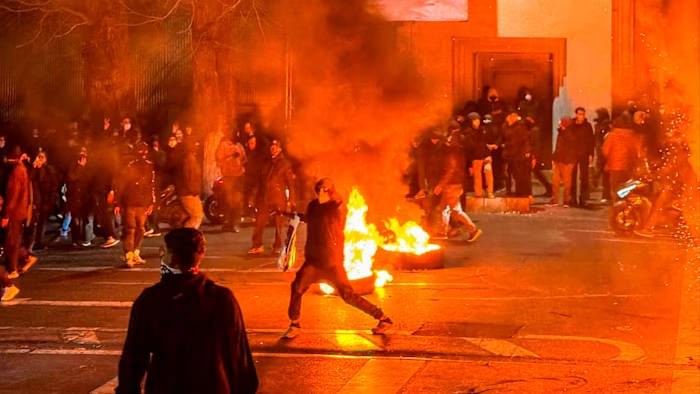
Last month, as traders in central Tehran and the historic Grand Bazaar closed their shops in protest at high prices, Iranian President Massoud Pezeshkian underlined the depth of his dilemma in managing the Islamic republic’s economic malaise.
Pezeshkian told parliament, “I am told that salaries are low; that is true. I am told that taxes are high; that is also true. But then I am told to raise salaries.” “Can anyone tell me where the money should come from? We are struggling to secure foreign exchange to cover people’s livelihoods, animal feed and basic commodities.”
In the weeks that followed, protests over economic grievances escalated into nationwide civil unrest that poses the greatest threat to the Islamic republic in years. Activist groups say hundreds of people have been killed and thousands detained as the regime escalates its crackdown.
Analysts say the crisis highlights how theocratic rule has been weakened by a toxic combination of decades of US sanctions, internal mismanagement and corruption.
Sanam Vakil, Middle East director at Chatham House, said, “It is inevitable that these protests will continue to grow and grow, translate this moment – protests are only caused by economic stagnation and political impasse.” “It didn’t need to be so revolutionary. His unwillingness to make concessions and his unwillingness to reform economically and politically have made it worse.”
Pezeshkian is not the first Iranian president to face such a crisis. Iran’s economy has been strangled by increasingly stringent Western sanctions since 2012, when then-US President Barack Obama stepped up pressure on Tehran over its nuclear program and convinced the European Union to do the same.
That year, Iran was cut off from the SWIFT global payments system. The rial devalued, inflation soared, investment declined and Iranians felt worse off – the same ills that have helped fuel the past two weeks of protests.
Esfandyar Batmanghelidj, chief executive of the Bourse and Markets Foundation think-tank, said 2012 was the year that pushed Iran, a country of 90 million people, into significant contraction for the first time since the early 1990s. Since then, “the growth rate has been basically half what it was up to that point”.
Between 2000 and 2012, the economy grew an average of 4.4 percent each year. He said that in the years that followed, the average growth slowed down to only 1.9 percent.
Batmanghelidj said the current fight for civil liberties and political change would have been “very different” if the country had followed its pre-sanctions economic trajectory.

A brief reprieve came in 2015 after Iran signed a nuclear deal with the Obama administration and other world powers, allowing relief from sweeping sanctions in exchange for tighter restrictions on nuclear activity.
Growth accelerated with promises of US and European investment into the country and the end of sanctions on oil exports, a major source of foreign currency, and inflation dropped below 7 percent, the lowest rate in decades.
Oil exports increased to a peak of 2.8 million barrels per day in May 2018.
But the relief was fleeting. US President Donald Trump, in his first term, withdrew from the nuclear deal the same month and began imposing hundreds of new sanctions on Iran.
With the threat of secondary sanctions, international trade crashed out, Iran was once again cut off from SWIFT and its oil exports fell by 300,000 b/d in 2019.

Growth declined sharply, the rial depreciated, and inflation once again soared to 40 percent. Trump also seized billions of dollars of Iran’s oil held in central banks abroad, cutting off an important source of foreign currency.
Batmanghelidj says the country has fallen into an “almost permanent state” of “economic pessimism”, characterized by “negative perceptions about current conditions, and most importantly, a deeply negative view about the future”.
Even when the nuclear deal was going on, there was “no movement on the negative sentiment on the economy”, he said.
“That pessimism then turns into political frustration as people come to perceive that the government is unable to protect or improve their well-being.”

Frustration erupted into street protests in 2017 and again in 2019 after the government of nuclear deal architect Hassan Rouhani raised the price of subsidized petrol by 50 percent.
Javad Salehi-Esfahani, an Iranian-born economist at Virginia Tech, said the collapse of the nuclear deal and its economic impact “destroyed the momentum of rapprochement inside Iran” with the West.
“Iranians started thinking that they could sell a lot of goods not only across borders, but around the world,” he said. “So there was a lot of hope. The loss of that hope had a big impact.”
Salehi-Isfahani said successive governments accused of mismanaging the economy had been “too reactive” in trying to deal with economic pressures. Analysts say they are also hindered by powerful interest groups that oppose the reforms.
Furthermore, there are competing power centers within the regime, with the ultimate decision-maker being Supreme Leader Ayatollah Ali Khamenei, 86, who has led the republic since 1989.
“When things reach crisis point they are reacting and trying to adjust economic policy,” Salehi-Isfahani said. The central bank often delayed action until “it became too difficult to defend the currency and too likely to devalue rapidly”.

The government’s tools to boost growth and revenue include increasing oil exports and exporting non-oil goods, but both are bound by sanctions. Oil exports reached 1.9 million b/d in December, according to the International Energy Agency, with production held steady at 3.5 million b/d, but US sanctions forced Iran to sell at a discount.
“Iran’s economy is very diverse. It resembles Türkiye’s economy, with one difference,” Salehi-Isfahani said. “Turks can use labor and human capital to produce things and sell them abroad. Iranians can’t do that.”
Yet during years of sanctions, Iranians have not suffered domestic shortages of any goods, except for a few specialist medicines like cancer treatments – for which Tehran blames US sanctions – even as the cost-of-living crisis has deepened.
“Most Iranians continue to make ends meet, it’s very difficult for them to do so, but we are not in a country like Venezuela or Syria, where there has been complete economic collapse,” Batmanghelidj said. “The main issue is affordability, not availability.”
Although some families “have fallen below the poverty line and are facing greater food insecurity, for most Iranians, it is about their relative well-being, where they think they should be versus where they are today”, he said.
For Iran’s largely young urban population, the wide gap between their aspirations and daily life under a repressive regime is fueling disillusionment and anger, analysts say.
According to Salehi-Isfahani, in the seven months since Israel launched a 12-day war against Iran in June, the rial has lost 40 percent of its value.
Annual inflation reached 42 percent in December, while food inflation rose to 72 percent, with the price of bread rising by 113 percent. Price increases have a more severe impact on poorer provincial areas where unrest is widespread.
As the protests began, Pezeshkian was presenting his budget for the year starting at the end of March, under which state workers would face large real pay cuts and overall spending would rise below inflation.
He also overhauled a highly criticized subsidy, ending a long-standing policy of providing cheap foreign exchange to importers that was widely blamed for corruption and distorted markets.
Instead, he expanded an existing scheme of cash transfers to households, providing monthly transfers of 10 million rials per person to 88 million Iranians, which is equivalent to $7, or $40 adjusted for local prices, according to Salehi-Isfahani.
Prices kept increasing.
Salehi-Isfahani said one of the government’s failures was to effectively deal with its huge fuel subsidy bill, which creates an opportunity cost of about $70 billion.
The currency and inflation turmoil was “a bit like a car heading towards a wall and eventually hitting it”, he said. “If you look at the way inflation was rising, it was bound to get into this kind of crisis.”
He partly blamed Israel’s wartime influence, but suspected it could also be due to Tehran spending money on rearmament under the threat of new Israeli or US attacks.
“They think they have to pay for mismanagement, pay for war damages, or stop the threat of another attack,” Salehi-Isfahani said. “They correctly saw that their real incomes were at risk. These are real incomes that were expected to grow over generations and have been stable for 15 years.”
Additional reporting by Malcolm Moore
