
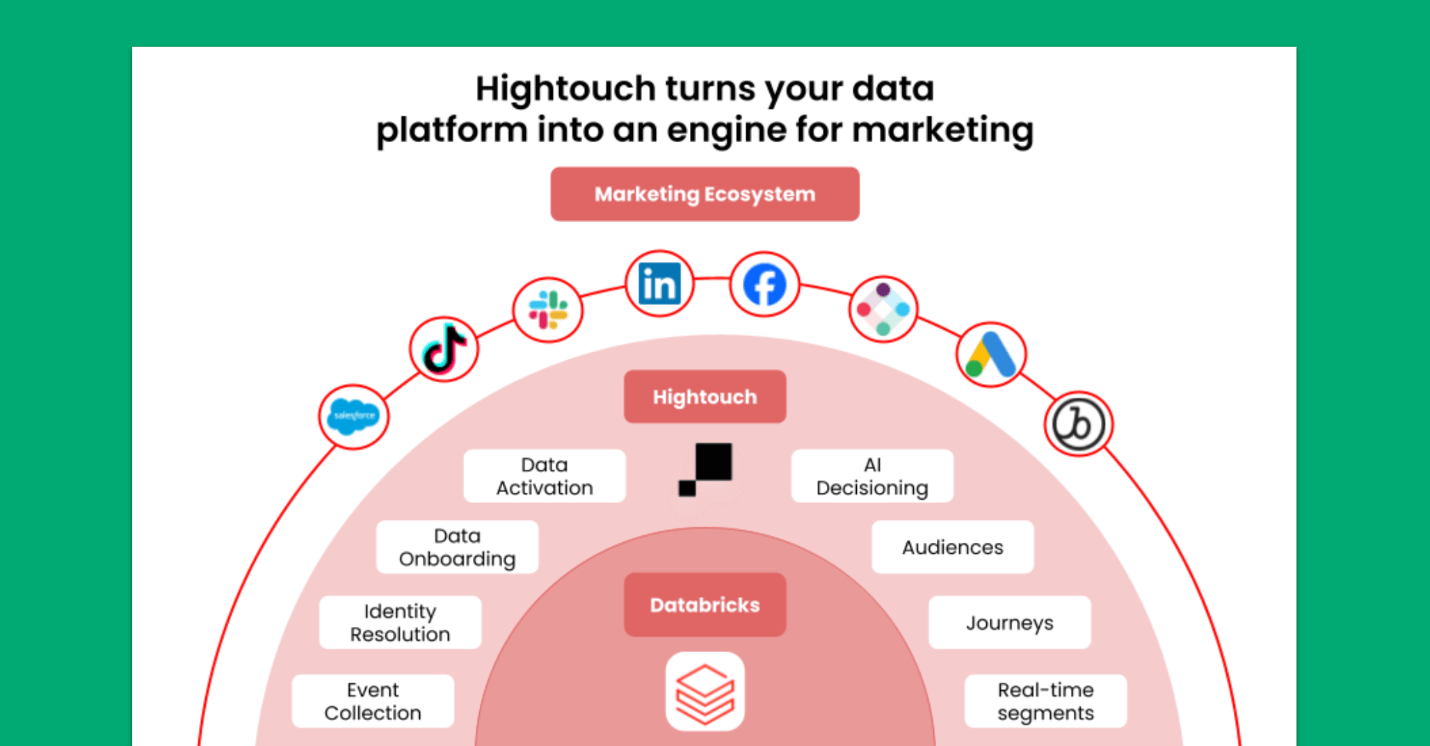
Whether an organization provides healthcare directly or supports patients and providers across the wider medical and insurance ecosystem, the rapid expansion of patient data — and of AI technologies that can act on it — creates an unprecedented opportunity to serve patients better and improve outcomes. This article explains how a composable customer data platform (CDP) built on Databricks supports “next best action” patient engagement, what it enables in practice, and where the approach has limits.
Why Data-Driven Patient Journeys Are Both Difficult and Important
Healthcare outreach sits between two competing pressures. On one side are the regulatory obligations attached to protected health information (PHI): HIPAA compliance, business associate agreements (BAAs) with every technology vendor that touches patient data, and strict controls on who can see what. On the other side are the practical challenges of reaching the right members with the right message at the right time across fragmented systems.
Unlike marketing in most industries, healthcare outreach is not primarily about selling a product. A well-timed reminder can change whether a patient completes a cancer screening, refills a prescription, or attends a post-surgical follow-up. That same engagement helps health plans and providers improve the quality metrics on which they are measured and paid, such as HEDIS, Medicare Star Ratings, and eCQMs. The difficulty is operational: no single platform handles every permutation of outreach, so non-technical teams end up coordinating campaigns across multiple disconnected systems, each with its own copy of patient data.
How a Composable CDP Works in Healthcare
A conventional CDP imports customer data into a vendor’s own cloud — creating another copy of PHI, another BAA, and another security review. A composable CDP inverts that model: it operates directly on the organization’s existing data platform, activating data where it already lives rather than moving it. In plain terms, the data warehouse remains the single source of truth, and the CDP becomes a controlled window onto it.
For many healthcare organizations that data platform is Databricks. Built on lakehouse architecture, it combines traditional warehouse and business intelligence capabilities with machine learning and real-time processing. Data stays inside the organization’s own cloud tenant, governance is enforced through enterprise security groups, and capabilities such as dynamic row- and column-level masking let teams work from one source of truth while shielding sensitive PHI and PII from anyone without a need to see it. Vendors such as Hightouch layer the activation tooling on top of this foundation, as described in the original Databricks engineering blog on which this article is based.
What Each Team Can Do With It
Once the data foundation is secured with role-based access, the composable CDP gives different teams self-service capabilities that previously required engineering support:
- Data teams define the segments and triggers — for example, members overdue for an annual physical or a recommended screening.
- Lifecycle teams initiate communications across email, phone calls, and text messages based on those triggers.
- Paid media teams sync audiences to advertising platforms to launch campaigns — or suppress ads to members for whom they are no longer relevant.
- Digital teams personalize websites and mobile apps in real time, showing each visitor relevant messages and offers.
Most importantly, these teams can build a single journey that spans all of those channels, so a member receives one coherent experience rather than four disconnected campaigns. Campaign results flow back into the same platform for analysis, closing the loop between action and measurement.
Where AI Fits — and Why Guardrails Matter More in Healthcare
AI can accelerate each of these workflows: analyzing data, suggesting segments, drafting journeys, and making per-member decisions about which message to send next. Agent-based marketing platforms now let outreach teams build these flows through natural-language workflows rather than SQL.
In healthcare, however, control matters more than speed. A poorly governed AI message in retail produces an irrelevant coupon; in healthcare it can produce misinformation with real consequences for a patient’s wellbeing. Any AI-assisted engagement program needs human review of message content, constrained decision spaces (the AI chooses among approved messages rather than composing freely), and audit trails that show why each member received each communication.
Practical Use Cases, From Simple to Complex
Organizations typically start with simple, automated communications that reliably help patients: appointment reminders, medication pickup and refill notifications, and screening checkpoints. These build the data foundation and organizational trust for more complex workflows, such as:
- Chronic condition management — ongoing journeys for conditions such as diabetes or hypertension, adjusted to each member’s health history.
- Program support — sustained engagement for members in a weight-management program, including those on GLP-1 medications.
- Episodes of care — structured communication sequences after surgery, or through pregnancy and maternity care.
- Cost optimization — syncing patient and medication data across operational systems to flag drugs facing formulary exclusion and identify lower-cost alternatives.
These complex journeys are where the composable approach shows its advantage: they demand a high degree of individualization, draw on clinical and operational data simultaneously, and serve patients whose care is most resource-intensive for plans and providers.
Limitations and What to Watch
Several caveats apply. The source material for this architecture comes from the vendors involved, and the pattern’s benefits — speed, consistency, compliance simplification — are easier to claim than to realize; results depend on the quality and completeness of the underlying patient data, which in healthcare is often fragmented across claims, clinical, and engagement systems. A composable CDP reduces data copies but does not by itself confer HIPAA compliance: access policies, BAAs with activation vendors, and consent management still have to be implemented correctly. Engagement metrics can also mislead — opening a reminder is not the same as attending the screening, so programs should be evaluated against clinical follow-through and outcome measures, not click rates. Finally, AI-driven personalization in healthcare is drawing increasing regulatory attention, and outreach programs should be designed to explain their decisions. For the data-engineering foundation this pattern depends on, see this related guide to modern data engineering with Lakeflow on Azure Databricks.
The Bottom Line
Many organizations already connect with patients outside clinical settings. A composable CDP extends those capabilities by letting teams act on centrally governed patient data across every channel — moving faster, personalizing more carefully, and engaging members according to their preferences and history. Done well, the payoff is measured not in campaign metrics but in screenings completed, prescriptions refilled, and conditions managed before they escalate.
