
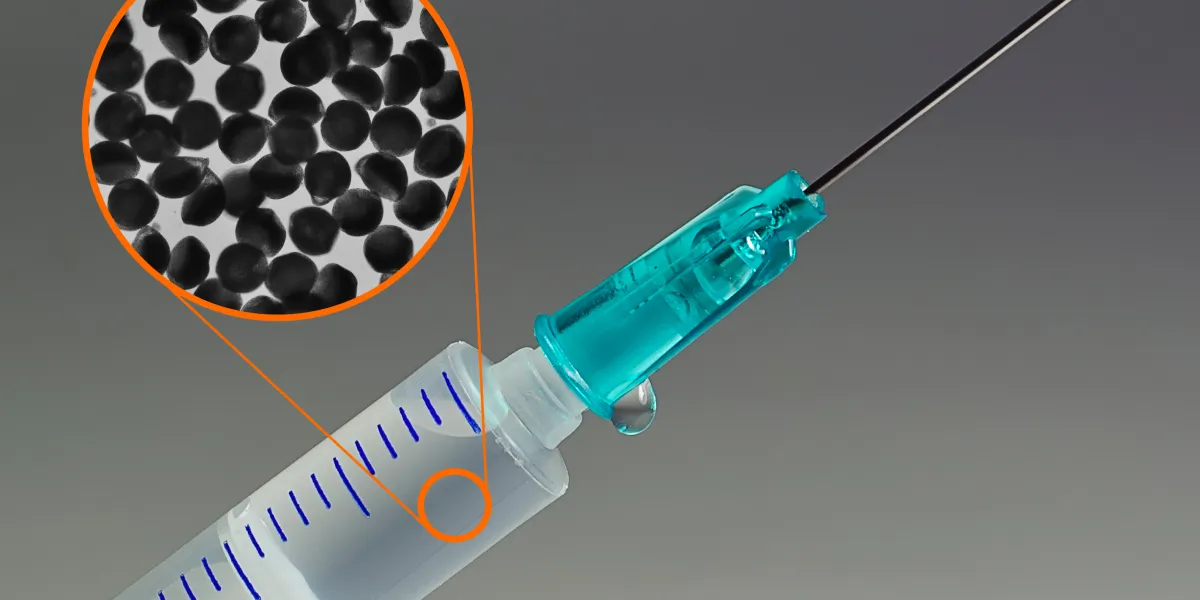
In 2023, Doyle’s laboratory developed a way to generate highly concentrated antibody formulations by encapsulating hydrogel particle. However, this requires centrifugation, a step that would be difficult to scale up for manufacturing.
in their new StudyThe researchers took a different approach that uses a microfluidic setup instead. Droplets containing antibodies dissolved in an aqueous prepolymer solution are suspended in an organic solvent and can then be dehydrated, leaving highly concentrated solid antibodies within the hydrogel matrix. Finally, the solvent is removed and replaced with an aqueous solution.
Using semi-solid particles 100 microns in diameter, the team showed that the force required to push the plunger of a syringe containing the solution was less than 20 newtons. “This is less than half the maximum allowable force that people typically try to aim for,” says MIT graduate student Talia Zheng, lead author of the new study.
More than 700 mg of antibody – enough for most therapeutic applications – can be administered with a two-milliliter syringe at a time. The formulations remained stable under refrigeration for at least four months. The researchers now plan to test the particles in animals and work on scaling up the manufacturing process.
