
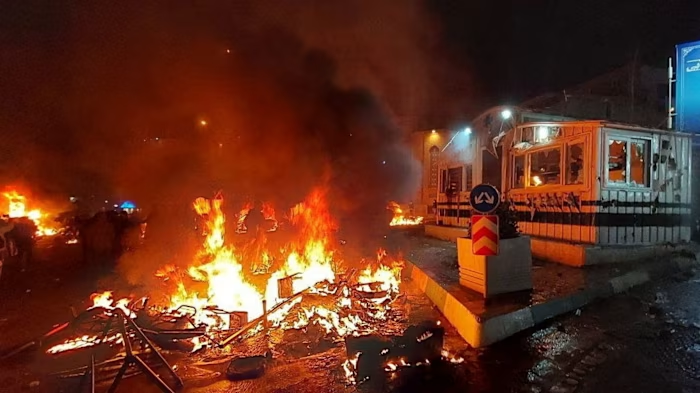
Iran has warned the US not to intervene militarily to support protests spreading across the Islamic republic as President Donald Trump said Washington was “ready to help”.
As two weeks of civil unrest pose the biggest domestic threat to the Islamic regime in years, US media reported that the Trump administration was considering military options in response to the protests. The report said no decision has been taken on intervention. The White House did not respond to a request for comment.
The US president has repeatedly said Washington is ready to come to the “rescue” of Iranians if authorities there kill protesters.
“Iran is looking at freedom, perhaps like never before,” Trump said on social media Saturday. “The United States is ready to help!!!”
Trump’s comments came as the regime stepped up its crackdown and struggled to contain the biggest protests in years amid reports of a rising death toll.
Foreign-based group Human Rights Activist News Agency said the death toll had risen to 116, including security forces, since the protests began in late December. It said more than 2,600 people have been detained.
It was not possible to verify the information. Iran has been cut off from the outside world since Thursday after the regime imposed a near-complete internet blackout and communications shutdown in the republic.
Speaker of Iran’s parliament Mohammad Baqer Ghalibaf, speaking in parliament on Sunday, warned the US against “miscalculations”. Ghalibaf, a former commander of Iran’s Revolutionary Guards, said, “We must be clear: in the event of an attack on Iran, the occupied territories (of Israel) as well as all American bases and ships will be our legitimate targets.”
America has many bases in this region. In June, Tehran fired missiles at a US base in Qatar in revenge for Trump’s decision to bomb the republic’s main nuclear facilities after he briefly joined Israel in its 12-day war against Iran.
Iranian President Massoud Pezeshkian warned the US on Saturday against meddling. Officials have repeatedly accused Washington and Israel of instigating the protests.
During a meeting with the Foreign Minister of Oman he said, “Recognizing that the Islamic Republic of Iran is like other countries, the US is adopting similar measures by encouraging some individuals to create chaos and riots.”
According to state television, he said the Iranian people “will support the country and the (Islamic) establishment more strongly than ever before”.
Oman has already played the role of mediator between America and Iran.

The unrest comes as the Islamic Republic is at its weakest in years as it faces growing internal and domestic pressures and an increasingly frustrated and angry population.
But videos posted online purportedly show protesters taking to the streets to protest government action. Authorities have warned that those detained will be dealt with swiftly and without leniency.
Tehran’s state prosecutor has warned that those who attack public buildings and security forces with weapons will face charges of waging war against God, which can carry the death penalty.
State-affiliated media said hundreds of people have been arrested and dozens of security personnel have been killed in the unrest, which escalated at the start of the Iranian weekend on Thursday.
The governor of Isfahan said on Sunday that 30 security personnel had been killed in that province since the protests began, Iranian state TV reported.
Authorities have accused “armed groups” of “attacking public and private property, causing widespread damage” including mosques in several provinces.
The demonstrations began due to economic grievances as shopkeepers in Tehran closed their shops in protest against rising prices. This has since escalated into nationwide anti-regime protests.
Pezeshkian, who came to power 18 months ago vowing to reform the economy, initially tried to calm the protesters. But as protests have intensified, authorities have stepped up their warnings.
“This is uncharted territory for the Islamic Republic because there is organic, bottom-up pressure on them, sections of society that were historically the backbone of the republic, opposing it, which has now become very large,” said Ellie Geranmayeh at the European Council on Foreign Relations.
“There are no easy answers to this pressure, and on top of that you have top-to-bottom pressure from the United States and Israel.”
The protests represent the most serious domestic threat to the regime since 2022, when Mahsa Amini was arrested for allegedly improperly wearing a hijab and died in custody. According to Amnesty International, more than 300 people were killed in the reaction against those demonstrations.
Iran today is in a weak position economically and militarily as a result of Israel’s disastrous 12-day war against the Islamic Republic in June.
During the conflict, Israeli forces assassinated Iran’s top military commanders and nuclear scientists, destroyed its air defenses and – along with the US – bombed its nuclear facilities.
Iranians rallied around the flag during the Israeli attack, as the foreign attack created a sense of nationalism that left people disillusioned with their leaders. But social and economic grievances are growing as the rial has lost more than 40 percent of its value since the war, leading to rampant inflation.
