

At its core, ML involves algorithms that analyze data, recognize patterns, and make predictions. These models “learn” from past data to improve their performance over time. For example, an ML model trained on user purchase history can predict which products a customer might buy next. Artificial Intelligence (AI) is no longer a futuristic concept. This is a boardroom conversation happening in almost every industry. From e-commerce and finance to healthcare and manufacturing, AI is being woven into many businesses. However, for decision making, two terms often create confusion: Machine Learning (ML) vs. Deep Learning (DL). Both can learn the most from data to help businesses achieve competitive growth. It is about making smart investments in technology that are in line with direct development goals. Let’s look at the difference to know more about it.
What is machine learning?
Machine learning is often described as the “workhorse” of AI. This is the technology that most everyday apps use in businesses. From recommended systems and fraud detection to future analytics in marketing. At its core, ML involves algorithms that analyze data, recognize patterns, and make predictions. These models “learn” from past data to improve their performance over time. For example, an ML model trained on a user’s purchase history can predict which product a customer is likely to purchase.
There are three main types of machine learning:
- supervised learning: Models are trained with labeled data (for example, predicting loan approval based on applicant data).
- unsupervised learning: The system finds hidden patterns in unlabeled data (for example, clustering customers into segments).
- reinforcement learning: The model learns by trial and error, receiving feedback based on its actions (for example, placement strategies).
For businesses, the appeal of ML lies in its ability to simplify decision making and improve efficiency.
What is Deep Learning?
Deep learning is a more advanced form of ML, and has attracted significant attention. It uses an artificial neural network with multiple layers to process data, mimicking the human brain. Unlike ML, which often requires data scientists to manually define features, deep learning automatically extracts these features from raw data. This makes DL especially powerful when working with redundant data such as images, text, and voice. However, deep learning requires massive amounts of data and computational resources. This means that it is not always practical for every business use. But when implemented correctly, its predictive power and automation capabilities are unparalleled.
Key differences to know between Deep Learning vs Machine Learning
Let’s look at the contradictions from a business perspective.
Data and Complexity
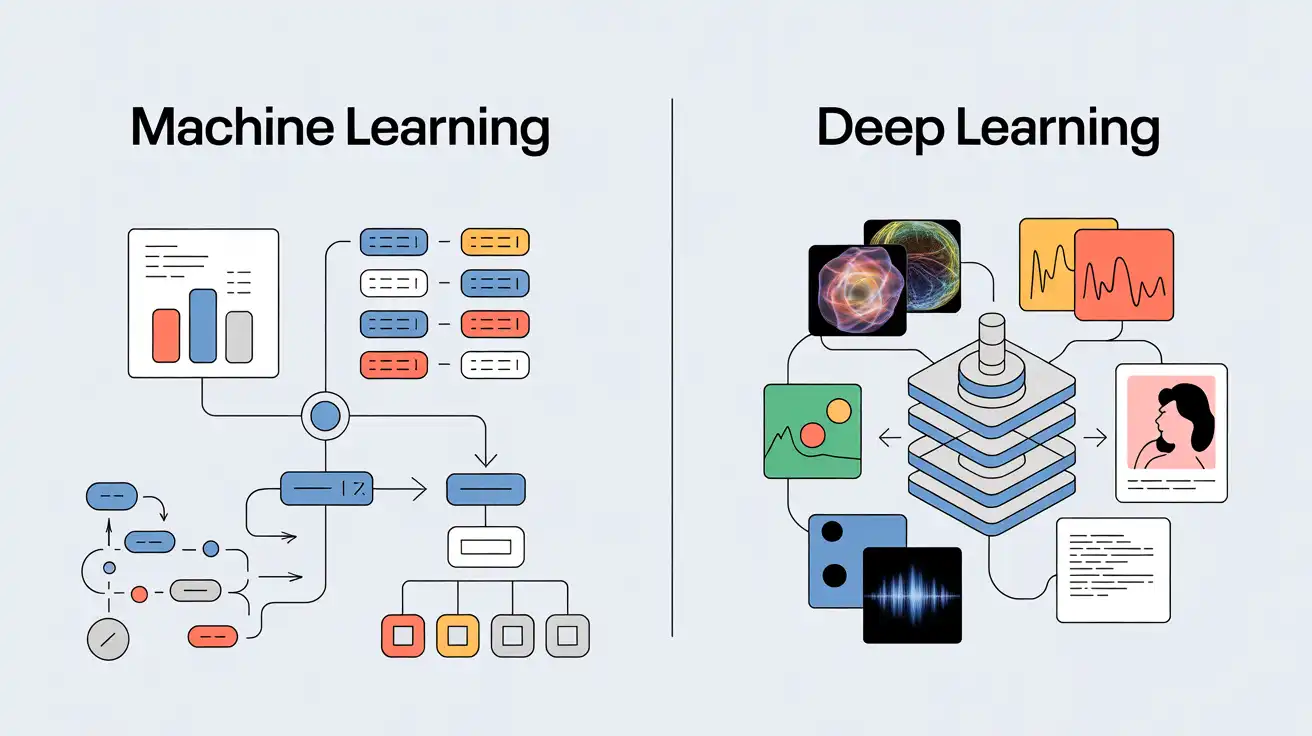
Machine learning works best with small, structured datasets. Think customer purchase history, demographic details or transaction records. If your business is currently starting its AI journey, ML Development Services There are more cost effective and efficient options. Whereas deep learning thrives on large amounts of redundant data such as images, audio or texts. This makes DL a preferred approach in advanced use cases. Such as speech recognition, medical imaging, or personal virtual assistance. 57% of businesses cite customer experience as the top use cases for business AI and ML.
feature engineering
One of the main differences is how each approach handles feature extraction.
- machine learning Humans (data scientists, analysts) need to identify which data attributes matter most. For example, in predicting creditworthiness, characteristics such as income level, employment status, and credit history are included in the model. This makes ML models easier to interpret but more labor-intensive.
- deep learningHowever, it automates this process. The neural network itself identifies relevant features. This makes DL more scalable and powerful but requires more computational resources.
Explainability and transparency
- machine learning models Are transparent. A decision tree or logistic regression model can be explained and audited. This makes ML suitable for industries where compliance and accountability are important. Such as finance, insurance, or healthcare.
- deep learning modelsWith their layered neural networks, these are often described as “black boxes”. They provide excellent accuracy but provide little explanation of how the decision was made. This makes them better suited for R&D-heavy tasks where predictive power is more important than transparency. according to McKinsey Global Survey56% of businesses already use AI in at least one function.
business applications
Machine learning use cases include: :
- Personalized e-commerce recommendations
- Detecting fraud in banking
- Predictive Maintenance in Manufacturing
- targeted marketing campaigns
deep learning use cases: :
- self-driving vehicle
- Medical diagnosis from imaging data
- Voice assistants like Alexa and Siri
- real time translation tools
Why does machine learning and deep learning matter for businesses?
Machine learning and deep learning are changing the way businesses operate by automating time-consuming manual tasks, delivering personalized customer experiences at scale, and empowering data-driven decision making. They also enhance cybersecurity by early detection of anomalies and potential threats while improving overall operational efficiency and reducing costs. As AI adoption continues to accelerate, it is clear that by 2025, almost every enterprise will rely on these technologies in some capacity. It also highlights how essential they have become for sustainable growth and competitiveness.
Real Life Business Examples
- Amazon’s Recommendation System: Uses machine learning to suggest products based on browsing and purchasing behavior. This level of personalization not only drives higher sales but also strengthens customer loyalty by making shopping experiences more relevant.
- Slack’s Workflow Automation: Leverages AI to automatically route customer questions to the right teams, reducing response times and improving support efficiency. Faster solutions lead to smoother operations and happier customers.
- Shopify’s chat support: Uses AI-powered chat assistance to connect with customers in real-time during checkout. By being available at the exact moment of decision making it helps boost conversion rates and overall customer satisfaction.
Choosing the right path for your business
The decision between ML and DL is not about which one is better. It’s about aligning technology with your business needs, data availability and resources.
choose machine learning If:
- You work with structured datasets
- Explanation and compliance required
- Resources are limited, but you want quick wins
choose deep learning If:
- You manage large-scale unstructured datasets
- Predictive accuracy is a priority
- You are investing in innovation-heavy areas like R&D or automation
conclusion
Machine learning and deep learning are not rivals; They work best together. Machine learning handles structured data for faster, better decisions, while deep learning extracts insights from complex data like images or speech. Combined, they help businesses automate, predict, and grow more intelligently. The real question is not whether to use AI, but how quickly you can make it part of your strategy. Whoever moves first will lead the game.
Frequently Asked Questions
One. Machine learning relies on human-defined features and works well with structured data. Deep learning uses neural networks to automatically extract features from unstructured data such as images or text, which requires more data and computing power.
One. Choose ML when you have structured data, limited resources, or need transparency for compliance. This is ideal for quick, interpretable insights like fraud detection or customer segmentation.
One. They automate tasks, personalize customer experiences, improve decision making, detect threats early, and reduce costs – making them essential for growth and competitiveness in data-driven industries.

I specialize in reviewing and refining AI-driven research, technical documentation, and content related to emerging AI technologies. My experience spans AI model training, data analysis, and information retrieval, allowing me to produce content that is both technically accurate and accessible.
Login to continue reading and enjoy expertly curated content.
