
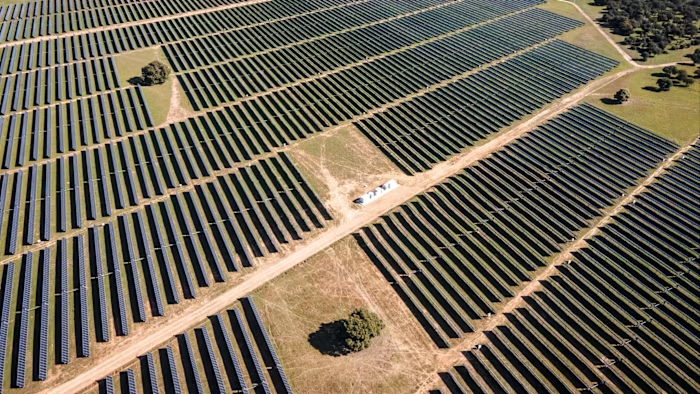
Spanish solar power is in the doldrums after falling electricity prices left owners of vulnerable projects in one of Europe’s top renewable markets looking for an exit.
The country has become a solar energy champion, thanks to abundant sunshine and the government’s pro-renewable policies. But growth in electricity production has outpaced demand, driving down electricity prices and squeezing generator profits.
Some power producers are struggling to sell plants whose valuations have fallen as officials talk of solar “saturation,” creating a contrast between Spain and other places — China, India, the Gulf states and European neighbors — where solar arrays are being built rapidly.
“It’s discount season,” said Carmen Izquierdo, co-founder of deals marketplace nTeaser. “Spain remains a dynamic market, but assets are coming under greater scrutiny.”
Other manufacturers are looking at installing batteries, which can supplement and potentially save unprofitable solar projects.
According to nTeaser, the price of operating solar plants was on average €916,000 per MWh at the beginning of 2024, but has now fallen to €648,000 per MWh.
There was a vibrant M&A market for the Spanish solar portfolio from 2022-24, including those of mixed quality, but sellers are now having to weed out the weakest parks to close deals.
“They are willing to sacrifice some part of the portfolio to pursue the rest,” Izquierdo said.
While cheaper power is a boon for users, the frustration is even greater on so-called ready-to-build projects, where land, permits and grid access have all been secured, but construction has not started.
A senior executive at a Spanish solar plants owner said: “The market is filled with ready-to-build projects that developers want to sell because they are no longer good enough in the current market.”
Some projects were for sale for just €1, the executive said, reflecting developers’ desperation to avoid further expenses and potential government penalties for not executing agreed construction plans.
The least attractive projects ready for construction are often located far from power grid nodes, requiring investment in expensive power lines.
As the solar recession began last year, some Spanish companies sold existing plants to foreign investors. Utility group Endesa sold a 50 per cent stake in two solar power portfolios to UAE state-owned clean energy company Masdar for a combined €1bn.
The socialist-led government of Prime Minister Pedro Sanchez says cheap electricity is a good thing, and is already attracting new industrial investment that will boost the economy.
But low prices are painful for producers. When they fall below zero, as they have more than 500 hours this year in Spain, producers may have to choose between taking excess power off the hands of paying wholesale customers or switching off.
Many producers protect themselves by selling power through long-term power purchase agreements (PPAs), which they sign with corporate customers at fixed prices for 10–20 years.
Last month, Zelestra, an independent power producer, signed two PPAs with Microsoft in the Aragon region, where the tech group plans to build a data center.
But negative prices are also affecting the market for PPAs, dragging down contract prices and prompting buyers to seek clauses that can let them benefit from ultra-low rates in the spot market.
Andres Acosta, innovation director at Levelton Energy, a clean energy marketplace, said the PPA prices buyers are willing to pay are typically lower than what developers need to make projects “bankable” – around €30 per megawatt hour.
“This has dramatically reduced the number of PPAs signed and means that most solar projects are no longer viable unless they are hybridized with batteries,” Acosta said.

Adding battery storage to solar plants helps limit price declines, allowing generators to store electricity when prices fall during the day, then sell it in the evening when demand and prices are higher.
Killian Daly, executive director of Energy Tag, a non-profit group, said: “Storage PPAs should be the natural cure for the market’s problems, but it is not growing as fast as it should.”
According to European Commission data, the UK, Germany and Italy are far ahead of Spain in terms of existing and planned battery installation.

Following nationwide blackouts in Spain in April, the government took steps in November to remove some regulatory hurdles to adding battery storage.
Pablo Martínez, head of Iberia at Modo Energy, a data provider, said one key change eliminated the need for a new environmental impact assessment when installing batteries within an existing solar plant.
This will reduce the time taken to complete a battery project from three or four years to less than 18 months, he said.
Additional reporting by Carmen Muela in Madrid. Data Visualization by Nasos Stylianou
climate capital

Where climate change meets business, markets and politics. Explore the FT’s coverage here.
Are you curious about the FT’s environmental sustainability commitments? Learn more about our science-based goals here
