
ExxonMobil has warned that Venezuela remains “uninvestable” without “significant change”, rebuking Donald Trump’s call for oil companies to inject billions of dollars to revive its oil industry.
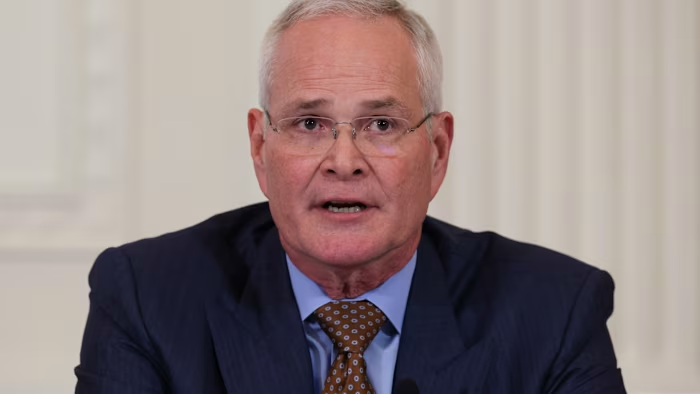
Darren Woods, the chief executive of America’s biggest oil company, expressed skepticism at a televised White House gathering of energy chiefs on Friday – while some other companies expressed optimism about the ability to tap the world’s largest oil reserves.
“If we look at the legal and commercial constructs, the frameworks that exist in Venezuela today, it is not worth an investment today,” Woods told Trump in a meeting. Which included many of America’s most prominent energy officials and some of the President’s top lieutenants.
“Significant changes must be made to those commercial structures, the legal system, there must be sustainable investment protections and there must be changes to the hydrocarbon laws in the country.”
Woods said the company’s assets in Venezuela have been seized twice since Exxon first entered the country in the 1940s.
His comments underscore how the largest energy groups remain reluctant to make large capital commitments in Venezuela, while Trump wants to push them to pour “at least $100 billion” into the country to increase production and ease U.S. oil prices.
The meeting came less than a week after Trump launched an audacious campaign to capture strongman leader Nicolas Maduro in Caracas and assert control over the country’s vast natural resources.
Trump told officials that he would decide which companies are allowed to enter Venezuela and that they needed to make the decision quickly. “If you don’t want to come in, just let me know, because I’ve got 25 people who aren’t here today who are willing to take your place.”
The FT reported earlier this week that the industry is unlikely to commit to making major investments in Venezuela without legal, financial and security assurances from Washington.
Other oil executives gathered at the White House – including service groups and those already operating on the ground – were more receptive to the president’s proposals, suggesting some level of capital could flow into the country in the near term.
Chevron said it could increase production by 50 percent within 18 to 24 months by expanding its existing operations, which pump about 240,000 barrels per day. Shell boss Vel Savan said the European oil major had “a few billion dollars of opportunities for investment” provided the US waives its sanctions. “We’re ready to go,” he said.
Spain’s Repsol said it could triple its current output to more than 150,000 b/d within two to three years. Eni, which employs about 500 people in Venezuela, said it has 4 billion barrels of reserves in the country and is ready to boost investment.
Pressed by Trump, Woods said Exxon would send a technical team to Venezuela within weeks to assess conditions. He also said he was ‘confident’ that the changes needed for investment could be implemented.
Continental Resources founder and longtime Trump ally Harold Hamm declined to make any commitments to invest in Venezuela, although he described its vast reserves as a “real jewel.”
Asked directly by Trump whether he planned to pump capital into the country, Hamm said Venezuela is a “very exciting thing” with “challenges” he said the industry “knows how to deal with.”
The mixed messages from officials on Friday underlined the complexities facing oil companies as they consider how to respond to Trump’s call to pour capital into a country that remains unstable and where many of them have been burned by confiscation in recent decades.
“The legal, political and geopolitical risks of making the large-scale investment in Venezuela that the administration wants are very significant,” said Meghan O’Sullivan, a Harvard professor and expert on geopolitics and energy.
But even as he tried to persuade them to make broader investments, Trump appeared reluctant to make any significant concessions regarding reimbursement or financial guarantees to oil companies.
The President clarified that companies whose assets were seized earlier were unlikely to receive compensation. He told ConocoPhillips Chief Executive Ryan Lance, whose company lost $12 billion because of the seizure: “You’re going to make a lot of money, but we’re not going back.”
“We’re going to start over with an even plate,” Trump said. “We’re not going to look at what people lost in the past because it was his fault. He was a different president.”
Trump appeared to rule out using US tax revenue to reimburse companies for investments in Venezuela, something he has previously railed against, telling officials they “don’t need government money”.
“Our oil giants will spend at least $100 billion of their own money – not the government’s money,” he said.
When later asked about a financial backstop for companies, Trump said he hoped it would not be needed. But he indicated that the US government could provide some type of protection and legal guarantees, which have been key demands of the industry. “You will get complete protection.”
However, Trump suggested that the Venezuelan regime would provide security on the ground rather than US troops. “I think the Venezuelan people are going to give you very good protection.”

Legal experts said there was “significant interest” among companies in potential investment in Venezuela, but larger undertakings would be required before it could be translated into action.
“The dilemma at the moment is that the landscape is not settled yet, there are logistical and political challenges,” said Carlos Sole, co-chair of the law firm Baker Botts Latin America practice.
He said a lot needs to change before companies can take action, including making it easier for U.S. companies to obtain licenses or sanctions waivers from the Office of Foreign Assets Control to conduct transactions in the country.
Aurelio Fernández-Concheso, head of the Venezuela office of law firm Clyde & Co., said he had received a lot of calls from clients in the oil and gas, transportation and insurance industries about doing business in the country, but “there was a lot of caution about how it would develop”.
“It’s one thing to pick up the phone and call an advisor, and another to write a check and put the money in the country.”
