
Author(s): gabriel y
Originally published on Towards AI.
First Leap: When Vibe Coding Feels Like Magic
When I first started vibe coding genie-hiI really thought it would help me go faster. I typed in a few sentences describing what I wanted, pressed enter, and a functional product appeared on the screen. For a brief moment I thought: So this is what 0→1 feels like in the AI era.
But the magic was only the beginning. The real work – the messy, unpredictable, deeply educational part – came right after.
Where challenges begin to manifest themselves
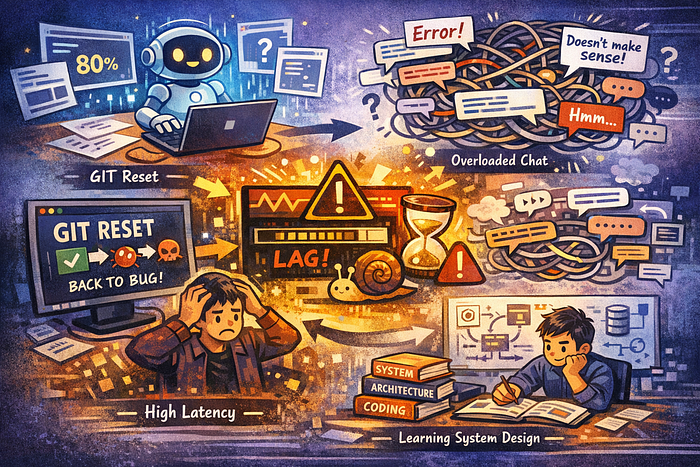
1. Vibe Coding is exceptional in reaching the first 80%. However, the remaining 20% hides every trap you can imagine. Whenever I asked the model to “adjust a small detail”, something huge shifted. It feels like asking someone to tighten a screw in your kitchen and finding out the next morning that they’ve completely transformed your house and you can’t even leave your bedroom.
2. And then came the long thread net. Putting everything in a single conversation worked at first, but after dozens of turns, the model’s coherence broke down. Instructions were misread, obstacles were forgotten, hallucinations sprang up in unexpected places. Fixing the issues within that flowing thread only caused it to flow further.
3. Another mistake: I procrastinated on Git. When you’re building alone, it’s easy to assume that version control can wait – until it can’t. I spent hours debugging issues that were immediately fixed by a new prompt. Without Git, coding vibes become a cycle of creation, destruction, and reluctant acceptance that AI can undo your work as quickly as it creates it.
But none of this is a challenge compared to what came next.
4. Latency was not an issue during the initial demo phase of Genie-Hi. At the time, the product was very simple, but once Genie-Hi became a more real product – with multiple flows, rich logic and user-facing features – performance signs began to surface. The app began to feel slow, and latency became the earliest indicator that the system was reaching complexity limits.
With AI tools, I started investigating the patterns behind the recession and gradually discovered what was happening. As more features grew, small architectural decisions accumulated into noticeable friction:
- Some API calls were running inadvertently in series instead of parallel
- There were some React components over-represent
- The front bundle had become quite large block main thread
- ,
None of this is unusual, however, anything can be taken away from a demo; A product can’t. While my background is in data science, I found myself learning system design concepts out of necessity. Latency was a message that told me the fundamentals of engineering become essential when a product moves beyond its demo phase.
This realization changed how I thought about building Jini-Hi or any app with Vibe coding: It wasn’t just about adding features – it was about making sure the system underneath could support them.
What I Learned: Exercises That Really Work
Eventually, after enough trial, error, and accidental UI changes, I developed a set of survival techniques that are now essential to making my code vibe.
1. Keep changes atomic and aggressively limited.
“Nuclear” means painful Specific. Generative models don’t understand locality, so if you put them in place, they overwrite the entire neighborhood.
I now always specify:
- precision block — I only paste the relevant functions, never the entire file
- what is allowed – For example, “You can update this
handleSubmitJust work.” - what is forbidden – “Do not modify any other component or file.” (This one sentence prevents 70% of the chaos.)
necessary? Absolutely. This is the only way to stop Genie-Hi from switching to a different app every time I blink.
2. Don’t let one model do everything. Treat AI tools as a distributed team.
I used to think that one powerful model could handle everything. Now I know better. Each tool has a characteristic and when you respect that the development becomes much more stable.
Here is the distributed “AI org chart” for Genie-Hi:

- chatgpt → my thought partner
- AI Studio → my developers
- Gemini → My UI Crew
- co-pilot → QA department
- notebooklm → My marketing and secretary team
- and much more to discover
Once I divided the responsibilities this way, the chaos decreased dramatically.
This (ironically) became the modular engineering workflow we all wanted.
3. Use multi-language signs as a precision tool.
Who could ever realize that being bilingual has its own power in vibe coding? Unexpectedly, switching between English and Chinese made the development more accurate. When something doesn’t make sense in English, Chinese is quick to explain it – and vice versa. Multi-language notation became my debugging strategy for human-AI communication.
4. Build E2E experiences as you go.
Vibe coding makes every difference instantly visible. Ginny-Hi forced me to learn in the real world where:
- UI/UX flow is only the beginning of a product – a true UX comes from actually using and feeling the product
- Feature requests don’t always make progress – they can expose structural debt.
- Whether you like it or not, architecture becomes a product constraint.
- Debugging is not a chore; it Is Work.
- The prototyping mindset and the engineering mindset should co-exist, but not at the same moment.
- E2E thinking means connecting vertical insights with horizontal flows.
None of this came from textbooks. Vibe coding didn’t replace engineering – it made engineering irresistible.
jinni-hi where is it now
In the midst of all this learning, frustration, rebuilding, and redesign, Genie-Hi quietly became cool. We refined the flow, fixed the architecture, reduced latency, simplified the UI, and rebuilt sections that weren’t scalable.
The new version isn’t ready for the full reveal yet – but it feels vibrant, intentional, and very close to the product I originally envisioned.
Consider this a soft teaser:
Something exciting is coming, and we can’t wait to share it soon.
Published via Towards AI
