

Building production-grade voice AI agents is one of the harder problems in applied machine learning. The difficulty is not transcription accuracy alone. A usable system has to hold context across a multi-minute call, call external tools mid-conversation without awkward pauses, recover gracefully when a caller corrects themselves, and stay reliable when the audio degrades from background noise, strong accents, or dropped words. Most systems handle one or two of those demands well; few handle all of them at once.
xAI’s grok-voice-think-fast-1.0, released in April 2026 and available through the xAI API, is the company’s flagship voice model and is positioned for exactly these complex, multi-step workflows in customer support, sales, and enterprise settings. xAI also reports using it in Starlink’s live phone operations.
What “full-duplex” means for a voice agent
Conventional voice systems are turn-based: they wait for the speaker to finish, then process and respond. A full-duplex agent listens and generates at the same time, so it can react to interruptions, handle a caller talking over it, and manage natural turn-taking. This is closer to how people actually converse, and it is the property the τ-voice benchmark is designed to measure.
The benchmark numbers
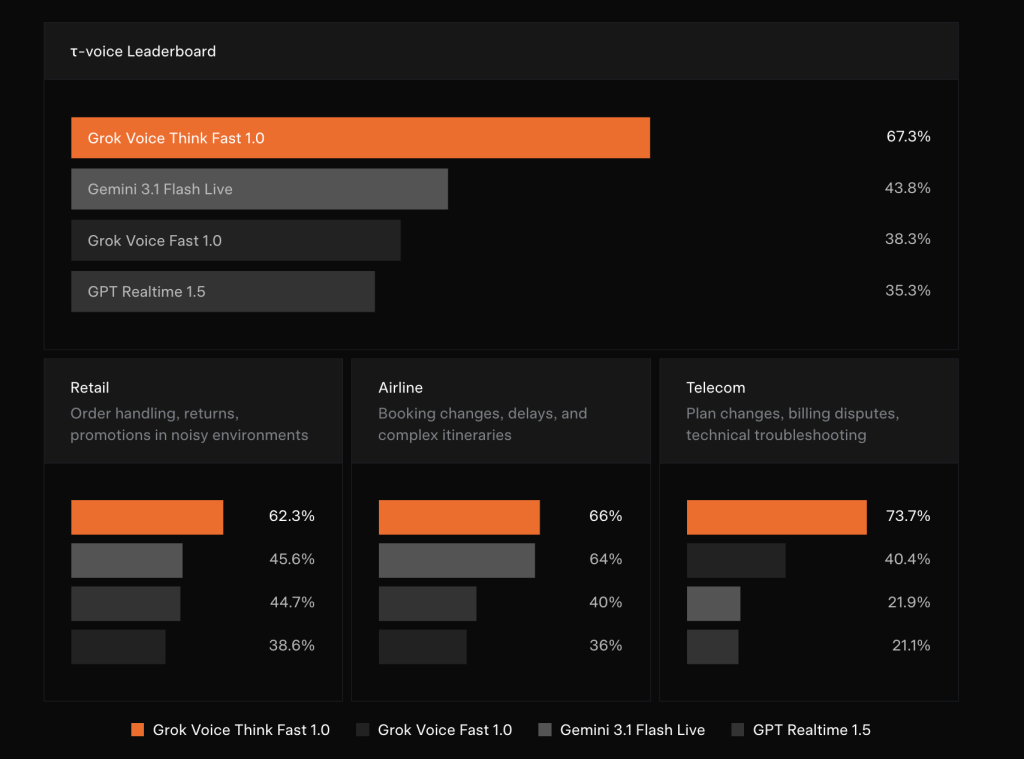
The τ-voice benchmark, introduced in a 2026 research paper, evaluates full-duplex voice agents under realistic conditions — noise, accents, interruptions, turn-taking, tool calling, and the accurate capture of structured data — across business-style domains. On the overall leaderboard, xAI reports grok-voice-think-fast-1.0 scoring 67.3%, ahead of Gemini 3.1 Flash Live (43.8%), xAI’s own previous Grok Voice Fast 1.0 (38.3%), and GPT Realtime 1.5 (35.3%). The model is reported to lead across the individual domains as well, with some of its widest margins in areas such as telecom and airline support. As with any vendor-reported result, the figures come from the model’s developer, so independent testing is the firmer guide.
Real-time reasoning with no added latency
A central design claim is how reasoning is handled. The model is described as reasoning in the background — working through multi-step problems while the conversation continues — without adding response latency. For engineering teams, this is the hard part: reasoning normally costs time, and time in a live call is felt immediately as an awkward silence.
Accurate data capture and read-back
The model is also built to capture and validate structured data such as names, addresses, phone numbers, and account numbers, even when spoken quickly, with an accent, or with a mid-sentence correction. In a worked example, it processes a spoken correction in real time, calls a lookup tool such as
search_address
with parameters like
"1450 Page Mill Rd"
and reads the normalized result back for confirmation. For teams that have built post-call cleanup pipelines to extract clean fields from messy transcripts, reliable capture-and-read-back during the call reduces downstream processing. The model natively supports more than 25 languages, which suits global deployments across customer support, phone sales, appointment booking, and reservations.
Deployment at scale
xAI points to live use rather than benchmarks alone, citing deployment in Starlink’s phone sales and customer-support operations, where a single agent spans many tools and a large set of workflows. The company has published operational metrics from that deployment; because they are self-reported, they are best read as indicative of what the system can do in production rather than as independently audited results.

Limitations and what to watch
Several caveats apply. The leaderboard and deployment figures are published by xAI, so independent evaluation across organizations and audio conditions matters before drawing firm conclusions. A benchmark, however realistic, still abstracts away the messiness of real callers, and strong scores do not guarantee equal performance on every accent, language, or edge case. Handing live phone interactions to an autonomous agent also raises practical questions about error handling, escalation to humans, privacy of captured data, and regulatory compliance in regulated industries. The capability is notable, but organizations should pilot it on their own call types and define clear human-in-the-loop fallbacks before relying on it.
