
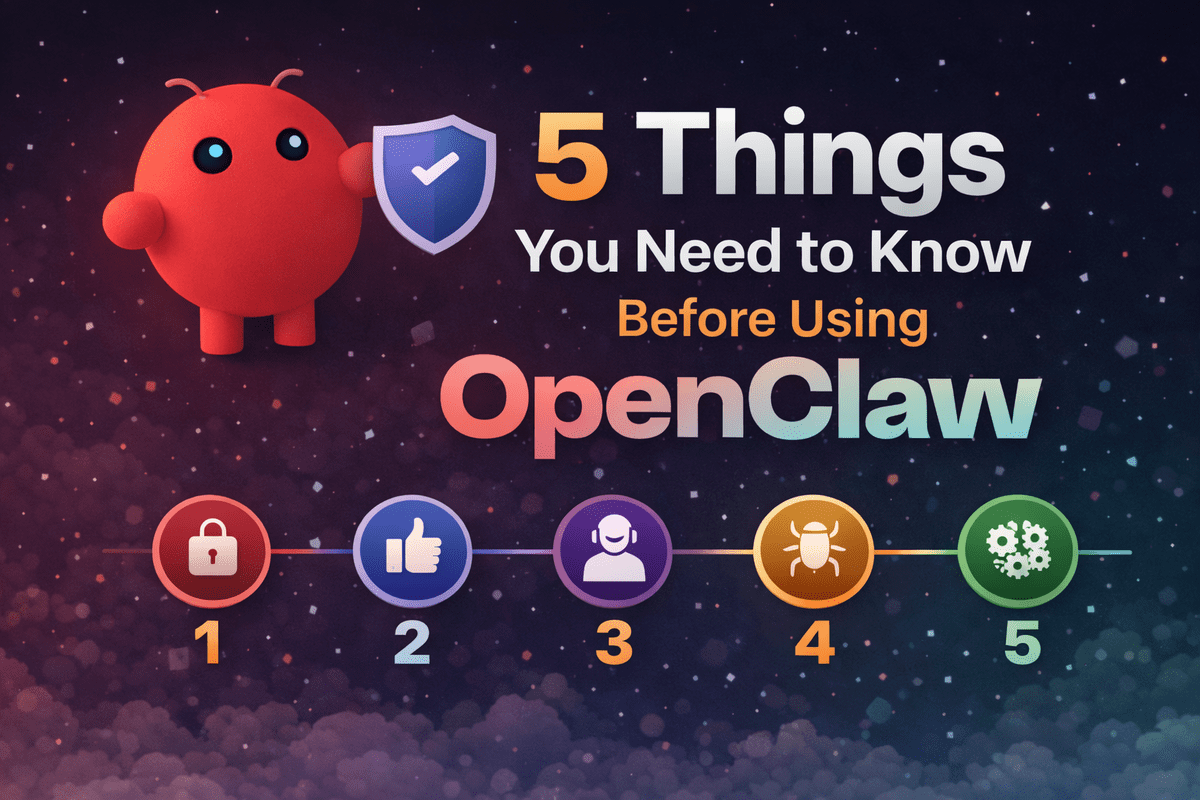
OpenClaw is one of the most prominent open-source autonomous agent frameworks available, with a very large following on GitHub. It is far more than a chatbot layer: it runs a persistent gateway process, installs executable “skills,” can connect to external devices, and is able to take real actions on a user’s systems and messaging platforms. That capability is exactly what makes it powerful — and why it should be approached with the same mindset used for running production infrastructure. Once an agent is granted access to skills, gateways, files, secrets, and plugins, the deployment carries genuine security and operational risk. The five points below cover what to understand before running OpenClaw locally or in production.
1. Treat it like a server, because it is one
OpenClaw runs a persistent process that listens, holds credentials, and invokes tools and models. The moment it is exposed to a network, it becomes something that can be attacked. Practical precautions include keeping the deployment local unless the configuration is well understood, checking logs and recent sessions for unexpected tool calls, and re-running the underlying audit after any change. A typical audit command looks like this:
openclaw security audit --deep2. Skills are code, not harmless “add-ons”
An OpenClaw skill is executable code, not a benign plugin. A skill can run commands, read files, trigger workflows, and interact directly with the host system, which makes skills powerful but also introduces real supply-chain risk. Security researchers have reported malicious skills uploaded to community registries such as ClawHub, often relying on social engineering to trick users into running unsafe commands. ClawHub has added built-in security scanning, including VirusTotal reports, so a skill can be reviewed before installation — but those results should always be read critically rather than trusted blindly.
3. Use a capable model
Because the agent can take real actions, the quality of the underlying model matters more than in a chat-only setting. A weaker model that misinterprets an instruction does not just produce a bad sentence; it can execute the wrong command, message the wrong person, or mishandle a file. Pairing OpenClaw with a stronger, more reliable model reduces the chance that reasoning errors turn into real-world mistakes.
4. Lock down secrets and the workspace
Secrets should be treated as high-value targets: API keys and provider tokens, Slack, Telegram, and WhatsApp sessions, GitHub tokens and deployment keys, SSH keys and cloud credentials, and browser cookies or saved sessions. In practice, that means storing secrets in environment variables or a secrets manager rather than in skill configuration or plain-text files; keeping the OpenClaw workspace minimal rather than mounting an entire home directory; restricting file permissions so only the agent’s user can access its workbench; and rotating any token immediately if something suspicious is installed or unexpected tool calls appear. Running OpenClaw inside a container or a separate virtual machine isolates a compromised skill from the rest of the machine. On a shared server, it should be treated as production infrastructure, where least privilege is the difference between a contained incident and a full account takeover.
5. Voice calls are real-world power — and risk
OpenClaw’s voice-call capability takes the agent beyond text by enabling outbound phone calls and multi-turn voice conversations, meaning it can speak directly to people. This is a significant feature that also carries high operational and financial risk. Before enabling it, clear boundaries are essential: who may be called, when, and for what purpose; what the agent is permitted to say in a live conversation; and how spending and call volume are capped. Without those limits, a misconfigured agent can place unwanted calls or run up real costs.
Limitations and what to watch
OpenClaw is fast-moving open-source software, so specific commands, plugin names, and security features change between versions; anything here should be checked against the current documentation before relying on it. The security guidance above reduces risk but cannot eliminate it — autonomous agents that execute code and hold credentials represent a genuinely new attack surface, and the registry-and-skills model is still maturing. The safest posture is to start isolated and minimal, grant capabilities deliberately, and expand only as confidence in the configuration grows.
Final thoughts
The promise of autonomous agents is not only intelligence but performance, trust, and security. A framework like OpenClaw provides the building blocks; deploying it responsibly — with isolation, least privilege, and careful skill vetting — is what keeps that power from becoming a liability.
The project and its registry are documented on the ClawHub GitHub repository. For related reading on this site, see coverage of designing multi-agent systems.
