
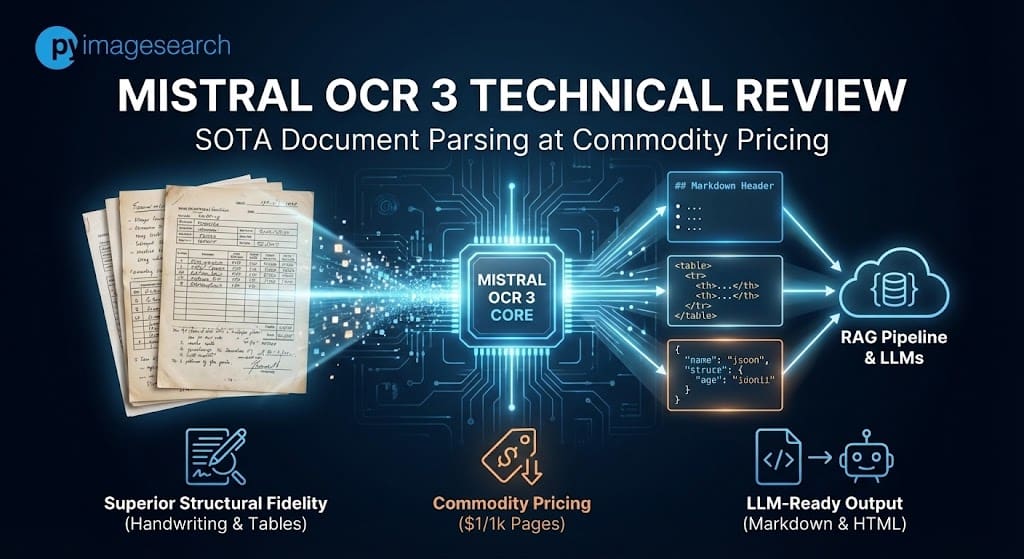
Optical character recognition has long been a commodity market where falling prices came at the expense of structural fidelity. The release of Mistral OCR 3 in December 2025 signals a shift. By claiming state-of-the-art accuracy on complex tables and handwriting — outperforming AWS Textract and Google Document AI by significant margins in its published benchmarks — Mistral positions its proprietary model not merely as a cheaper alternative but as a technically stronger parsing engine for retrieval-augmented generation (RAG) pipelines. In plain terms: the model turns messy documents into clean, structured text that language models can actually use. This review examines the architecture, benchmark performance against the hyperscalers, and the operational realities of deploying Mistral OCR 3 in production.
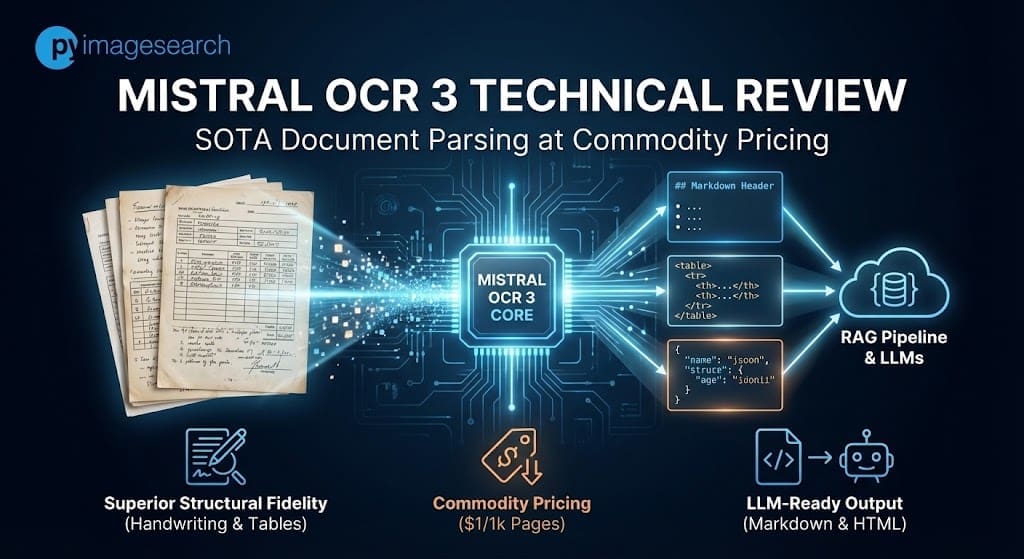
A structure-aware architecture
Mistral OCR 3 is a proprietary, efficiency-focused model optimized for converting document layouts into LLM-ready Markdown and HTML, available through the mistral-ocr-2512 endpoint. Where traditional OCR engines such as Tesseract, and earlier iterations of AWS Textract, focus on bounding-box coordinates and raw text extraction, Mistral OCR 3 targets the “structure loss” problem that undermines modern RAG pipelines.
According to Mistral’s announcement, the model is much smaller than most competing solutions yet outperforms larger vision-language models on document-density tasks. Its key innovation is the output modality: rather than returning coordinate JSON that requires post-processing, it emits Markdown enriched with HTML-based table reconstruction. The model has, in effect, been trained to recognize document semantics — understanding that a grid of numbers is a table, not just adjacent text.
Benchmark performance

| metric | mistral ocr 3 | Azure Dock Intelligence | deepseek ocr | Google DocAI |
|---|---|---|---|---|
| handwritten accuracy | 88.9 | 78.2 | 57.2 | 73.9 |
| Historical Scanned Accuracy | 96.7 | 83.7 | 81.1 | 87.1 |
One published comparison is worth noting: a score of 57.2 for DeepSeek suggests that general-purpose open-weight models still lag specialized proprietary endpoints on structured-document tasks.
Structural integrity: tables and forms
For financial analysis and RAG, table fidelity is effectively binary — the output is either usable or it is not. Mistral OCR 3 shows notably better detection of merged cells and multi-row headers than earlier systems.
| metric | mistral ocr 3 | aws texttract | Azure Dock Intelligence |
|---|---|---|---|
| Accuracy of complex tables | 96.6 | 84.8 | 85.9 |
| form accuracy | 95.9 | 84.5 | 86.2 |
| Multilingual (English) | 98.6 | 93.9 | 93.5 |

Figure 2: Comparative accuracy across document tasks. Note the delta in the “Complex Tables” and “Handwritten” categories.
Edge cases and failure modes
Benchmark scores rarely tell the whole story, and early adopter feedback points to specific limitations. Format sensitivity is one: developers report inconsistencies between PDF and JPEG input handling, where converting the same document between formats can change extraction quality. Complex multi-column layouts with irregular text flow remain a challenge, and the model sometimes imposes table structure on non-tabular column text.
The model is also a black box. As a purely SaaS offering, it cannot be fine-tuned on proprietary datasets — specialized medical forms, for example — the way self-hosted vision transformers can. And despite the reported 74 per cent win rate over its predecessor, enterprise users caution that clean structural output can mask OCR hallucination: high-fidelity Markdown looks perfect to the human eye even when individual digits have been flipped, which makes human-in-the-loop verification essential for financial data.
Pricing and deployment
Mistral OCR 3 is priced at $2 per 1,000 pages, with a 50 per cent batch-API discount bringing high-volume processing to $1 per 1,000 pages — undercutting legacy document-AI providers by as much as 97 per cent, as reported by VentureBeat. The fully managed model removes local VRAM requirements, though it introduces data-privacy considerations for regulated industries. For high-volume archival digitization, the cost difference is non-trivial, particularly for teams migrating from AWS Textract, where complex table and form extraction can cost far more per page depending on region and feature flags.
| Speciality | Specification/Cost |
|---|---|
| model id | mistral-ocr-2512 |
| standard api price | $2 per 1,000 pages (1) |
| batch api price | $1 per 1,000 pages (50% off) (1) |
| Hardware Requirements | Nobody (mother-in-law). Accessible via API or documentation AI Playground. |
| output format | Markdown, Structured JSON, HTML (for tables) |

Figure 3: Mistral reports an overall 74% win rate for OCR 3 over its predecessor.
FAQ
How does Mistral OCR 3 pricing compare with AWS Textract and Google Document AI?
Mistral OCR 3 costs $2 per 1,000 pages via the standard API. The batch API processes documents asynchronously — ideal for archival backlogs — and applies a 50 per cent discount, bringing costs down to $1 per 1,000 pages.
Is Mistral OCR 3 available as an open-weight model?
No. Mistral OCR 3 is currently proprietary, available only through the Mistral API and the company’s document-AI tooling.
Limitations and what to watch
Vendor-published benchmarks, including the 74 per cent win rate, have not yet been broadly replicated by independent evaluations, so buyers should run pilots on their own document mix before committing. Pricing and endpoint names can change quickly in this market. The most important operational caveats are the PDF-versus-image format sensitivity, weaker handling of irregular multi-column layouts, and the risk of silent digit-level hallucinations in otherwise clean output — all of which argue for sampling-based human review in any workflow where numbers matter. For teams exploring adjacent tooling, see this site’s guides to schema-compliant structured output on Amazon Bedrock and self-hosted AI for beginners.
