
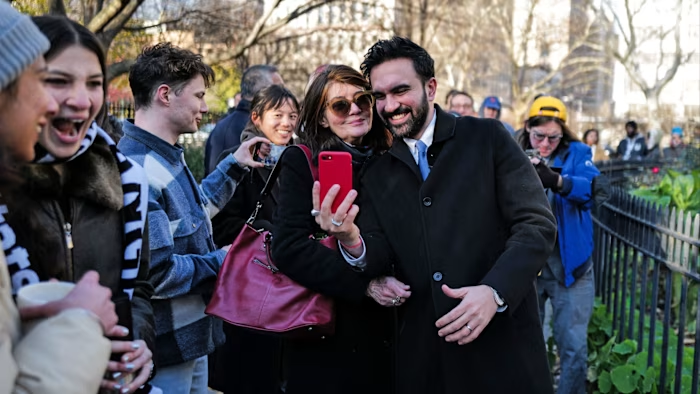
New York City’s new Mayor Zohran Mamdani is pushing a plan to tax millionaires higher, ignoring warnings that it would trigger a flight of the rich from America’s financial capital.
Incoming Deputy Mayor Dean Fuleihan acknowledged that “new revenue” would be needed to balance New York’s budget and fulfill Mamdani’s costly campaign promises. But he dismissed fears that wealthy people would turn their backs on the city in protest of a potentially higher tax burden.
“The people who are leaving are the people who can’t afford New York, not the millionaire class,” Fuleihan told the Financial Times. Most people understood that addressing its affordability crisis was “essential to the success of business and New York,” he said.
Mamdani, a self-described democratic socialist, was sworn in as New York’s first Muslim mayor in a private ceremony in a disused subway station just before midnight on New Year’s Eve, marking the culmination of a surprise rise to power that has stunned America’s political establishment.
The 34-year-old New York State Assemblyman, whom most voters had never heard of a year ago, rode to success on a wave of anger over the high cost of living in America’s most populous city and a promise to use the power of government to help working-class New Yorkers.
He has promised to raise the city’s personal income tax rate by 2 percentage points to about 5.9 percent on annual income over $1 million and raise the top corporate tax from 7.25 percent to 11.5 percent – the same rate as neighboring New Jersey.
The extra revenue will pay for an ambitious social program that includes free universal child care – expected to cost $6bn a year – as well as free buses, state-owned grocery stores and the construction of 200,000 affordable housing units over the next 10 years.
However, any revenue-raising proposal would face resistance in the New York Assembly in Albany. Gov. Kathy Hochul, a Democrat who is up for re-election this year, has said she opposes raising personal income taxes.
“It’s going to be a balancing act for Hochul,” said Basil Smickle, a professor at Columbia University’s School of Professional Studies and former executive director of the New York State Democratic Party.
On the one hand, he will be under pressure to help Mamdani implement his agenda but he will have to avoid “provoking a reaction from conservative voters in the state”. “The suburbs will pull him to the right,” he said.
However, Mamdani’s allies insist that Hochul wants to cooperate with the mayor to fulfill his election promises.
“The Governor has been very clear publicly that his intention in the upcoming session is to be able to provide universal child care,” said Sherif Soliman, director of the Mayor’s Office of Management and Budget.
He said Hochul made sure last year’s New York state budget included a credit to help families pay for child care.
In a December 28 interview, Hochul appeared to voice her support of Mamdani’s plans. “Employers in New York will really benefit when their own employees don’t have to worry about who’s going to take care of their kids,” he told 77 WABC Radio.
Former Mayor Bill de Blasio’s plan for universal, publicly funded early education for 4-year-olds, paid for by the city, was also initially considered unrealistic, Fuleihan said.
Fuleihan, who was de Blasio’s budget director at the time, said, “Everyone said it couldn’t be done… It’s not worth doing.” “Well, three months later it was funded by the state and it was executed in two years.”

However, Mamdani faces other challenges. The previous administration of Eric Adams had increased New York City’s budget by more than $2 billion to $118 billion and left a projected deficit of approximately $4.7 billion that would need to be covered under the city’s balanced budget rule.
The Citizens Budget Commission, a non-partisan fiscal watchdog, says the structural deficit Mamdani would face could be even larger – as much as $8 billion. Outgoing City Comptroller Brad Lander has said the city may face a $10.4 billion budget gap in the next fiscal year.
The city has also been affected by federal spending cuts imposed by US President Donald Trump. He has blocked or blocked $18 billion in funding for infrastructure projects, while his “one big beautiful bill” cut health and food stamp programs that millions of poor New Yorkers rely on.
CBC chief Andrew Rein said, “Mamdani comes with ambitious plans and serious financial challenges – a budget gap, the need to prepare for federal cuts and be better prepared for a recession.”

Rein cautioned Mamdani against raising taxes further, saying that New York City already has one of the highest combined marginal individual income tax rates in the US. He said surveys showed that only 11 percent of the city’s residents thought their government was using their money wisely.
“So we have to be concerned not only about the affordability of housing and transportation in New York City, but also about the affordability of our tax system,” Rein said. “There is a real risk of an exodus of residents and businesses.”
He said that in the year ending July 2024, New York City lost 91,000 residents due to domestic migration.
However, a study released in October by the Fiscal Policy Institute, a think-tank, found that when New York state last raised personal income tax rates in 2021, there was “no significant increase in migration among high-income earners”. It says the top 1 percent of earners move out of the state less often than all other income groups.
Fuleihan acknowledged that the incoming Mamdani administration would operate under great financial constraints. “Look, this is serious, I’m not going to play it down,” he said. The city will need to raise “new revenue” to balance its budget, which he acknowledged requires “cooperation with Albany.”
But “we can’t just say there are fiscal challenges and therefore we can’t do what New Yorkers said … that they want out of this election,” he said. He said tackling the affordability crisis was “our mandate”.
He said New York’s moneyed classes could easily absorb the tax increase — especially because it would outweigh the substantial tax cuts in Trump’s “big beautiful bill” that particularly benefits the wealthy.
Soliman said it would be wrong to reduce New York to its finance industry and the fortunes of its many millionaires. The city is “the financial capital of the world”, he said, but it is also “a city of low-wage workers, whether it’s retail or healthcare”, a “tech scene” and a “thriving arts and culture community”.
“It needs to become a global capital for different economic and ethnic viewpoints. And (Mamdani’s) agenda is animated by that.”
