
Drug development is slow and expensive: the average research-and-development lifecycle runs 10 to 15 years, and a large share of candidates fail during clinical trials. One recurring obstacle appears early — identifying the right protein targets. Proteins are the functional molecules of living organisms; they catalyze reactions, transport molecules, and serve as the targets for most modern drugs. Being able to rapidly classify proteins, understand their properties, and surface under-researched candidates could meaningfully accelerate discovery.
This is where data engineering, machine learning, and generative AI converge — and, as a Databricks solution accelerator demonstrates, the entire pipeline can run on a single governed platform. This article walks through what that pipeline does, stage by stage, and where its limits lie.
What the Accelerator Builds
The AI-powered drug discovery accelerator demonstrates an end-to-end workflow through four processes: ingesting and processing over 500,000 protein sequences from UniProt (the standard public protein database); classifying those proteins with a transformer model as water-soluble or membrane-transport; enriching the data with LLM-generated research insights; and making everything explorable through AI-enabled dashboards that accept natural-language queries.
Step 1: Data Engineering With Lakeflow Declarative Pipelines
Raw biological data rarely arrives analysis-ready. The source data comes as FASTA files — a standard format representing protein sequences as dense strings of single-letter amino-acid codes that are nearly impossible to read by eye. By the end of the pipeline, researchers can query that same data in plain language, asking for, say, under-researched human membrane proteins with high classification confidence.
Lakeflow declarative pipelines refine the data through a medallion architecture: a bronze layer for raw ingestion of FASTA files, extracting IDs and sequences with BioPython; a silver layer that parses and structures the records, pulling out protein names, organism, gene names, and other metadata via regex transformations; and a gold layer of curated, analysis-ready data enriched with derived metrics such as molecular weight, ready for dashboards, ML models, and research. The result is clean, governed protein data in Unity Catalog — and the lineage carried across each stage provides real value for scientific reproducibility, since every derived value can be traced back to its source sequence.
Step 2: Protein Classification With a Transformer Model
Not all proteins are equally promising targets. Membrane transport proteins — embedded in the cell membrane, regulating what enters and exits cells — are especially important drug targets. The accelerator uses ProtBERT-BFD, a BERT-based protein language model from Rostlab fine-tuned for membrane-protein classification. The model treats amino-acid sequences like language, learning relationships between residues to predict function, and outputs a classification (membrane or soluble) with a confidence score written back into Unity Catalog for downstream filtering.
Step 3: Generative AI Enrichment
Classification answers what a protein is; researchers also need context — what current research says, where the gaps are, whether a target is under-explored. The accelerator brings in an LLM here, using both the Databricks Foundation Model API and external model endpoints to create registered AI functions that enrich protein records with research context, either on demand or in batch.
Step 4: Natural-Language Exploration
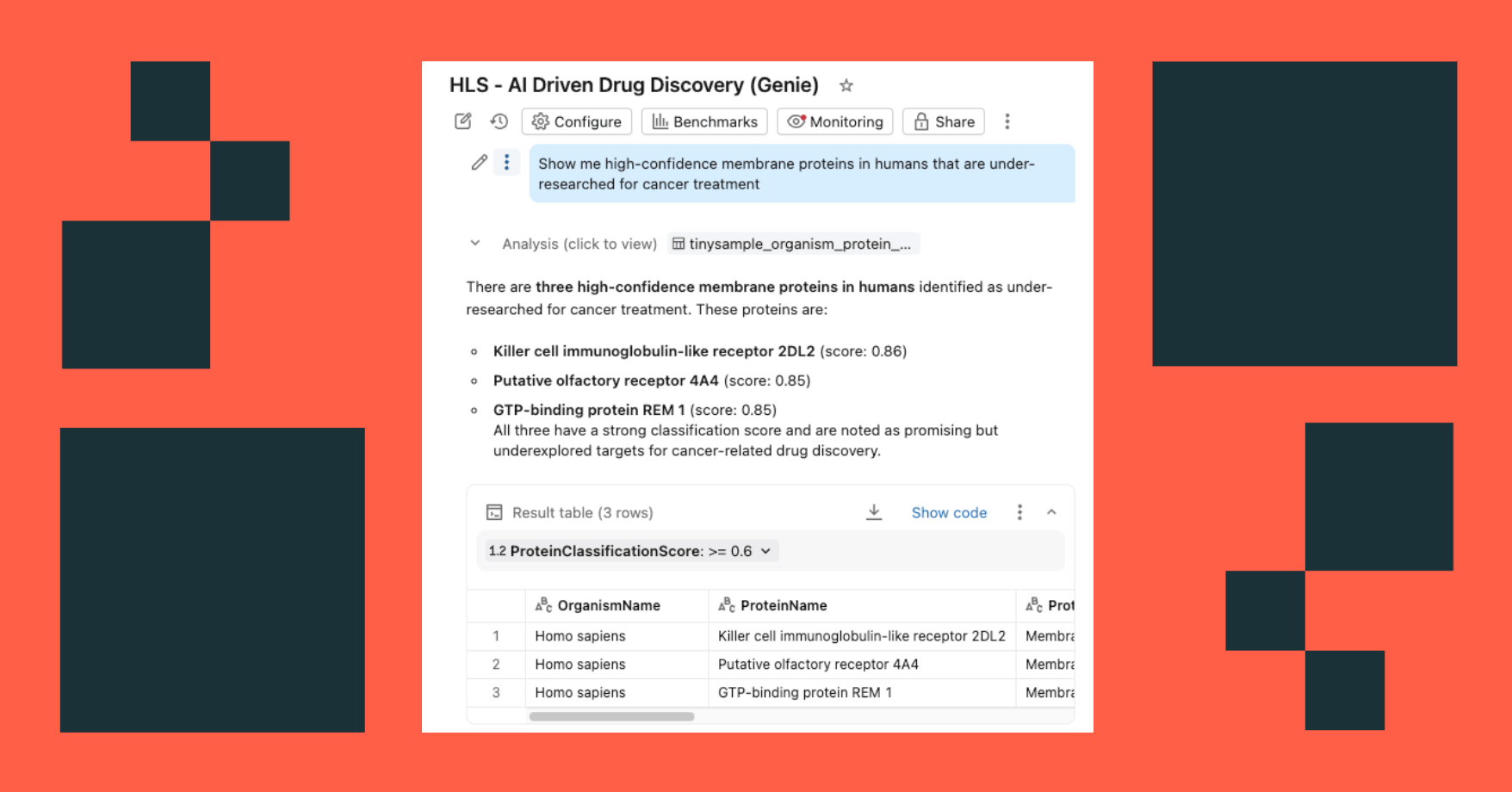
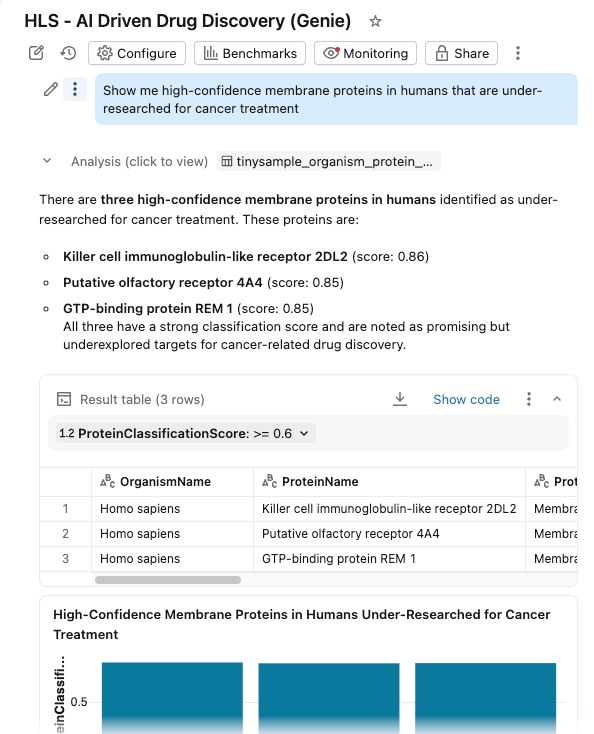
Everything comes together in an AI/BI dashboard with a Genie Space enabled. Researchers can filter proteins by organism, classification score, and protein type; explore distributions of molecular weight and classification confidence; and ask questions in natural language, such as surfacing high-confidence human membrane proteins that are under-researched for cancer treatment. The dashboard queries the same governed tables in Unity Catalog, with AI functions supplying enrichment as needed.
The Power of a Unified Platform
The accelerator’s appeal is not any single component but that all of them run in one place. There is no data movement between systems, no separate MLOps infrastructure, and no disconnected BI tools: a protein sequence enters the pipeline and flows through transformation, classification, enrichment, and natural-language querying entirely within one governed environment. For research, that unification is not just convenient — it is what makes the end-to-end lineage, and therefore reproducibility, possible.
What Comes Next
The accelerator is a demonstration of what is possible; a production system could extend it in several directions: processing the full UniProt database with provisioned-throughput endpoints; adding classification models for other protein properties; grounding LLM responses in scientific literature through a retrieval pipeline; integrating downstream molecular-simulation workflows; connecting to structure-prediction tools such as AlphaFold or ESMFold to add 3D context; and expanding to other genomic formats (FASTQ, VCF, BAM) for large-scale sequencing and variant analysis. The full accelerator is available on GitHub, linked from the original Databricks blog post.
Limitations and What to Watch
Several caveats are important, particularly given the clinical stakes. This is a reference accelerator, not a validated discovery tool: a membrane-versus-soluble classification with a confidence score narrows a search space but does not identify a viable drug target, and every candidate still requires experimental validation. LLM-generated “research context” is subject to hallucination and must be treated as a pointer to literature to verify, not as established fact — enrichment should cite sources a scientist can check. Model quality also depends on the training distribution: a classifier fine-tuned on known membrane proteins may generalize poorly to novel or poorly characterized families, which are precisely the under-researched candidates the pipeline is meant to surface. And running discovery on a single commercial platform brings the usual trade-off between integration convenience and vendor dependence. For the data-engineering foundation underneath this pattern, see this related guide to Lakeflow on Databricks.
